
MNRF or a Thread Lift? They Solve Different Problems
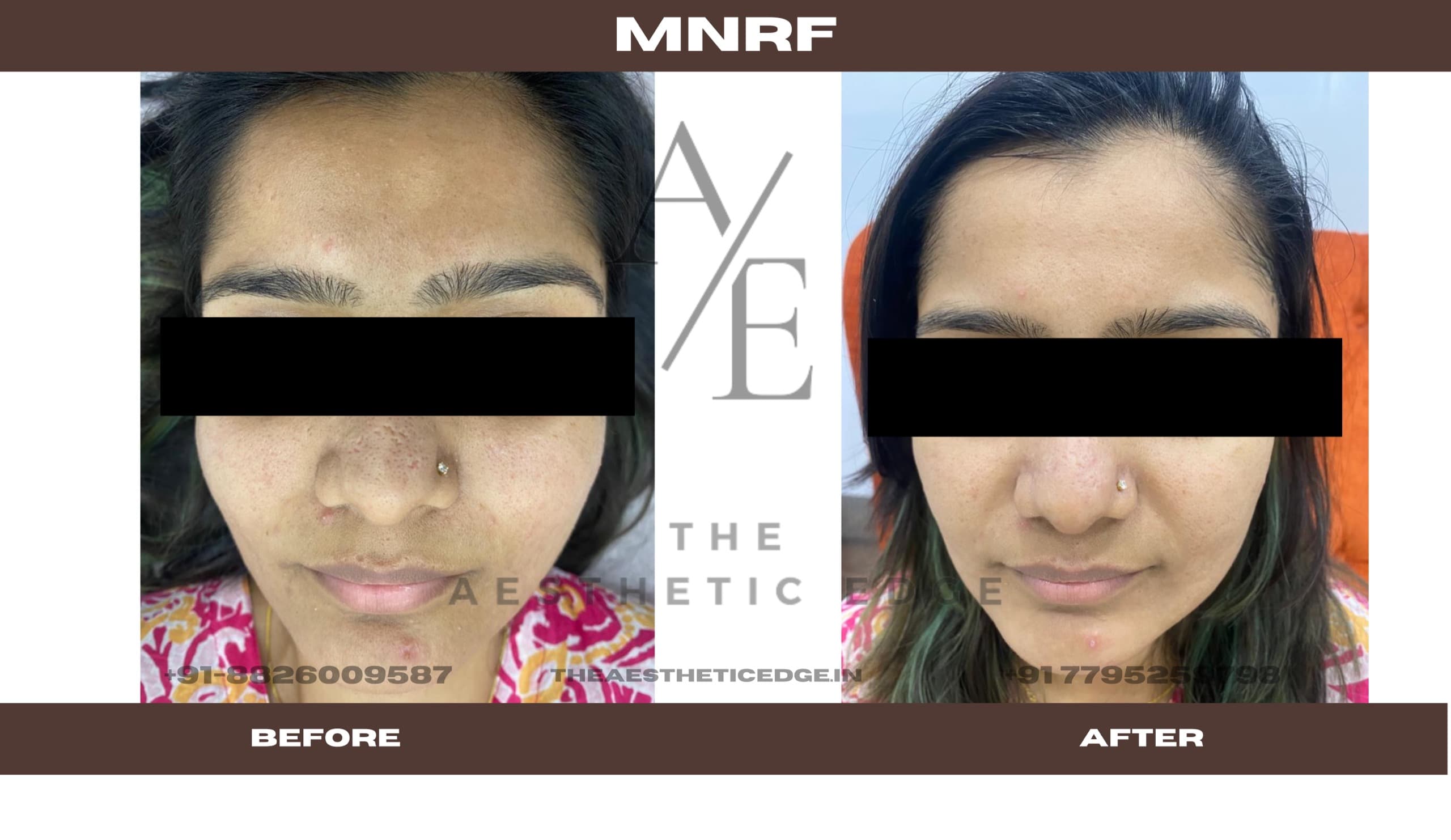
MNRF and a thread lift answer different questions. MNRF drives radiofrequency into the deeper skin to rebuild collagen, which is what acne scars, open pores, texture and early laxity need. A thread lift places fine dissolvable threads under the skin to physically reposition tissue that has slid downward. If your jawline has dropped, MNRF will not lift it; if your problem is scarring, threads will not touch it.
That is the whole comparison in miniature, and for a good number of patients it settles the question in one sentence. Where it does not — where you have both a softened contour and skin quality you are unhappy with — the rest of this piece sets out the differences that actually decide a plan.
What is each treatment physically doing?
MNRF stimulates; threads reposition and then stimulate.
In an MNRF session, fine needles carry radiofrequency energy into the deeper layers of the skin. That energy triggers a collagen response at the level where scars, enlarged pores and early laxity actually sit. Nothing is placed in the face. The change is remodelled tissue, and it arrives gradually.
In a thread lift, dissolvable threads are introduced through a fine needle or cannula along vectors planned in advance, then drawn to lift tissue into a new position. The lift is mechanical and it is visible during the procedure itself. As the threads break down they provoke a collagen response along their path, so a second, slower effect follows the first.
One is a biological prompt. The other is a structural intervention that also prompts biology.
Which concerns does each one genuinely own?
MNRF owns scarring, pores and texture. Threads own descended tissue.
Where MNRF is the sensible choice. Acne is long gone but the scars and open pores it left are not. Rough texture. Stretch marks. Fine lines and skin that has begun to loosen in a way creams do not touch. Radiofrequency delivered under the surface remodels collagen beneath a scar, which is work no thread performs and no cream reaches.
Where a thread lift is the sensible choice. A jawline that has softened and cheeks that have started to slide downward. Mild to moderate laxity in skin that still has reasonable quality, in someone not ready for surgery. The thread lift page is direct about the limits of that: the degree of lift a thread can achieve is modest by design, and where laxity is significant, a different approach serves the patient better. A surgical facelift produces a far larger and longer-lasting change, and a good doctor will tell you when that is what your face actually needs.
Neither treatment can be argued into the other's territory. MNRF does produce a tightening effect on early sagging, but that is firming, not repositioning. Threads do stimulate collagen, but along the path of the thread rather than across a field of scarring.
How quickly does each one show?
Threads are immediate. MNRF is gradual.
The thread lift result is visible for the lift itself at the end of the appointment, and continues improving as collagen builds over the following weeks. With MNRF, early change can be visible after the first session, but the result of substance builds over weeks as collagen remodels — which is precisely why sessions are spaced apart.
If you have an event in a fortnight, that difference is not a detail. If you are treating scarring you have had for a decade, it matters much less.
What does each one commit you to?
MNRF is a course. A thread lift is an appointment with a finite lifespan.
Most MNRF plans run to three or four sessions, spaced by the doctor, each around sixty minutes, with progress photographed as the course goes on. The treatment page does not publish how long the result lasts.
A thread lift is typically a single in-clinic appointment of under an hour, performed under local anaesthetic. Its duration is published: generally several months to around a year, depending on the thread type, the area, your skin and your age. The collagen laid down along the threads' path can outlast the threads themselves, which are absorbable and need no removal.
So one is several visits with an unstated horizon; the other is one visit with a stated and finite one. Which of those reads as an advantage depends entirely on how you prefer to spend time and money.
What is recovery like, and what can go wrong?
Both are day procedures. The thread lift carries the wider range of complications, and the honest comparison has to say so.
After MNRF: redness and mild swelling that usually settle within hours, tiny crusts at needle points for a few days that should not be picked, and skin that burns easily for a couple of weeks — so SPF 30 or higher and shade are part of the treatment.
After a thread lift: mild swelling, bruising or a feeling of tightness for a few days, with facial massage, vigorous facial movement and face-down sleeping avoided in the first week. Small irregularities such as puckering or dimpling can appear along a thread's path early on and usually settle, but should be reported if they persist. Infection or thread extrusion is uncommon and warrants a call to the clinic rather than home management. Where threads are placed on the nasal bridge, circulation is a specific and serious consideration, which is why that procedure belongs to a doctor and why severe pain, blanching or a dusky colour change must be reported straight away.
Numbing differs too: MNRF uses numbing cream; a thread lift uses local anaesthetic.
Who is ruled out?
MNRF is avoided in pregnancy and breastfeeding, with a keloid tendency, and with an active skin condition such as psoriasis or eczema in the treatment area.
Threads are avoided in pregnancy and breastfeeding, with an active skin infection, where there is skin cancer, and where laxity is significant enough that another approach is more appropriate.
Both consultations screen for this before anything is booked.
What do they cost?
MNRF starts from ₹6,999 per session. A thread lift is priced from ₹399 per thread — and that per-thread qualifier is the important part, because a plan uses a number of threads decided by the doctor, not one. Neither figure is a plan total, and a plan total is not something either page will state before an examination. The consultation is ₹500, waived off against treatment.
Can you have both?
Often, yes — they address different layers, and the thread lift page already notes that combined plans are common and that the doctor sequences them.
Skin quality and tissue position are separate problems, and a face can have both. What you should not accept is a plan that treats one as a substitute for the other. If someone offers threads for acne scarring, or MNRF for a jawline that has genuinely descended, the recommendation has been fitted to the treatment rather than to you.
Book a consultation at Indiranagar or Bellandur and ask which of your concerns is a quality problem and which is a position problem. That one distinction will do most of the deciding.