
MNRF Treatment: The Myths Worth Clearing Up Before You Book
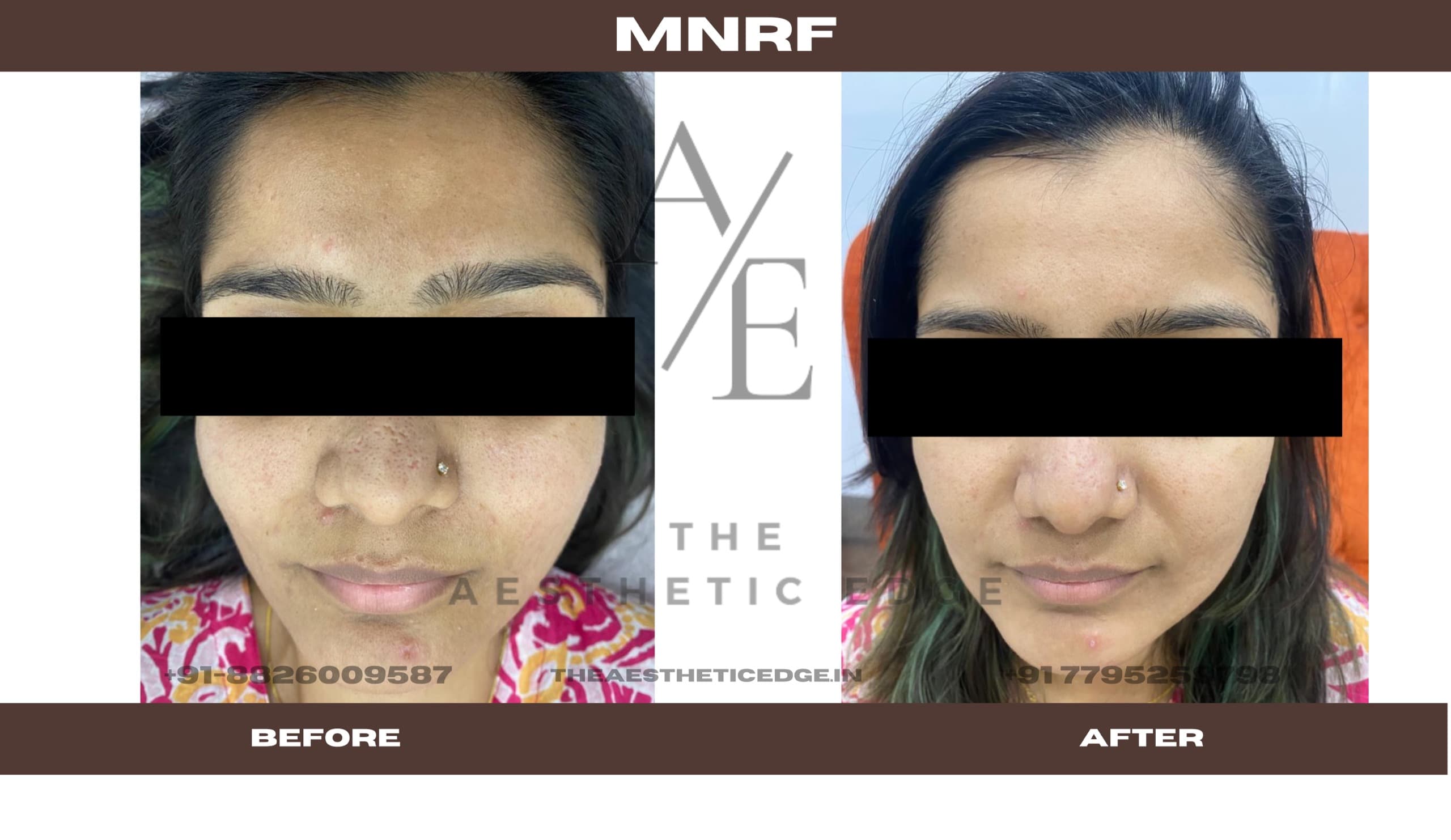
Four beliefs turn up in almost every MNRF consultation: that it is plain needling under a grander name, that energy treatments are unsafe on Indian skin, that a single appointment settles the matter, and that recovery costs a week indoors. None survives contact with the treatment. MNRF is needling plus radiofrequency released below the surface, normally three or four doctor-spaced sessions, with visible downtime counted in hours.
Here is each of the common ones, with what is actually the case.
"Isn't this just microneedling with a fancier name?"
It is needling plus a second mechanism, and the second one is the point.
Microneedling with a Dermapen creates controlled micro-channels, and the skin repairs itself with new collagen and elastin. That is a real treatment with real uses, and nothing here diminishes it.
MNRF adds radiofrequency carried through the needles into the deeper layers, so collagen is stimulated at the level where acne scars, open pores and early laxity actually sit. The needling is the route; the energy is the payload. Whether you need the second mechanism depends on what is being treated and how deep it lies.
"Energy treatments darken Indian skin, don't they?"
Some do. This one is chosen precisely because it is less likely to.
The concern is real and worth taking seriously: skin carrying more melanin tends to answer irritation with pigment. What distinguishes MNRF is that the needles put the energy underneath the surface instead of across it, so the pigment-bearing layer is passed through. That is the basis for a lower pigmentation risk than many surface lasers.
Lower, not eliminated. Settings are still chosen for your skin type by the doctor, and the sun protection afterwards still carries weight.
"One session and I'll see my scars gone?"
Most plans run to three or four sessions, spaced by the doctor according to scar depth and the concern being treated.
There is a second half to this myth that does more damage — the expectation that whatever the sessions achieve will be total. Collagen remodelling produces meaningful improvement in texture and scarring; it is not an eraser. A clinic that tells you which of your scars will improve a lot, which a little, and which need something else entirely is being more useful than one that promises uniformity.
"It must be extremely painful."
Numbing cream is applied before anything begins, and most patients describe warmth and pressure rather than pain, with brief discomfort over the more sensitive spots.
The preparation stage is where the comfort is won, which is why the skin is cleansed and numbed properly rather than quickly. If you have a low tolerance or are anxious, say so at the assessment rather than enduring it silently — it is a normal thing to raise.
"I'll need a week off work."
Redness and mild swelling follow every session and usually settle within hours. Light crusting can appear at the needle points and stays for a few days, and those must be left alone rather than picked.
The commitment that genuinely runs long is not appearance but sunlight: for a couple of weeks afterwards, treated skin burns easily, and SPF 30 or above plus shade are part of the treatment rather than a suggestion.
"If it worked, I'd see it straight away."
Some early change can show after the first session. The result worth having builds over weeks as collagen remodels, which is the whole reason sessions are spaced apart rather than run back to back.
This is why progress is photographed at each visit. Skin changes far too slowly for a daily mirror to register, and people routinely under-rate their own improvement when asked to judge from memory.
"It's only for acne scarring."
That is its most familiar use, not its only one.
The same collagen response is used for open pores, where tightening the surrounding skin softens how prominent they look; for early sagging and fine lines, giving a non-surgical firming effect that accumulates over weeks; and for rough texture and the appearance of stretch marks across a course of sessions.
What it does not do is target pigment directly. For freckles, sun spots and marks left behind by old acne, a Q-Switch laser is the tool built for that job.
"It's basically an advanced facial, so anyone trained can do it."
At The Aesthetic Edge, MNRF is performed by a doctor, always.
The reason is in the settings. Depth and energy are mapped to your skin at the assessment and adjusted zone by zone during the hour, and getting those numbers wrong on skin that pigments readily is not a cosmetic disappointment — it is a clinical one.
"Sunscreen afterwards is just something clinics say."
It is the part of the protocol you personally control, and the treated skin burns easily for around a fortnight.
In a city with year-round exposure this is not a seasonal instruction. Skipping it between sessions works against the money already spent on the sessions themselves.
"It's suitable for everyone, surely?"
No, and the exceptions are documented.
Anyone pregnant or breastfeeding, anyone with a tendency to form keloid scars, and anyone with an active skin condition such as psoriasis or eczema in the treatment area should not proceed. All of these are screened at the consultation, which is one of the reasons the consultation exists.
Where does that leave you?
With a treatment that is slower, more specific and less dramatic than social media suggests, and considerably more usable on Indian skin than an older generation of resurfacing was.
How a session runs, start to finish, is set out on the MNRF treatment page. If you want the myths tested against your own skin rather than in the abstract, book a consultation — ₹500, set off against your treatment if you go ahead.