
After a Korean HydraFacial: what is normal and what means call the clinic
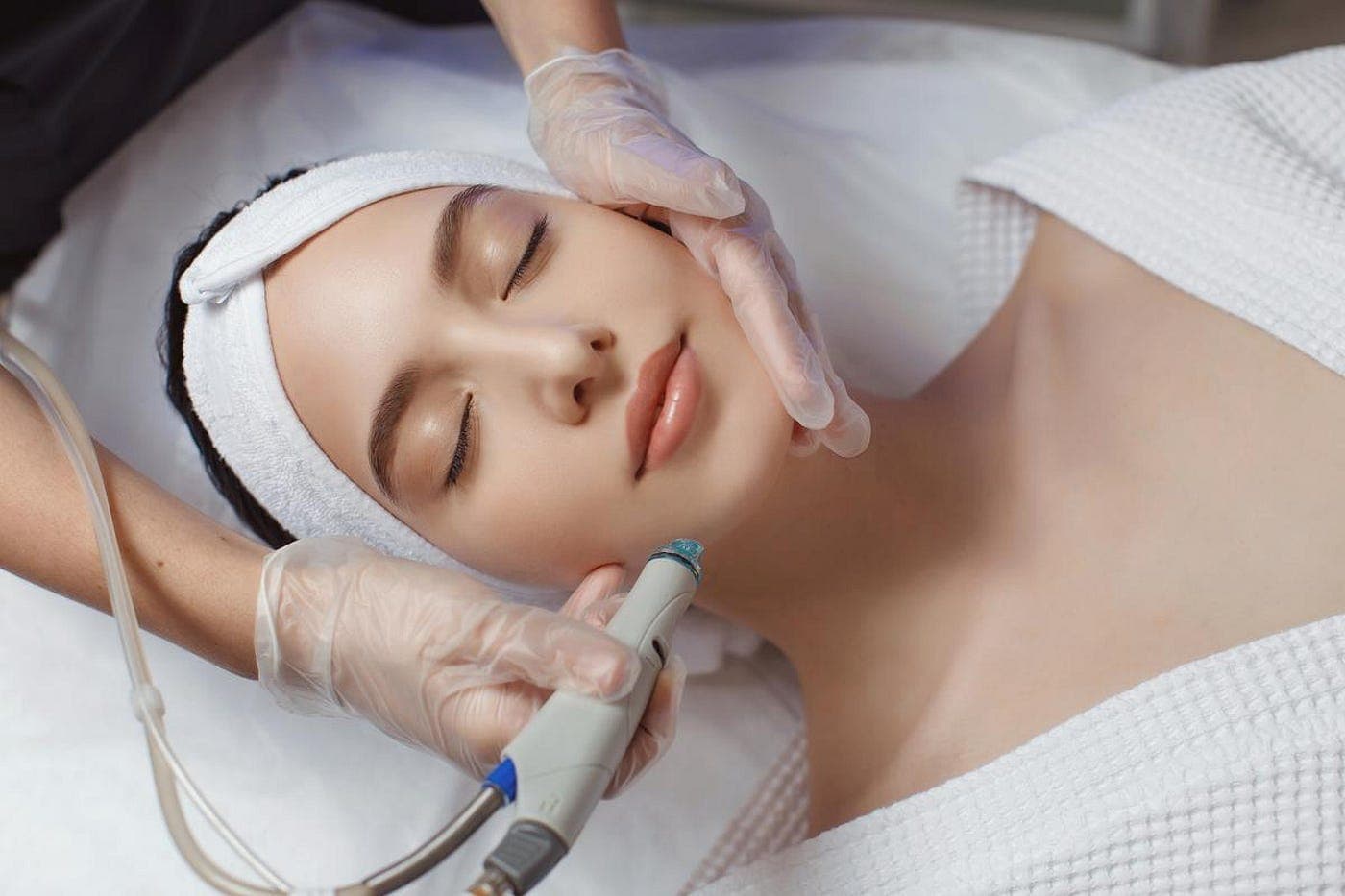
Mild redness for an hour or two is expected. Short-lived sun sensitivity for several days is expected. A small breakout in the first week is expected. Redness that persists past a day is not — telephone the clinic rather than treating it at home. This article separates the two, and does not ask you to diagnose anything yourself.
There is no downtime after a Korean HydraFacial, which is one of the reasons people choose it. That makes anything you do notice afterwards feel more surprising than it would after a treatment with a published recovery period. Below is what is described as expected, and the point at which the right response is to pick up the phone.
What is expected in the first couple of hours?
Mild redness or flushing. It is common straight after the extraction step, in which the device's spiral tip lifts blackheads and build-up out of pores by suction, and it usually settles within an hour or two. Some people notice nothing at all.
The session itself is not described as painful. The extraction feels like firm cool suction, the gentle acid step can tingle briefly, and the LED is felt only as light. You can wear makeup the same day and go back to work the same day.
What is expected over the first 48 hours?
Skin that feels smoother and looks brighter, and skin that is more sensitive to sun than usual. Exfoliated skin burns more easily for several days, which is why every session finishes with broad-spectrum sunscreen and why daily sunscreen afterwards is part of the treatment rather than an optional extra.
The aftercare over these two days is short: skip the gym, sauna and steam for about 48 hours, hold off on retinoids or acids at home for a few days, and keep the rest of your routine simple. Layering strong actives straight on top undoes the barrier work the session ends with.
What is expected in the first week?
Occasionally, a small breakout. What is described here is congestion that was already forming surfacing after extraction — it settles on its own, and it is not a reaction to the serums. It is the single most common thing people write in about, and in most cases it needs nothing done to it.
That is a general description of what tends to happen, not a reading of your skin. If what you are seeing does not match it, or if you simply are not sure whether it matches it, that uncertainty is itself a reason to ring rather than a reason to wait and watch.
When should you telephone rather than wait?
Ring the clinic, rather than treating it at home, if any of the following applies. Several of these come straight from what we document about this treatment; the rest are listed because they are not among the expected effects described above, and anything outside that list is worth a call.
- Redness that persists past a day. This is the one we name explicitly. Flushing that has not gone after 24 hours should be reported rather than managed at home.
- Anything that is getting worse rather than settling at any point after the first 48 hours, including a breakout that is spreading or deepening instead of resolving.
- Pain of any kind, at any point after you leave. The session and the days after it are not described as painful, so pain does not belong to the expected course.
- Swelling that increases instead of subsiding.
- Blistering, weeping, crusting or skin that has broken. Broken skin is something we treat as a reason not to proceed with a session at all, so it is not something to sit with afterwards either.
- Redness spreading beyond the area that was treated.
- A rash, hives, or intense itching. None of these appear in the expected effects for this protocol.
- Anything affecting your eyes, including pain, swelling around the eye, or a change in vision.
- Feeling unwell in yourself — fever, chills, or generally feeling ill in the days after the appointment.
This list deliberately does not tell you what any of these things might be. That is not something to establish from an article, and it is not something you should be establishing at all.
What should you not do while you wait to speak to someone?
Do not apply anything new to try to fix it. The instinct after a treatment is to reach for a soothing mask, an acid, a spot treatment or a retinoid you have at home, and adding an unfamiliar product on top of skin that has just been exfoliated makes the situation harder to assess and occasionally worse.
Do not squeeze or pick at anything, including a breakout that surfaces in the first week. The reason extraction is done by suction during the session is precisely that there is far less trauma to the skin that way.
Keep sunscreen going, keep the routine simple, and photograph what you are seeing in daylight if you can — it makes the conversation faster when you do get through.
What if it is outside clinic hours?
Telephone the clinic when it opens if what you are seeing is on the list above and you are able to wait comfortably. If you cannot reach us and you are genuinely worried — and particularly if there is pain, spreading redness, anything affecting your eyes, or you feel unwell in yourself — seek medical advice locally rather than waiting for us to open. Your nearest doctor or hospital is the right place for anything that feels urgent.
Nobody at this clinic would rather you sat at home overnight being unsure. A call that turns out to be nothing is a good outcome, not a wasted one.
Why you should not work out what it is yourself
Because two different things can look identical in a mirror, and because the people who can tell them apart have your notes in front of them — your skin type, the barrier condition recorded at the review that opens every session, what was used on the day, what you told us about isotretinoin, strong retinoids, or a recent peel.
An article cannot have any of that. What it can do is tell you where the line sits between watching and calling, and this one is deliberately drawn on the cautious side of that line.
What makes an unexpected week less likely next time
Most of it happens before the treatment rather than after. Every session opens with a skin review in which a doctor checks your skin type, your barrier condition, and anything active that would mean rescheduling rather than proceeding that day. An active rosacea flare, sunburn, an infected inflammatory breakout or broken skin can all be made worse rather than better, and those are reasons to move the appointment.
Be complete about what you are using at home. Recent isotretinoin, strong retinoids or a recent peel change how the gentle acid exfoliation step is set, and sometimes mean deferring the session. The same applies if you have recently had a chemical peel elsewhere, or a Hydra Medi Facial more recently than you had planned to.
If you have a question about a session you have already had
Ring us. That is genuinely the whole answer, and it does not depend on whether you think the question is a small one.
If you are yet to book, a consultation is ₹500, waived off against treatment, and it is where anything on your skin that needs thinking about gets thought about before rather than after. Book an appointment at Indiranagar or Bellandur.