
Korean HydraFacial: The Myths Worth Clearing Up Before You Book
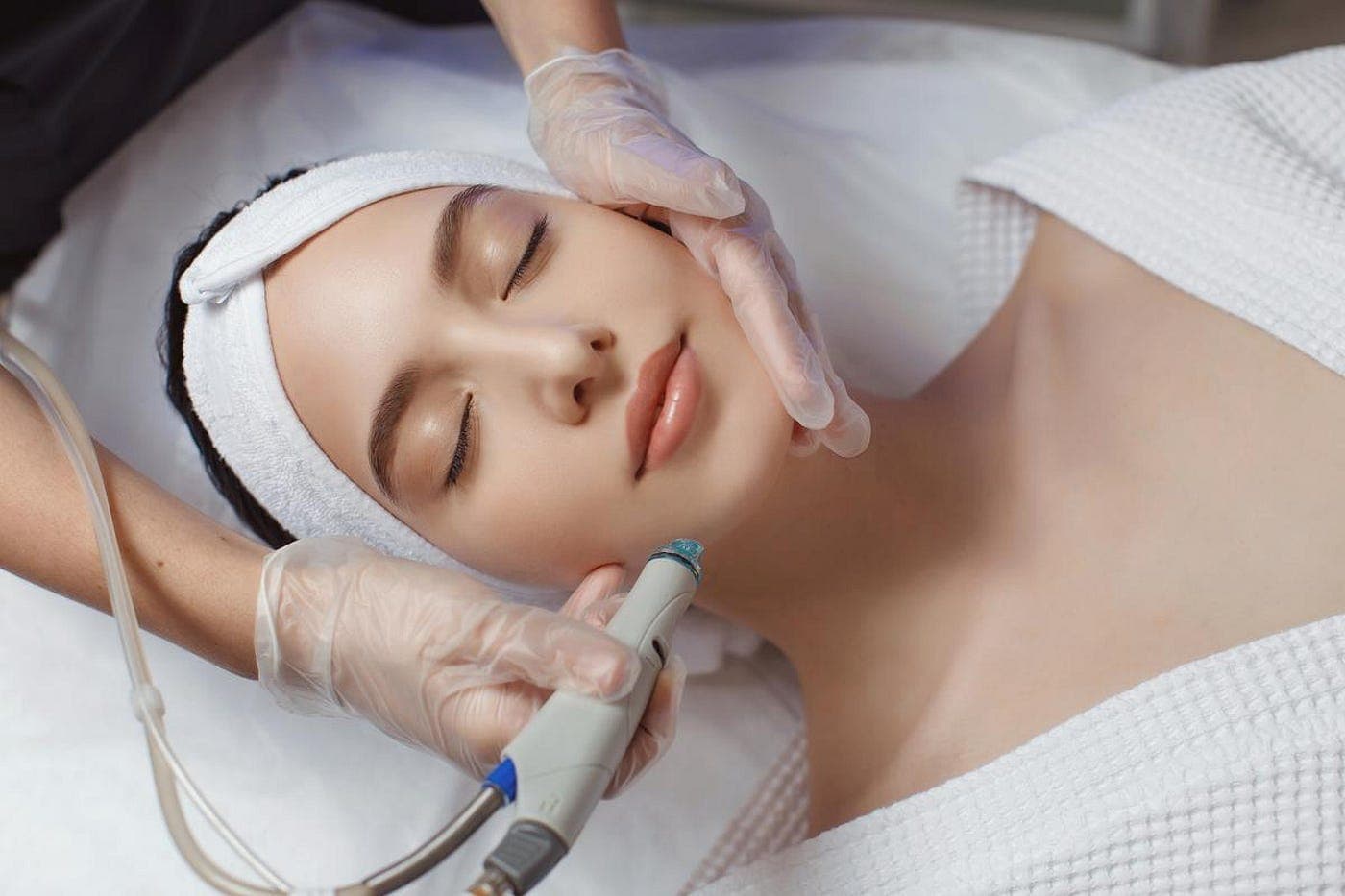
The most common misunderstanding about a Korean HydraFacial is that it is a different machine. It is not — it is the same medical-grade device and the same doctor supervision as our standard facial, run as a fourteen-step protocol. Most of the other myths follow from that one: what glass skin means, whether a single session is enough, and whether it treats pigmentation.
None of these are silly assumptions. They are what the name and the social feeds imply, and people arrive at the clinic holding them because nobody has told them otherwise. So here they are, one at a time.
Is it a different machine from a standard hydrafacial?
No. The device is the same, and so is the doctor supervision. What differs is the protocol built around it — fourteen steps instead of a standard three-stage session, with serums infused in thin layers, plus a cooling mask, LED and a short lymphatic massage.
That layered approach, several light steps rather than one strong one, is what the "Korean" in the name refers to. You are booking a longer appointment, not newer hardware, and any description implying you are paying for a different technology has the story wrong.
Will it actually give me glass skin?
You should expect brighter, smoother, more even-looking skin the same day. What you should not expect is the poreless finish in edited photos and videos, which is lighting and retouching as much as it is skincare.
Pores do not close. What happens is more ordinary and more honest than that: a cleared, evenly hydrated surface reflects light evenly, and that even reflection is the whole of the effect. Texture creates it, not a product laid on top. Anyone promising flawless skin from a facial is overselling it.
Is one session enough?
One session gives a visible same-day result, which is precisely why it is such a common pre-event booking. But this is a maintenance facial, and the benefit comes from regularity rather than from any single visit.
Once a month is the schedule, the same as with any maintenance facial. Each session builds on the last, and the reason to keep going is that skin quality holds between visits rather than drifting back. Booking one appointment and expecting the result to stay is the mismatch that leaves people disappointed six weeks later.
Is it just the standard facial, stretched out for more money?
No — the difference is in what is added, and whether that addition is worth it depends on you. A standard Hydra Medi Facial is cleanse, exfoliate and oxygenate in one sitting of around 45 minutes. The Korean protocol runs 75 to 90 minutes and adds the layered serum infusions, the cooling mask, LED and the lymphatic massage.
For most people on a straightforward maintenance schedule, the standard session is genuinely enough, and we will say so. The longer protocol earns its time in two situations: an event on the calendar where the same-day glow is the point, and skin that needs the extra barrier work.
Is it too harsh for sensitive skin?
Usually the opposite. It suits all skin types, including sensitive skin, and the reason is structural rather than promotional — the exfoliation is deliberately gentle, and the protocol finishes on barrier support rather than on the exfoliating step. Reactive skin generally tolerates this better than a stronger single-step treatment.
The caveat is real, though. An active rosacea flare, sunburn or infected inflammatory breakouts are reasons to reschedule rather than push through, and the assessment at the start of the session is what decides that. Do not make that call at home — if you are unsure whether something counts as active, call the clinic before your appointment and describe it.
Does extraction mean my blackheads get squeezed?
No. The device's spiral tip uses suction to lift blackheads and surface build-up out of pores, so there is no squeezing and no manual pressure, and far less trauma to the skin than a traditional extraction.
A second pass covers the nose, chin and any congested area, where build-up is heaviest and one pass rarely finishes the job. If your experience of facials is a therapist pressing at your nose with tissue-wrapped fingers, this is a different thing entirely.
Will it clear my pigmentation or my acne?
This is the myth worth being most careful about. The brightening infusion is aimed at dullness and uneven tone at the surface — it is not aimed at pigmentation sitting at depth, and this is a maintenance treatment rather than a corrective procedure.
So if you are booking it hoping to shift melasma, long-standing pigment patches, marks left by old acne, or active inflammatory acne, it is not the right treatment for that, and we would rather tell you now than after your third session. Bring those concerns to a consultation instead. There are corrective options, and which of them fits is a clinical decision that needs a doctor looking at your skin, not an article guessing.
Does no downtime mean no aftercare?
No, and this is where results quietly get thrown away. There genuinely is no downtime — makeup the same day, back to work the same day, mild redness settling within an hour or two. Aftercare is a separate question.
Sunscreen daily without exception, because exfoliated skin burns more easily for several days; the session ends with sunscreen for that reason, and it is part of the treatment rather than an optional extra. Skip the gym, sauna and steam for about 48 hours, and hold off on retinoids or acids at home for a few days. Keep the routine simple in between — layering strong actives straight on top undoes the barrier work you have just had done.
Two things should prompt a call rather than a home remedy. If redness is still there a day later, contact the clinic instead of treating it yourself. And if small breakouts surface in the first week, that is congestion that was already forming coming to the surface and it usually settles on its own — but call us if it spreads, becomes painful, or does not settle. Neither is something to self-assess.
Does my prescription really matter for a facial?
Yes, more than almost anything else you could tell us. Recent isotretinoin, strong retinoids or a recent peel change how the exfoliation step is set, and sometimes mean deferring the session altogether.
People leave this out because it feels irrelevant to something as routine as a facial. It is the disclosure that most often changes what happens in the room.
Ask before you book
If any of the above changed your mind about what you were booking, that is the article working. Book a consultation at Indiranagar or Bellandur — ₹500, waived against treatment — and a doctor will tell you whether the fourteen-step Korean HydraFacial, a standard session from ₹2,999 per treatment, or a chemical peel from ₹2,999 per session is the honest fit for your skin.