
Korean HydraFacial on Indian Skin: What Changes and Why It Matters
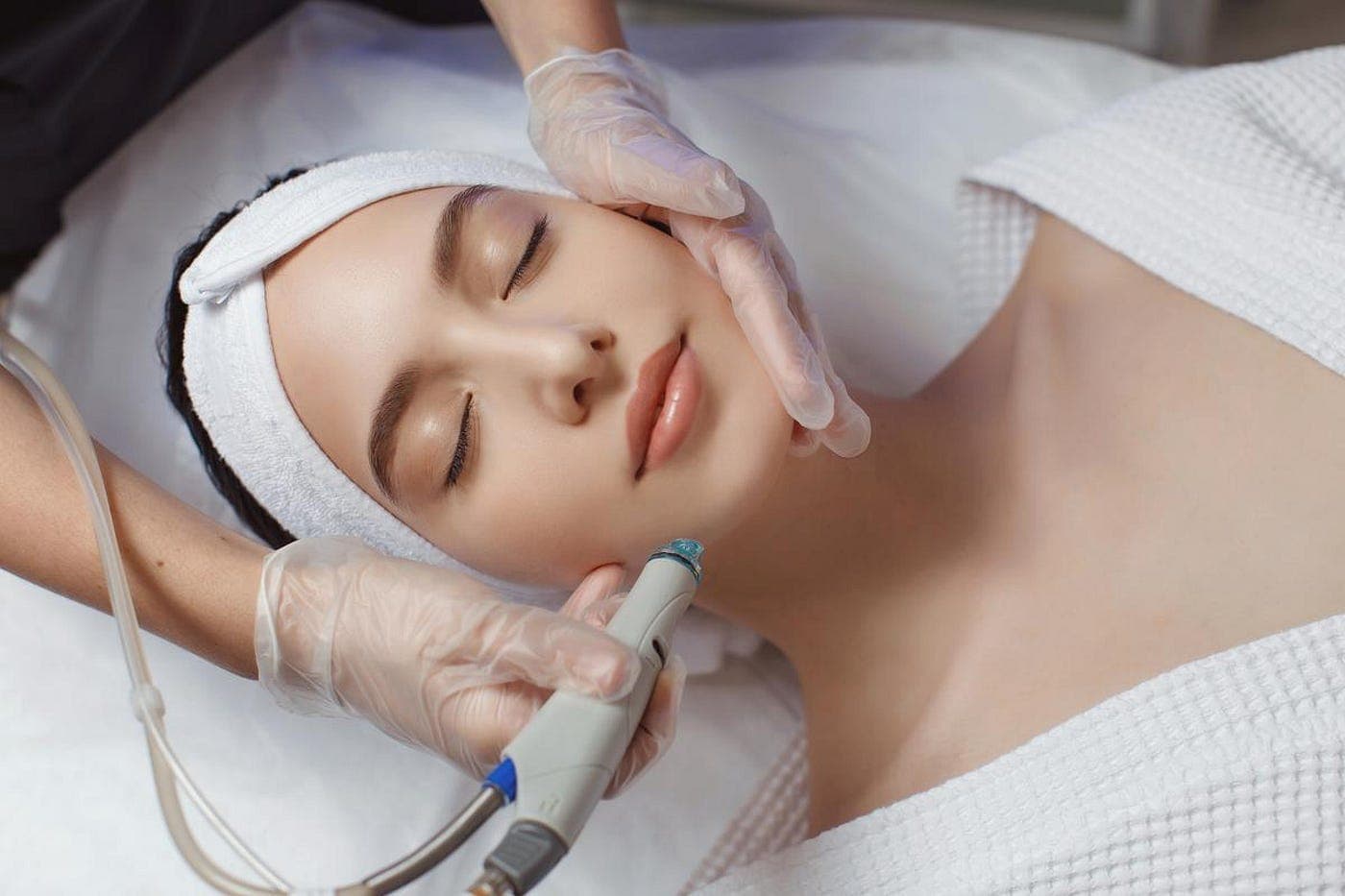
On deeper skin tones the question is less what a Korean HydraFacial can add and more how little it disturbs. Melanin-rich skin tends to respond to inflammation and trauma by leaving pigment behind, so the parts of this protocol that matter most are the deliberately gentle exfoliation, the suction extraction that replaces squeezing, and the barrier support it finishes on.
This is a facial, not an energy-based treatment, so none of the usual skin-tone conversation about device settings applies here. What does apply is simpler and more useful: how much the skin is provoked, how a mark behaves afterwards, and how the concern you came in with actually looks on your skin rather than on someone else's.
Why pigmentation after the fact is the thing to think about
Skin with more melanin in it commonly reacts to being irritated by producing more pigment in the same spot — the mark that outlasts a spot, a scratch or an aggressive extraction long after the original irritation has gone. It is why people with deeper skin tones so often say the breakout was not the problem; the shadow it left for the next few months was.
Nothing in this article can tell you how your own skin behaves — that is an assessment, not a reading exercise. But it is the reason a maintenance facial on deeper skin should be judged by its gentleness first. A treatment that gets you a good week and a mark that lingers into the next season is not a good trade.
The parts of the protocol that keep the handling light
Three steps do most of that work, and each is a deliberate design choice rather than a shortcut.
Extraction is done by suction, not by fingers. The device's spiral tip lifts blackheads and surface build-up out of pores, so there is no squeezing and no manual pressure — which the protocol exists to avoid, because that pressure is where much of the trauma in a traditional facial comes from.
Exfoliation is kept mild on purpose. A gentle acid loosens dead surface cells, and it is deliberately gentler than a peel: the aim is smoothness rather than shedding. If you have had a stronger single-step treatment leave your skin red and reactive, this is the difference you would notice.
The session ends on barrier support rather than on the exfoliation. Peptide and ceramide serum goes on last of the three layers, followed by moisturiser to seal them and broad-spectrum sunscreen. Finishing on repair rather than removal is what makes the result hold, and it is why the protocol is suitable for all skin types, including sensitive skin.
Lower trauma is the intent of every one of those choices. It cannot be promised that any treatment will leave no mark on any skin, which is exactly why the doctor's assessment happens before the first cleanse and not after.
Dullness looks different on deeper skin
On fair skin, an unhappy complexion tends to announce itself as redness. On deeper skin tones, the same surface problems more often read as a flat, greyish or ashy cast and as patchiness — tone that looks uneven across the face rather than angry in one place. Makeup not sitting the way you want is frequently the first thing people notice, before they would describe the skin itself as dull.
That has a practical consequence. Because a flush is genuinely harder to see on deeper skin, the instruction to tell us if redness has not settled is more important, not less — you may be relying on how your skin feels rather than on what you can see in the mirror. Do not talk yourself out of mentioning it because it does not look dramatic.
What the protocol offers against that flat, uneven look is the layered approach itself: a cleared and evenly hydrated surface reflects light evenly, and even light reflection is the whole of the dewy effect. Texture creates it, not a product sitting on top. The brightening infusion, an antioxidant blend applied as the second of the three serum layers, is aimed at exactly this — dullness and uneven tone.
What this protocol does not treat
This is where being specific matters most. The brightening step targets dullness and uneven tone at the surface, and it is not aimed at pigmentation sitting at depth. That distinction covers a lot of what people arrive hoping for.
If your concern is melasma, long-standing pigment patches, marks left behind by old acne, or scarring, this facial is not the answer to them, and our Korean HydraFacial page describes a maintenance treatment rather than a corrective one for that reason. We are not going to guess in an article at what would suit those concerns instead — bring them to the consultation, where a doctor can look at your skin and say what is actually appropriate. There are corrective options; choosing between them is a clinical decision, not a blog one.
What this treatment does reliably offer is same-day brightness and smoothness, building over a course of monthly sessions. Judge it on that.
Sun sensitivity when you do not obviously burn
Exfoliated skin burns more easily for several days after a session, and daily sunscreen is part of the treatment rather than an optional extra. Deeper skin tones tend to tan rather than visibly redden, so that extra sensitivity is easier to underestimate — the absence of an obvious burn is not evidence that nothing happened.
Given that pigment is the outcome you most want to avoid, this is the single aftercare instruction worth being rigid about. It also runs alongside the rest: skip the gym, sauna and steam for around 48 hours, and hold off on retinoids or acids at home for a few days, so the barrier work is not immediately undone.
What to tell us, and when
Some things are ours to judge rather than yours. Active rosacea, sunburn, infected breakouts or broken skin can be made worse by a treatment that exfoliates and extracts, and they are reasons to reschedule — so tell us before the session rather than deciding at home whether they count. The same applies to recent isotretinoin, strong retinoids or a recent peel, all of which change how the exfoliation step is set and sometimes mean deferring altogether.
Afterwards, two signs are worth a phone call rather than a home remedy. Mild redness right after extraction is common and usually settles within an hour or two; if it is still there a day later, contact the clinic. Small breakouts occasionally surface in the first week where congestion was already forming, and those settle on their own — but call us if they spread, become painful, or do not settle. Please do not pick at them. The reason the protocol extracts by suction instead of pressure applies just as much to your fingers at home as it does to ours in the clinic.
Have your skin assessed first
The honest way to find out whether this suits your skin is to have someone look at it. Book a consultation at our Indiranagar or Bellandur clinic — ₹500, waived against treatment — and we will tell you whether the fourteen-step protocol, a standard Hydra Medi Facial at from ₹2,999 per treatment, a chemical peel from ₹2,999 per session, or something else entirely is the right starting point.