
Korean HydraFacial Aftercare: The First Week, Day by Day
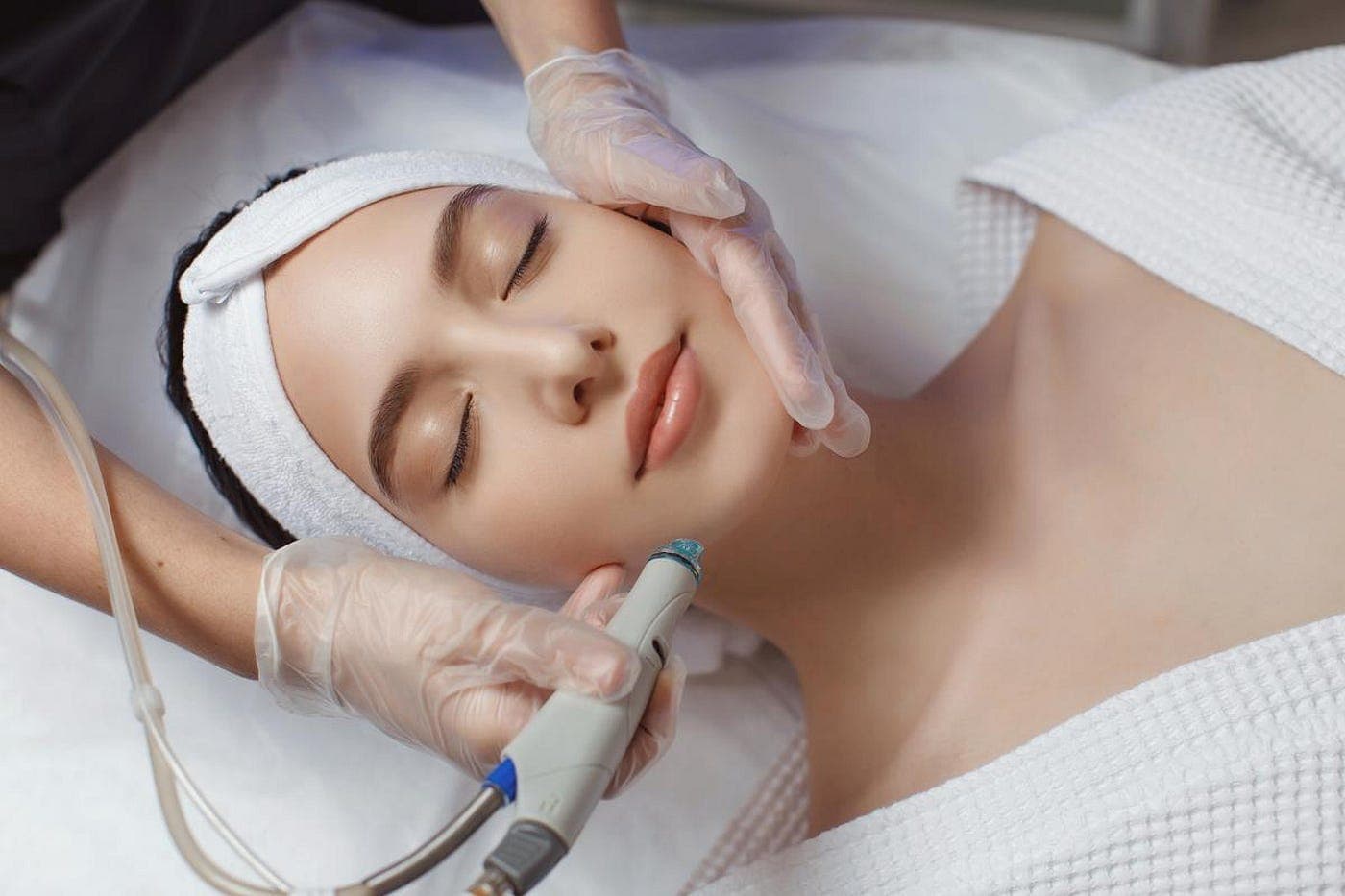
There is no downtime after a Korean HydraFacial — makeup and work the same day. The first week is about protecting what the session did rather than recovering from it: broad-spectrum sunscreen daily without exception, no gym, sauna or steam for about 48 hours, and no retinoids or acids at home for a few days.
That is the whole of the aftercare in one paragraph. The rest of this article explains why each of those exists, and — more importantly — the specific things that are worth ringing the clinic about rather than looking up.
Day 0: what should I do the evening of the session?
Very little, deliberately. The Korean HydraFacial finishes with moisturiser sealing in three layered serums and then broad-spectrum sunscreen, so your skin leaves the clinic already dressed. Adding to that the same evening works against it.
Mild redness or flushing straight after the extraction step is common and usually settles within an hour or two. You can wear makeup the same day if you need to.
Keep the evening routine to a gentle cleanse and your usual moisturiser. Skip anything strong, and skip anything new — the whole point of the barrier work in steps nine to thirteen is undone by layering actives straight back on top of it.
Days 1 and 2: what am I actually avoiding?
Heat and sweat, for about 48 hours. That means the gym, the sauna and the steam room. Hot yoga and a long steam after a workout are the two that catch people out.
This is a shorter and gentler list than you would get after a resurfacing procedure, because nothing here has been resurfaced — the exfoliation step is deliberately mild, and the aim across the whole protocol is smoothness rather than shedding. You are not waiting for skin to heal. You are giving freshly cleared pores and freshly infused serums two days without being flooded with sweat.
Sunscreen starts on day one and does not stop. More on that below.
Days 3 to 5: when can my retinoids and acids go back?
After a few days, and reintroduce them one at a time rather than all at once. Our own guidance is to hold off on retinoids or acids at home for a few days after a session and to keep the rest of the routine simple in the meantime.
If you are not sure where your particular product sits — a prescription retinoid is not the same as a mild over-the-counter serum — ask at the clinic rather than guessing. That question takes thirty seconds to answer on the phone and is not worth improvising.
This is also the window in which a pre-event session lands well. Three to five days before a function is the documented gap, which is why the day-three-to-five mark is the point at which skin has settled and taken up the hydration.
Days 6 and 7: what if a breakout appears?
Occasionally, congestion that was already forming surfaces as small breakouts in the first week after a session. It settles on its own and is not a reaction to the serums.
The useful instruction here is what not to do: do not pick at it, do not start a new spot treatment on top of skin that has just had barrier work, and do not conclude that the treatment did not suit you. If it is not settling, that is one of the things to tell the clinic about — see the next section.
Why does sunscreen matter more this week than usual?
Because exfoliated skin burns more easily for several days, and your session included two exfoliating steps rather than one. Alongside the protocol's own gentle acid step, every Korean HydraFacial session includes a complimentary chemical peel — a ₹1,999 session on its own. Sunscreen is applied as the final step of the treatment for exactly this reason: it is part of the treatment, not an optional extra afterwards.
Practically, in Bangalore: reapply if you are outdoors for hours, take the sun seriously on a two-wheeler commute, and be realistic about a long daytime function. This is the single aftercare instruction with the clearest consequence for ignoring it.
What should make me ring the clinic?
Ring us — do not try to work out what it is, and do not treat it at home — if any of the following happen. Some of these come straight from our own documented notes on this protocol; the others are here because they are worth a phone call whatever the cause:
- Redness that persists past a day. This is the one our own notes name explicitly: tell the clinic rather than treating it at home.
- Breakouts that are not settling on their own over the first week, or that are spreading.
- Skin that becomes broken, blistered, crusted or weeping anywhere that was treated.
- Pain, stinging or burning that is increasing rather than easing.
- Swelling, or a rash spreading beyond the area that was treated.
- A sunburn-type reaction after being outdoors in the days following the session.
- Feeling unwell in yourself — for example a fever — alongside any skin change.
Deliberately, this article does not tell you what any of those signs means. You should not self-assess, and a search engine is a poor substitute for someone who has seen your skin and knows exactly what was done to it. The purpose of the list is only to tell you when to pick up the phone.
How to escalate. Call the clinic during opening hours and describe what you are seeing; if we need to look, we will bring you in. If something is sudden or severe, or you feel unwell in yourself, seek urgent medical care locally straight away rather than waiting for clinic hours or for a call back. Nobody will mind you ringing about something that turns out to be nothing.
When can I book the next session?
Once a month is the documented rhythm, and the benefit comes from that regularity rather than from any single visit. If you found the fourteen-step protocol longer than you want every month at 75 to 90 minutes, a standard Hydra Medi Facial at around 45 minutes and from ₹2,999 per treatment is a reasonable alternative between the longer sessions.
Ready to book your next one?
If your first week raised a question — about your actives, your training schedule, or something you noticed on day three — bring it to the next session rather than working around it alone.
Book an appointment at Indiranagar or Bellandur. A consultation is ₹500, waived against your treatment.