
How Korean HydraFacial Actually Works, Step by Step
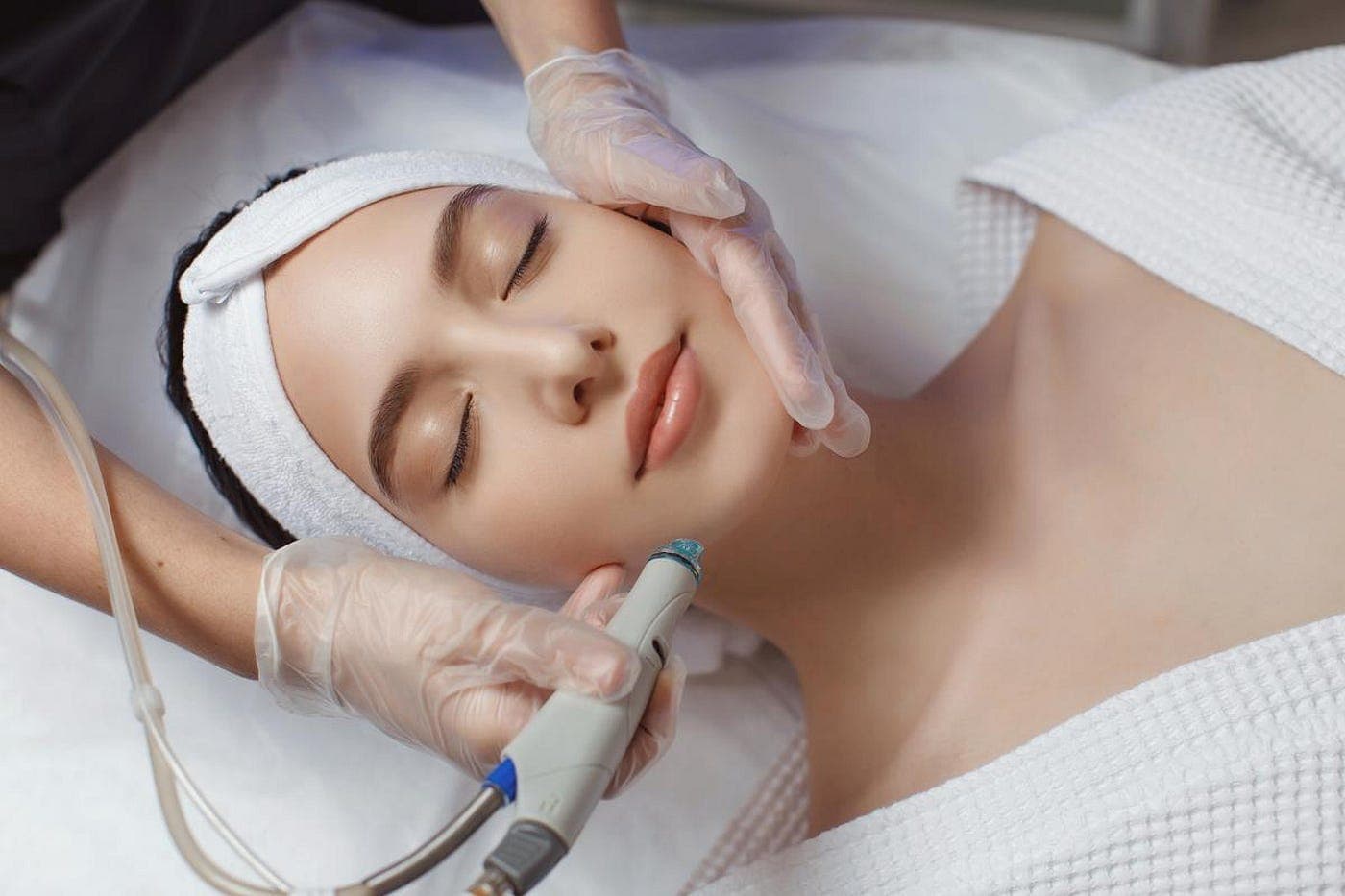
The Korean HydraFacial is our HydraFacial run as a longer, fourteen-step glass-skin protocol. It works by clearing the skin's surface with medical-grade suction rather than squeezing, then rebuilding it in thin layers — hydration, brightening and barrier serums in sequence, finished with a cooling mask, LED and massage. Nothing is injected, and there is no downtime.
That is the short version. If you want to understand what you are consenting to before you sit in the chair, the longer version is worth ten minutes, because almost every step has a reason behind it that is not obvious from the name.
What is the protocol actually trying to do to your skin?
It is trying to change the surface, not the structure underneath. Korean skincare's central idea is that a healthy barrier and thin, repeated layers do more than one strong treatment, and this protocol is built on that premise from beginning to end.
So the whole session moves through three phases. First it clears the surface — makeup, sebum, dead cells and the build-up sitting in pores. Then it puts hydration and antioxidants back in, in layers thin enough to absorb. Then it protects what has just been done, so the result holds rather than lifting off over the next few hours.
This is a maintenance facial, not a corrective procedure. Holding that distinction in mind explains most of the choices below.
Why does it begin with two cleanses instead of one?
Because the two cleansers dissolve different things, and neither one finishes the job alone. The first is oil based, and it lifts makeup, sunscreen and sebum — the oil-soluble layer that water-based products cannot fully remove on their own. The second is water based, and it clears what the first step loosened.
The point of splitting it is that skin ends up genuinely clean without being stripped. A single aggressive cleanse can take the barrier down with the grime, which would work directly against everything the rest of the session is trying to build.
How is the exfoliation step different from a chemical peel?
It is deliberately gentler, and the goal is different. A mild acid is used to loosen dead surface cells so the skin is smoother and the serums that follow have somewhere to go. It is not trying to make your skin shed.
That matters because a chemical peel is a corrective treatment with an intended shedding phase and its own aftercare. The acid step here is calibrated for smoothness, which is why the session finishes with makeup on and no recovery. If your skin genuinely needs a peel's depth, that is a different conversation and a different appointment — and every session here includes a complimentary chemical peel, which is a ₹1,999 session on its own.
What does the extraction step actually do to a pore?
It empties it by suction rather than by pressure. The device's spiral tip creates a vortex at the skin's surface that lifts blackheads and build-up out of the pore, and there is no squeezing and no manual pressure anywhere in the step.
The mechanical difference is the whole point. Squeezing pushes some of a blockage downward and inflames the surrounding tissue, which is why manual extraction so often leaves marks that outlast the blackhead. Suction pulls in the direction the blockage is already trying to go, so there is far less trauma to the skin.
A second pass follows over the nose, chin and any congested area, because build-up is heaviest there and one pass rarely finishes it.
Why three thin serum layers instead of one rich product?
Because thin serums applied in sequence absorb better than a single rich one sitting on top. That is the core idea Korean skincare is built on, and it is the main reason this protocol runs longer than a standard facial.
The three layers go on in a deliberate order:
- Hyaluronic-based hydration first, into the freshly cleared surface, because it is the thinnest and needs the most direct contact with the skin.
- An antioxidant and brightening blend second, aimed at dullness and uneven tone at the surface — not at pigmentation sitting deeper.
- Peptide and ceramide barrier support last, because barrier repair is what makes the result hold between sessions rather than fading in a week.
Order is not decorative here. A rich barrier serum applied first would slow everything after it.
What are the cooling mask, the LED and the massage for?
Each one closes a specific gap. A cooling sheet mask calms any flush from extraction and, just as importantly, stops the layered serums evaporating before they have settled. Red LED supports repair and calms inflammation — it generates no heat, and you feel nothing beyond the light itself. A short lymphatic massage along the drainage lines helps reduce puffiness, particularly around the eyes and jawline.
Then a moisturiser seals the layers in, which is what prevents the hydration lifting off over the next few hours, and broad-spectrum sunscreen finishes every session.
Why is sunscreen part of the treatment rather than advice?
Because exfoliated skin burns more easily for several days afterwards. That is a direct consequence of the acid step, so the sunscreen at the end is closing a vulnerability the session itself opened — which is why it is applied in the chair rather than mentioned on the way out.
Daily sunscreen after the session is part of the treatment, not an optional extra.
Does any of this explain why sensitive skin copes with it?
Yes, and it is the gentleness of the exfoliation combined with the barrier work at the end. Reactive skin generally tolerates this better than a stronger single-step treatment, because the protocol never asks the barrier to take one large hit and then finishes by supporting it.
That said, an active rosacea flare, sunburn, infected inflammatory breakouts or broken skin can be made worse, and those are reasons to reschedule rather than push through. The skin review at the start of every session exists to make that call. Recent isotretinoin, strong retinoids or a recent peel also change how the exfoliation step is set, and sometimes mean deferring the session — so tell the doctor what you have been using.
What can this mechanism not do?
It cannot close a pore, and it cannot reach what is happening below the surface. You should expect brighter, smoother, more even-looking skin the same day. What you should not expect is the poreless finish you see in edited photos and videos, which is lighting and retouching as much as skincare.
The glass-skin effect is optical. Cleared, evenly hydrated skin reflects light evenly, and that is what reads as glow — texture creates it, not a product applied on top. Anyone promising flawless skin from a facial is overselling it.
Nor is one session a plan. A single visit gives a visible same-day result, which is why it is such a common pre-event booking, but skin quality that holds comes from monthly sessions. If you are booking for a wedding or event, leave three to five days rather than going the day before, so any transient redness has settled.
What should you expect afterwards, and when should you tell the clinic?
Mild redness or flushing straight after extraction is common and usually gone within an hour or two. Small breakouts in the first week happen occasionally — that is congestion which was already forming surfacing after extraction, not a reaction to the serums.
Please do not sit at home working out what something means. Tell the clinic if redness persists past a day rather than settling, if anything is painful or spreading, or if what you are seeing simply does not match what you were told to expect. None of that is common, and none of it is yours to assess alone — the clinic has your notes and can tell you in a minute whether it needs to be seen. Ring the branch you were treated at, and ask to be seen if you are unsure.
For 48 hours, skip the gym, sauna and steam, and hold off on retinoids or acids at home for a few days. Keep the rest of your routine simple.
How does it compare with a standard session, and what does it cost?
A standard Hydra Medi Facial is cleanse, exfoliate and oxygenate in one sitting, around 45 minutes. This runs 75 to 90 minutes and adds the layered infusions, cooling mask, LED and lymphatic massage. For maintenance on a schedule, the standard session is enough for most people; this one suits an event, or skin that needs the extra barrier work.
Cost depends on which of those you book and whether you are on a monthly course, so there is no single figure worth quoting here — you will have it in writing before anything starts. The consultation is ₹500, waived against your treatment.
If your skin is dull, rough, or never quite sits right under makeup, book an appointment and have it looked at properly first.