
The Hollywood Carbon Peel: The Worldwide Trend, Assessed for Indian Skin
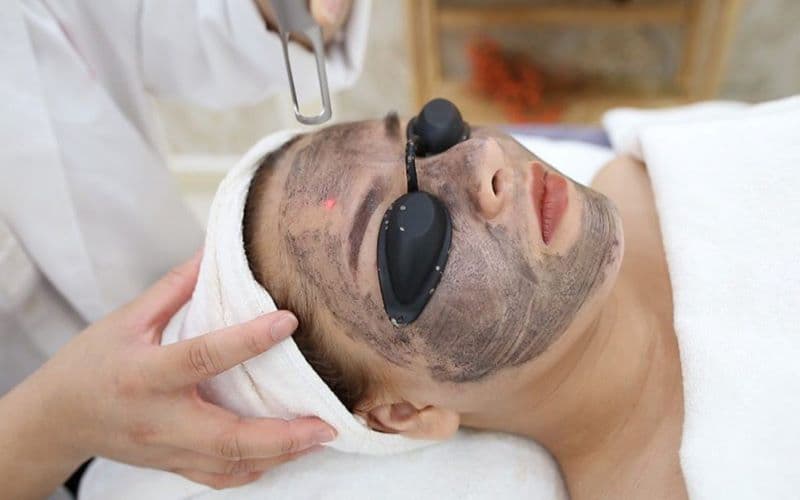
The Hollywood carbon peel is a nickname, not a product. What sits behind it is a carbon laser peel: a carbon lotion drawn into the pores, then vaporised with a laser so the trapped oil and debris come out with it. For Indian skin the honest fit is oiliness, congestion and enlarged pores — not pigmentation, which the treatment is not documented to address.
That distinction is most of what this article is about, because it is the point at which the international version of the trend and the reason Indian readers usually search for it stop matching.
Is "Hollywood peel" an actual treatment name?
No. It is a media name, and it has several siblings — you will also see the same procedure called a China doll peel or a black doll peel, both of which refer to the dark carbon layer that goes on before the laser passes.
There is no separately branded Hollywood Peel on our menu, because there is no such distinct procedure. What we offer, and what those names describe, is a carbon laser peel. If a clinic quotes you for a "Hollywood Peel" at a premium over a carbon peel, it is worth asking what the difference is, because the nickname on its own is not one.
Why did it become a trend at all?
Because the format suits the way it gets talked about.
A session runs about 30 to 45 minutes including preparation and aftercare. The downtime is little to none — mild redness, if any, usually settles within a few hours. And first results are often noticeable after a single session, with the change reading as a subtly clearer, less shiny complexion rather than anything obviously done.
That combination — under an hour, no recovery, visible the same evening — is exactly the treatment shape that fits into a pre-event schedule, and exactly the one that photographs well as a story. It is a genuinely convenient treatment. The convenience is real. The trouble is that convenience is most of what the trend communicates, and it leaves out what the treatment is actually for.
What does a carbon laser peel actually do?
A carbon-based lotion is spread over the area and given time to penetrate into the pores, where it binds to oil and debris. A low-energy laser pass binds the carbon to what it has absorbed; a higher-energy pass vaporises it, taking the trapped material out with it, while a smoke evacuator clears the residue. Calming products and sunscreen finish the session.
So the mechanism is a pore-clearing one. Clearing the pore lining and reducing surface oil is what brings breakouts down and makes enlarged pores less obvious over a series of sessions. The laser energy also warms the deeper layer, prompting collagen regeneration that improves firmness and elasticity alongside the cleansing effect.
That is the documented list: oil, congestion, breakouts, pore appearance, and a collagen effect. It is a substantial list. It simply is not the list most people arrive with.
Does it treat tanning, dark spots or pigmentation?
This is the question that matters for an Indian reader, and the answer is that the carbon peel is not documented as a pigmentation treatment.
Search interest in India around laser facials skews heavily toward pigmentation — tanning after a summer, melasma across the cheeks, marks left behind by old acne. Those are melanin behaviours, and melanin-rich skin does more of them. The carbon peel's mechanism is drawing carbon out of a pore. Nothing in that mechanism is aimed at pigment sitting in the skin.
The treatment that is aimed at exactly that is the Q-Switch laser, and it is worth reading the difference carefully. Q-Switch delivers extremely short, high-energy pulses that shatter unwanted pigment into particles small enough for the body to clear, while leaving surrounding skin intact — and that very short pulse duration is precisely why it is documented as suitable for Indian and other deeper skin tones that burn easily with other lasers. It is used for freckles, sun spots, acne marks, melasma, laser toning and tattoo removal.
If pigmentation is what brought you to a search for a Hollywood peel, the honest redirection is to a pigmentation assessment, not to a pore treatment with a glamorous nickname.
Is a carbon peel appropriate for deeper skin tones?
Here we have to be careful, and being careful is the point.
The carbon laser page makes no blanket claim about skin tone in either direction, and we are not going to invent one. What it does document is a screening step: your doctor checks skin type and rules out anything that would make a laser peel unsuitable that day, before the first session. That screening is not a formality on melanin-rich skin. Any laser working on deeper skin tones needs the operator to know what they are doing with energy settings, which is one of the practical reasons a laser peel belongs in a doctor-led setting rather than a salon.
The aftercare instruction that follows carries the same weight. Skin is more reactive to UV straight after a session, and daily broad-spectrum sunscreen both protects the result and prevents post-treatment pigmentation. On skin that pigments readily, in a city that gets strong sun most of the year, that sentence is the whole plan and not an optional extra.
Does one session really do it?
Partly, and the trend leans on the partly.
Improvements are often noticeable after a single session — that much is true and is why the pre-event booking exists. But the documented course is a series of four to six treatments spaced a few weeks apart for the full effect, with results then holding for several months alongside maintenance sessions.
Read the two together and the realistic version is: one session for an event this week, a course if the actual complaint is ongoing oiliness and congestion. A single session is a good look, not a change in how your skin behaves.
What does Bangalore add to this?
Two things that genuinely matter, rather than local colour for its own sake.
The first is oil. Humid stretches and a commute that puts particulate on your face for the length of the ride give congestion plenty to build on, which is why oily, blocked skin is such a common complaint at both clinics. That is squarely the problem this treatment was designed around.
The second is UV. Sun exposure is the standing risk to any result on pigment-prone skin, and it is the reason the sunscreen instruction after a session is written the way it is.
What can go wrong, and who should wait?
Mild redness or warmth is the usual immediate effect and typically goes within a few hours. Some patients find the skin a little dry or flaky for a day or two as surface debris clears — moisturise, and leave scrubs alone while that settles. If redness is still there the next day, tell the clinic rather than treating it yourself.
Some people should postpone rather than push through: active skin infection, recent sunburn, pregnancy, and certain oral acne medications are all reasons to wait, and your doctor screens for them before the first session. Active, inflamed acne may need medical treatment first — a laser peel is not the answer to every breakout, and being told so is a reasonable outcome of a consultation.
What else is worth asking about?
If your skin is sensitive or reactive rather than oily, or you want something you can repeat monthly, a Hydra Medi Facial is the gentler shape: cleansing and infusion, exfoliation and oxygenation in one sitting, documented as suitable for all skin types including sensitive skin, and run as monthly maintenance rather than as a course.
If the complaint is pigment, the conversation belongs on the Q-Switch page.
So, worth booking?
If you have oily, congested, breakout-prone skin and you want it clearer — yes, this is a well-suited treatment with an unusually convenient format, and the trend is not wrong about how easy it is to fit in.
If you came for a glow before a wedding next weekend, one session is a reasonable thing to book, as long as you know that is what you are buying.
And if you came because you have been told a Hollywood peel will lift pigmentation, please have the pigmentation looked at properly first. A consultation is ₹500, waived off against treatment, and it exists so that someone examines your skin before anyone books a laser for it.
Book a consultation at Indiranagar or Bellandur, and have the trend checked against your actual skin.