
HIFU vs Evolve Skin Tightening: How to Choose
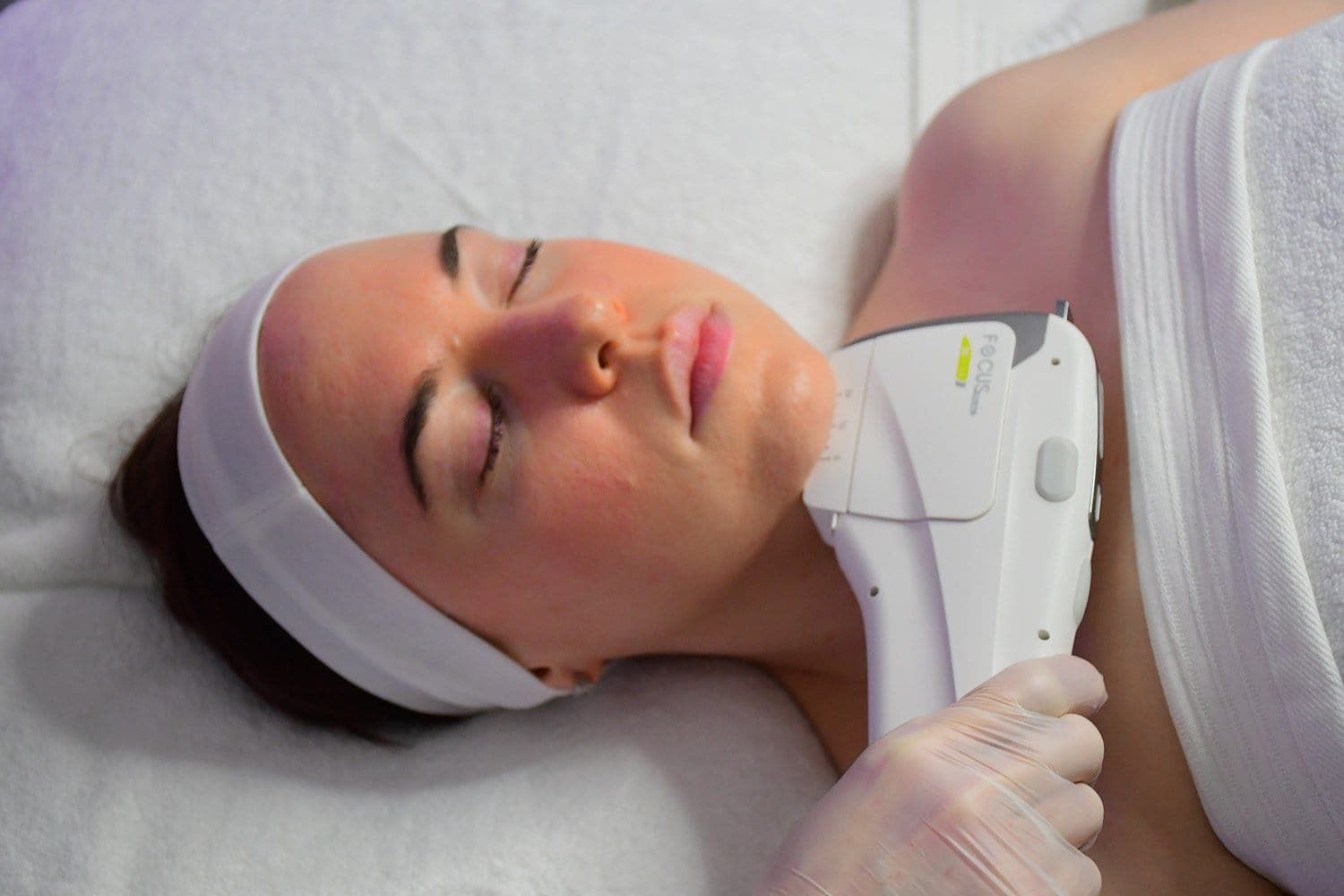
These two devices get compared constantly and rarely compete for the same job. HIFU delivers focused ultrasound to a set depth beneath intact skin, and is used on the face, jawline and neck. Evolve straps hands-free applicators to the body — abdomen, flanks, thighs, arms and buttocks — and combines radiofrequency, muscle stimulation and vacuum-assisted fat reduction in one platform.
That single distinction settles most of the decision before any of the finer comparisons matter. But the two are not simply "face device" and "body device", and the differences in how the energy is delivered, how a session runs and how long a course takes are worth understanding, because they change what your diary and your expectations need to accommodate.
What is the actual difference in how the energy gets in?
HIFU — High-Intensity Focused Ultrasound — concentrates ultrasound energy at a precise depth below the skin surface to stimulate collagen production. The word doing the work is focused: the energy passes through the surface untouched and converges at the chosen depth, so there is no wound, no injection and no incision to heal.
Evolve works through the skin rather than past it. It is a platform with three modes. Tite uses heated applicators to warm the deeper skin layers and prompt a collagen response. Tone uses electrical muscle stimulation to produce contractions in the muscle beneath the treatment area, working it in a way that is difficult to replicate voluntarily. Trim uses vacuum-assisted radiofrequency on stubborn subcutaneous fat in a defined area.
So the mechanisms overlap on exactly one point — both ask your own collagen to respond to controlled heat — and diverge everywhere else. Evolve can also address muscle and localised fat, which ultrasound tightening does not attempt. HIFU is delivered to a depth chosen for the face, which a strapped-on body applicator is not built to do.
One practical consequence worth knowing: because radiofrequency heats tissue rather than targeting pigment, Evolve is generally suitable across skin tones, unlike some light-based devices where depth of skin tone restricts what can be used. Suitability for either device is confirmed by the doctor at assessment.
Which one treats the area I am worried about?
This is the row that decides it for most people.
HIFU is used on the face, neck and décolletage. Within that, the areas most commonly treated are the brow, the nasolabial folds, the jawline and the neck — the places where mild laxity tends to show first.
Evolve treats the abdomen, flanks, thighs, arms and buttocks. The patients it is built around describe skin that loosened after pregnancy or after weight loss and has not bounced back, or a midsection that stays untoned despite consistent training.
If your concern is a blurring jawline, the ultrasound conversation is the relevant one. If it is loose skin across the abdomen after a pregnancy, it is the body platform — and no amount of preference for one device over the other changes which part of you it is designed to treat.
What does a session actually involve?
They feel almost nothing alike.
HIFU. The doctor examines the degree of laxity first and says plainly whether it can achieve what you want. The skin is then cleansed and a grid is drawn over the treatment area, so the energy is delivered evenly rather than by eye. The handpiece is passed over that grid, and you can expect brief tingling or warmth at each pass. A session runs from about 30 minutes to an hour and a half depending on the area. No anaesthesia is required. Most patients report minimal discomfort, and the settings can be adjusted if it is more than that.
Evolve. Preparation matters more here than people expect: come with the area clean and shaved, and with no lotion, makeup, perfume, powder or oil on the skin, because anything on the surface interferes with how the energy is delivered. The applicators are then strapped on and the programme runs hands-free — nobody is holding a handpiece. Expect warmth throughout, and, if Tone is included, strong but tolerable muscle contractions.
That hands-free design is a genuine advantage rather than a marketing point: because the applicators are strapped rather than held, several areas can be treated in the same session and the treatment time is predictable. It is one of the reasons patients who are fitting appointments around a working week choose it.
How many sessions, and how soon does anything show?
Neither is a same-day result, and both are honest about that.
With HIFU, the change comes from new collagen rather than from a product, so improvement develops over the weeks and months after the session and continues rather than peaking on the day. That is why the result is reviewed some weeks later. How many sessions you need depends on your skin and the area treated — your doctor gives a realistic plan at consultation rather than a fixed package.
With Evolve, a course is usual, and the number is set at consultation for the same reason. Some change is often noticeable soon after treatment, and it continues developing over roughly the next six to eight weeks as collagen builds.
Downtime is effectively a draw. HIFU patients resume normal activities immediately, with any slight redness settling within a few hours. Evolve patients return to daily activity immediately too, with mild soreness in the treated area for about a day — particularly after Tone.
Where does each one genuinely win?
HIFU wins when the concern is facial: a softening jawline, a neck that has lost definition, brow or nasolabial laxity. It wins for anyone who wants the change to be gradual and unremarkable to the people around them, and for anyone unwilling to break the skin at all. It also wins on simplicity — one appointment, no course commitment agreed in advance, no preparation beyond turning up.
Evolve wins when the concern is on the body, and especially when the concern is not purely skin. If what bothers you is a combination of loose skin, weak underlying muscle tone and a pocket of stubborn fat, it is the only one of the two that has a mode for each of those. It wins on session logistics as well: hands-free delivery, multiple areas at once, predictable timing.
Neither of those is a claim that one device is stronger. They are different tools, and the honest comparison is about fit.
What can neither of them do?
HIFU is a non-surgical option for mild to moderate laxity, not a substitute for surgery — the degree of lift is modest, and if your laxity is beyond what it can address, a sound consultation says so rather than selling you a course.
Evolve is body contouring, not weight loss. It changes the shape and firmness of a treated area in someone near a stable weight; it is not a weight-management programme and should not be chosen as one. What it can achieve for post-pregnancy laxity depends on how much laxity there is, and your doctor should be straightforward about that at consultation.
What are the side effects, and what should I report?
After HIFU, redness and mild swelling are common and usually gone within a few hours; the area can feel tender or slightly numb for a few days, and small temporary bruises are uncommon but possible, particularly along the jawline.
After Evolve, redness and warmth in the treated area normally settle within hours, mild soreness lasts about a day, and the skin can feel dry or sensitive for a short period. Blistering or burns are rare, and are the reason surface preparation and correct settings matter — report any persistent pain or blistering to the clinic rather than treating it at home.
The exclusions differ slightly and both are checked before treatment. Neither is advised during pregnancy or breastfeeding, or over an active skin infection or open lesion in the treatment area. HIFU is not used where there are metal implants in the field; Evolve is set aside for a pacemaker or metal implant in the field, active skin disorders in the area, a tendency to keloid scarring, or an immunosuppressive condition.
How should I decide?
Start from the body part, not the device. Then ask whether your concern is skin alone or skin plus muscle and fat, and how quickly you need to see something. Those three answers usually make the choice for you.
A consultation is ₹500, waived against treatment, and the assessment is the point at which a doctor tells you which of these — if either — matches the degree of laxity you actually have. Book an appointment and bring the photograph that made you start looking.