
GFC Hair Loss Treatment vs Exosome Hair Treatment: How to Choose
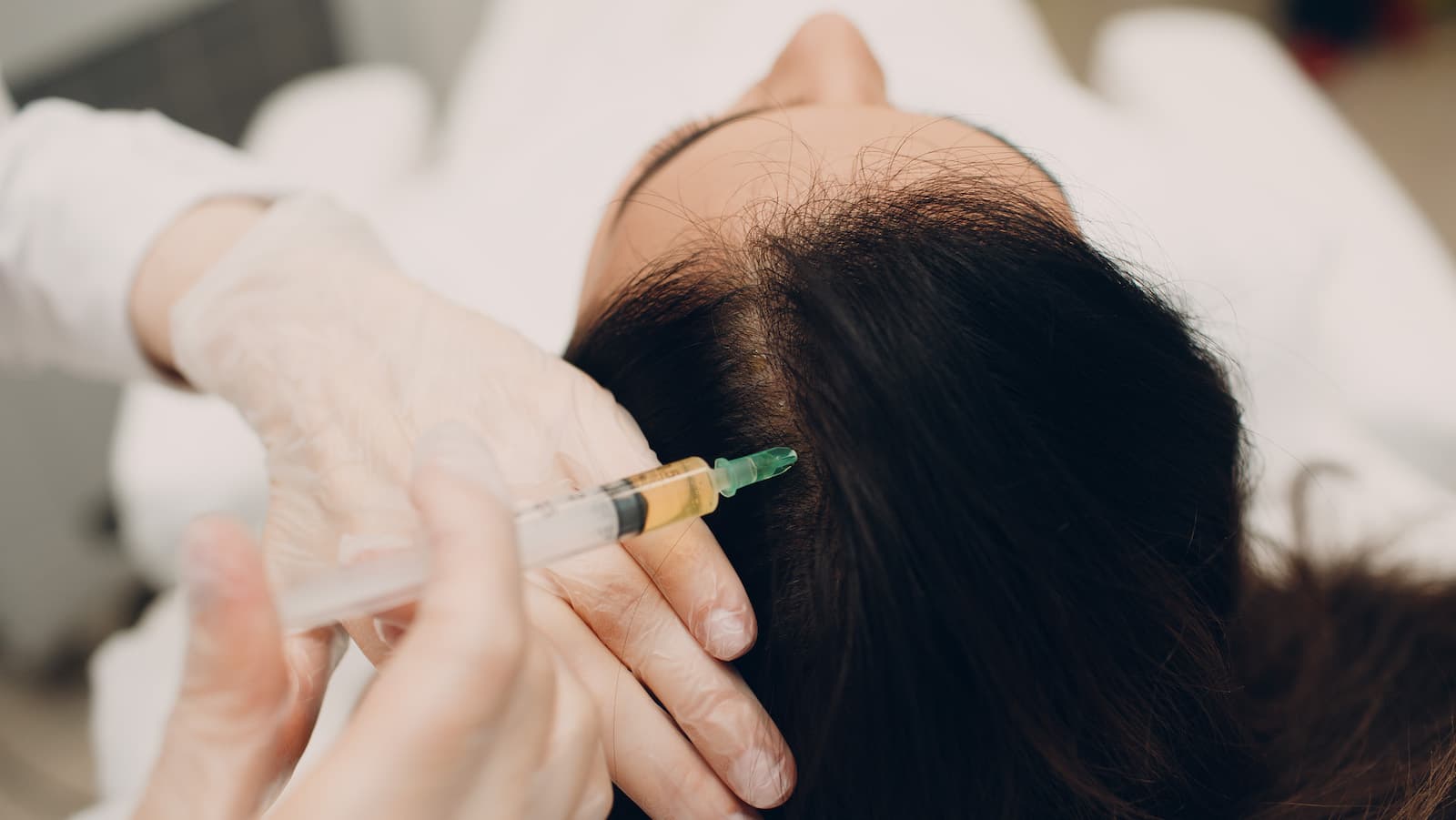
One is made from you and one is not, and that is the axis this decision actually turns on. GFC is prepared from about 10ml of your own blood, processed in the clinic and injected back into the thinning areas. Exosomes are prepared in a laboratory, typically from stem-cell culture, so there is no blood draw at any point.
What is actually in the syringe?
The two treatments are closer in intent than the names suggest. Both put growth signals into a scalp where follicles are weakened but still alive. They differ in where those signals were made.
GFC is autologous — the material starts as your own blood. Around 10ml is drawn at the start of the appointment and processed in-clinic to isolate the growth factors your platelets release, and roughly 4 to 5ml of that concentrate goes back across the thinning areas through fine needles. Nothing synthetic is introduced.
Exosome hair treatment is not autologous. Exosomes are tiny vesicles carrying growth factors and signalling molecules, prepared in a laboratory rather than from you, most commonly from stem-cell culture lines and screened by their manufacturer. There is no draw and no centrifuge step — the vial is readied while anaesthetic cream numbs the scalp, and the injection portion itself runs roughly 20 to 30 minutes.
Does it matter that one comes from my own body?
For a good number of patients it is the whole decision, and it does not need defending. "I want a treatment made from my own blood rather than a synthetic product" is one of the reasons people arrive asking for GFC by name, and a clinic's job is to answer that preference straight rather than talk you out of it.
There is a second thing the autologous route quietly buys, and it is worth being explicit about because it is easy to miss under the newer, shinier option. Blood- derived scalp treatments have simply been in use for longer. That is not our claim about our own treatment — it is what the exosome page itself says, and we would rather it sat in both places.
What the autologous route costs you is straightforward: a needle in the arm, a processing step, and a preparation whose concentration is limited by what your own blood yields on the day.
What do I gain by choosing the lab-prepared route?
Three things, and they are real.
No draw. Some people will not have blood taken, or would simply rather not. That is a sufficient reason on its own, and exosome treatment removes the step entirely.
A higher concentration of signals. Exosomes carry growth factors and signalling molecules at a higher concentration than blood-derived preparations can typically reach. If you have already had a blood-derived treatment and the question in your mind is "what else is there", that is the substantive answer rather than a marketing one.
A shorter course. Exosome treatment typically runs to three or four sessions spaced around four weeks apart. GFC typically runs to four to six sessions, spaced by your doctor, with maintenance roughly every two to three months afterwards. On appointment-count alone, the exosome course is the shorter commitment.
What you give up in exchange is maturity of evidence. The exosome page states it without hedging: the treatment is newer than blood-derived scalp therapy and long-term outcome data is still accumulating. That is not a reason to avoid it — it is a reason to want an honest candidacy assessment rather than a package, and to ask at consultation about the specific product being used, where it comes from and how it has been screened. Those questions have answers, and you are entitled to hear them before anything is bought.
Where do the two agree?
More than a comparison usually admits, and this is the part most likely to change what you actually do.
Both are performed by a doctor, always. Both act on follicles that are weakened but still active, in men and women alike, which makes the earlier and moderate stages of thinning the strongest candidates for either. Neither will do anything for an area that has been bare or scarred for years — GFC supports follicles that are still present, and exosomes signal follicles that still exist; neither can rebuild ones that have gone.
Both take scalp photographs before the first session and reassess density against them at around the three-month mark. Both leave you with no downtime and normal activity the same day. With both, reduced shedding is usually the first change patients notice, and visible density takes months, because hair grows roughly a centimetre a month regardless of what the follicle has been signalled with. No clinic can honestly promise a visible difference in 30 days, and neither treatment can promise regrowth where too little active follicle remains.
The practical consequence: if a doctor examines your scalp and says the follicles are too far gone, choosing the newer option does not rescue the plan. Candidacy is a bigger determinant of your outcome than which of these two you pick.
So who does each one genuinely suit?
GFC tends to fit the patient who wants the material to have come from their own body; the patient who has already tried PRP elsewhere and wants a more concentrated version of the same idea in a usually shorter course; and the patient whose crown is thinning who wants to act while there is still hair there to work with.
Exosome treatment tends to fit the patient who would rather skip the blood draw altogether; the patient whose parting is widening but whose hair is still there, just finer; and the patient who wants the newest option available and is comfortable with an evidence base that is still filling in.
Neither list is a verdict. They are the starting positions people usually walk in with, and they get tested against what the scalp examination actually shows.
Does choosing one rule out the other?
No. Exosome sessions can often sit alongside prescribed medication or other in-clinic regrowth treatments, sequenced by your doctor so the scalp is not overloaded. Bring everything you currently use to the consultation, including over-the-counter products — the sequencing decision depends on it.
Who should not have either?
Neither treatment is carried out during pregnancy or breastfeeding, or where there is an active scalp infection. GFC is additionally not carried out while you are on antibiotics or blood-thinning medication. For exosome treatment, aspirin, anti-inflammatories and blood thinners are usually paused beforehand on your doctor's instruction — which is also why small bruises are more likely if that instruction was not followed.
Disclose all medication at consultation. It is the screening step that both treatments share.
What should I watch for afterwards?
With either, mild soreness, redness, tenderness or itching at the injection points for a day or two is normal and settles on its own. Avoid scratching; a gentle shampoo helps. Strenuous exercise, swimming, steam and direct sun are avoided for two days, and hair products for six hours.
If soreness or redness worsens rather than settles, runs on well past a few days, or the scalp looks or feels infected, contact the clinic rather than waiting for the next scheduled session.
Getting the question answered properly
Provenance is a preference you are allowed to hold, but candidacy is a finding somebody has to make by looking at your scalp. Book an appointment at Indiranagar or Bellandur — ₹500, waived off against treatment — and ask the doctor to tell you plainly how much active follicle you still have before either treatment is discussed.