
Dermaplaning vs Chemical Peel: How to Choose
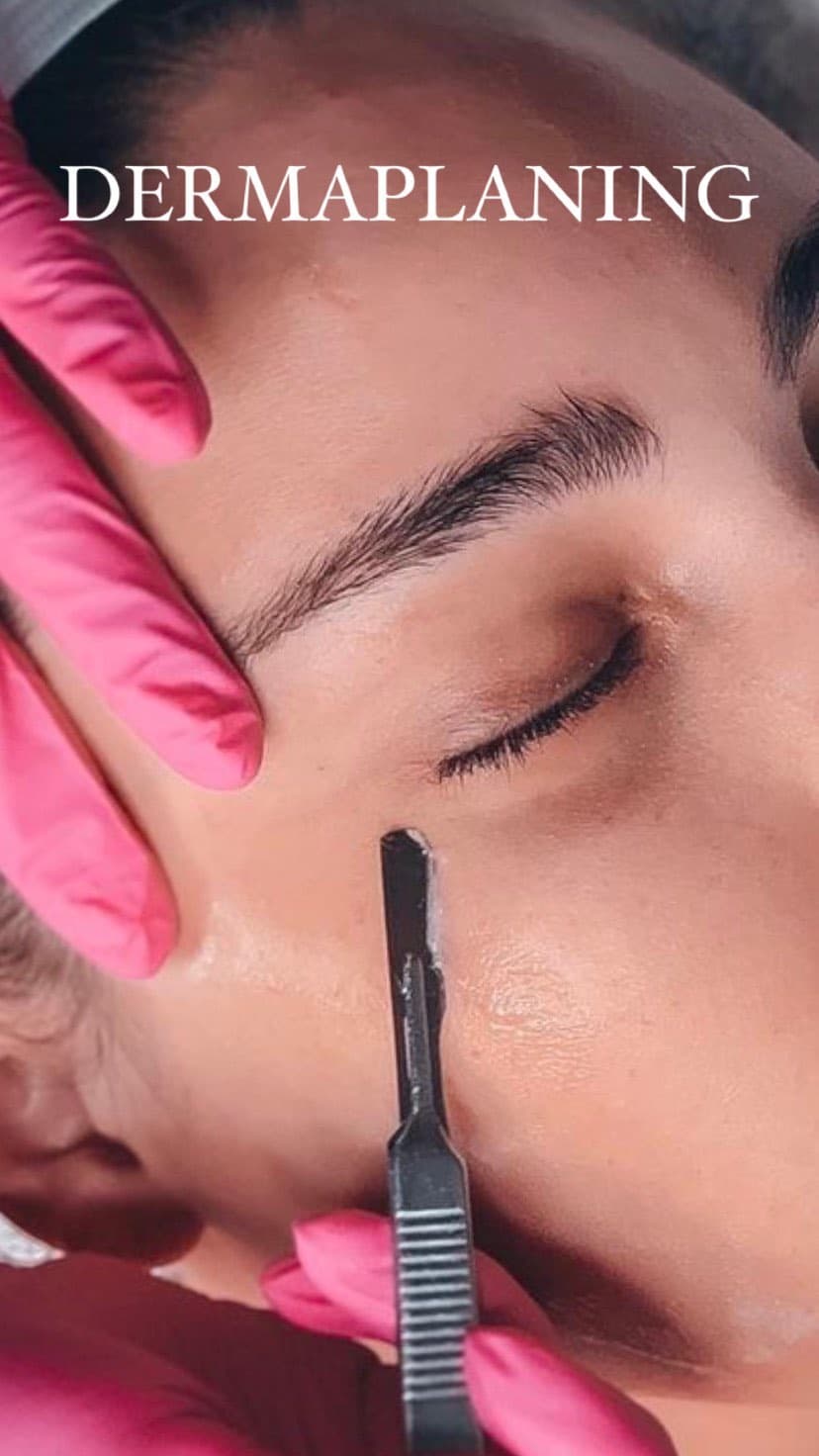
Dermaplaning and a chemical peel both exfoliate, but they answer different complaints. Dermaplaning is a blade that lifts dead surface cells and fine facial hair, with no downtime and a same-day result. A peel is a solution chosen for your skin type that works on marks, tone and texture over a course. Neither replaces the other.
That is the honest headline, and it is why a straight winner does not exist here. What does exist is a fairly clear map of which concerns each one is actually built for. Below, both treatments are described from their own treatment pages — dermaplaning and chemical peel — with the cases each genuinely wins.
What is the actual difference between the two?
One is physical, the other is chemical. Dermaplaning uses a sterile single-use blade held almost flat against the skin, drawn in short strokes while the skin is kept taut, lifting away dead surface cells and the fine vellus hair most people call peach fuzz. The angle and pressure are what make it exfoliation rather than a shave. A session runs 30 to 45 minutes.
A chemical peel uses a controlled solution brushed onto the skin, left in place for roughly three to five minutes depending on the peel, then neutralised. The depth — superficial, medium or deep — and the acid itself are chosen by a doctor for your skin type, after a patch test. That selection is the treatment. As the peel page puts it, a peel that is too strong for your skin type causes pigmentation rather than clearing it.
So the choice is less about which is stronger and more about what you are asking the skin to do.
Which one fits if my complaint is fine facial hair?
Dermaplaning, without much debate. Removing the vellus hair is part of what the blade does, and a peel does not do it at all. If the thing you notice is fine hair catching the light in photographs, or foundation sitting patchy over it, that is the treatment built for the complaint.
The commonest worry attached to this is worth answering directly: the hair regrows exactly as it was, same texture and same colour. Cutting hair does not change the follicle. It can feel blunter for a few days simply because a tapered tip was cut straight across, which is where the myth comes from.
Which one fits if my complaint is acne marks or uneven tone?
The peel, clearly. This is the case dermaplaning does not claim. Peels lift pigmented surface cells and encourage turnover underneath, so post-acne marks and other shallow discolouration read as lighter over a course. Speeding up cell turnover also improves the colour, clarity and brightness of the surface, particularly on sun-dulled skin.
Fine lines follow the same pattern. Medium-depth peels prompt new collagen as the skin repairs, which softens the look of fine lines and shallow age spots over several treatments. Dermaplaning makes no such claim, and it would be misleading to imply it does — its result is surface smoothness and better product absorption, not a change in pigmentation or collagen.
The trade is time. A peel result of this kind is built over a course your doctor sets, typically over several months for superficial peels. It is not a single-appointment answer.
Which one suits congested, breakout-prone skin?
The peel has the genuine advantage here, and dermaplaning has a real restriction. Salicylic and other keratolytic peels clear the pore lining, which helps congested, breakout-prone skin settle between sessions. That is a mechanism the blade simply does not have.
Dermaplaning, meanwhile, is not done over active inflamed spots, pustules or cysts — working a blade across them can spread bacteria and worsen them, which is why active inflammatory acne is a reason to postpone. If your acne is settled and the concern is texture or marks, dermaplaning is often fine. The assessment decides, not the internet.
Both have their own exclusions. Dermaplaning is deferred for active cold sores, sunburn, broken or infected skin, and some skin conditions. Peels are postponed or ruled out in pregnancy and breastfeeding, for certain peels in diabetes, after recent isotretinoin or other acne treatment, and after recent cosmetic surgery that has left the skin sensitive.
Which has less downtime?
Dermaplaning, plainly. There is nothing to recover from: skin looks slightly pink for an hour or two, a soothing serum and sunscreen go on before you leave, and you can wear makeup the same day — usually better than before. That is the main reason patients book it in the run-up to an event.
A superficial peel leaves slight redness or flaking for a few days. Deeper peels flake more and for longer. The treated area can also look lighter or darker than surrounding skin while it settles, and daily broad-spectrum sunscreen is the single biggest factor in whether that resolves cleanly.
Both increase sun sensitivity. After dermaplaning, skin burns more easily for around a week and daily sunscreen is part of the treatment rather than an optional extra. After a peel, you are asked to stay out of direct sunlight for about a week, skip swimming and strenuous exercise for the first 24 hours, and avoid waxing, threading or bleaching for a week.
How often would I be having each one?
Dermaplaning is roughly every three to four weeks, matching the skin's own renewal cycle — going more often exfoliates skin that has not finished rebuilding. The result is visible immediately and holds for about three to four weeks, so the rhythm and the result line up.
Peels work on a schedule your doctor sets. Superficial peels are usually repeated several times over a few months to build a result; medium and deep peels need fewer sessions. Results are long-lasting rather than permanent, and range from months to years depending on depth — with sun protection deciding where in that range you land.
Are both suitable for Indian skin?
Peels are, when the depth and solution are chosen for your skin type by a doctor and a patch test is done first. The peel page is direct about why that matters: deeper pigmented skin is more prone to post-inflammatory pigmentation, which is precisely why the peel is selected after assessment rather than picked off a menu. The patch test is not a formality.
Dermaplaning carries no acid and no depth decision, which removes that particular variable. Its own caution is different: small nicks or grazes are uncommon in trained hands but more likely on uneven or very reactive skin, and they heal within a few days.
What should I watch for afterwards, and when should I contact the clinic?
Contact the clinic rather than trying to judge it yourself — this applies to both treatments.
After a peel, expected recovery is redness, dryness and flaking, and skin that temporarily looks lighter or darker while it settles. Let it shed on its own; picking at flaking skin is what turns a normal recovery into a mark. Scarring, infection and prolonged swelling are uncommon but possible, which is why the aftercare instructions are not optional. If the skin becomes painful rather than tight, if redness spreads or worsens instead of settling, if you see signs of infection, or if anything looks different from what you were told to expect, ring the clinic and describe it.
After dermaplaning, mild pinkness for an hour or two is normal. Get in touch if a nick is not healing over a few days, if an area becomes increasingly sore or inflamed, or if breakouts flare after treatment.
In both cases, please do not self-assess from photographs online. You are looking at your own skin for the first time in this state and have nothing to compare it against. Call the clinic, describe what you are seeing, and let the team decide whether you need to be seen. If something changes outside clinic hours and you are concerned, seek medical attention locally rather than waiting for the clinic to reopen.
What do they cost, and how do I decide?
Dermaplaning is ₹1,999 per treatment. Chemical peels start from ₹2,999 per session, with the actual figure depending on the peel your doctor selects. The consultation is ₹500 for either, waived off against treatment.
The short decision rule: if the complaint is fine facial hair, dull texture or makeup that will not sit flat before an event, dermaplaning is the treatment built for it. If the complaint is acne marks, uneven tone, congestion or fine lines, a peel is the one with the mechanism to address it — over a course, not a session. And if you are unsure which of those describes you, that is exactly what the assessment is for.
The two are also not mutually exclusive. Clearing the surface first helps a peel reach the skin more evenly, which is why dermaplaning is often used as a prep step rather than on its own — but whether that sequence suits your skin, and how it would be spaced, is a decision for your doctor rather than something to plan yourself. Book a consultation and bring the complaint rather than the treatment name.