
Combining Teeth Whitening and Smile Makeover: Order, Spacing and Why
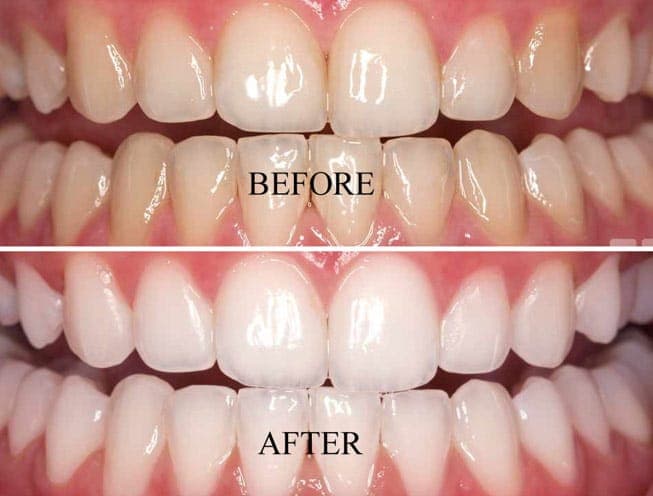
Whitening comes before restorative work, not after. Gum health and decay are treated first, then alignment or whitening, and only then veneers and crowns — because crowns and veneers do not bleach, so the natural shade has to be settled before a restoration can be matched to it. How far apart each stage sits is decided at the planning appointment.
That is the whole answer. The rest of this article is why each step sits where it does, which is worth understanding, because a sequence you have agreed to is much easier to stick with when the reason for it is not a mystery.
Why can the restoration not simply be matched afterwards?
Because the matching is done once, in a laboratory, at the moment the restoration is made. A crown, a veneer or a tooth-coloured filling is built to a shade chosen on the day, and that shade does not change again. Whitening acts on natural enamel only — it will lighten the teeth on either side of a crown and leave the crown precisely where it was.
Do the restoration first and whiten afterwards and you have created the problem you were trying to solve: a front tooth that no longer matches its neighbours, and a restoration that has to be remade to catch up. Doing it in the reverse order costs one appointment more of patience and saves paying for the same crown twice.
What comes before either treatment?
Health does. On a smile makeover the sequence is deliberate — gum health and any decay are dealt with first, then alignment or whitening, then the restorative work. Nothing cosmetic is built on a foundation that has not been checked.
Whitening has the same rule stated its own way: a professional clean comes before the gel, so that it meets clean enamel rather than a layer of deposit, and the examination beforehand looks for decay, cracks and exposed roots. Bleaching over any of those causes real pain. Neither treatment skips this stage for a patient in a hurry, and a plan that offers to is not one to accept.
Where does alignment fit in?
Before the restorative work and before the final shade is locked in. If teeth are going to be moved, their positions need to be settled before anything is made to fit them — a veneer built to a tooth's current position stops fitting the moment the tooth moves. Alignment is also the step that extends a timeline most, which is why it is worth raising at the very first appointment rather than discovering it midway.
Whether alignment is part of your plan at all is decided at assessment. A smile makeover is a plan rather than a fixed procedure list, and which treatments it contains comes out of the examination.
How far apart should the stages be?
Neither treatment sets a fixed interval, and this article is not going to invent one. What is documented is the shape rather than the calendar: whitening is usually one in-clinic session, occasionally two, while a makeover involving restorative work runs across several visits spread over weeks to months depending on what the plan contains.
What your dentist is actually waiting for between whitening and shade-matching is for the colour to be stable enough to match against with confidence. That is a clinical judgement made by looking at your teeth, not a number that can be quoted in advance, and it is exactly the kind of thing to ask at the planning appointment so that you can arrange your own diary around the answer.
What does a trial smile do for the sequence?
It moves the disagreements to the front, where they are cheap. Photographs, study models or a digital mock-up let you and your dentist agree what the result should look like before anything irreversible happens, and temporary restorations let you live with a shape for a while before the final ones are made.
Use it. The mock-up stage is the point at which to say the teeth look too long, too short, the wrong shape or too white — and "too white" is a real answer that people give. Tooth width, length, midline and gum line are assessed against your own features so the result reads as your smile rather than a template, and your opinion is part of that assessment rather than a courtesy.
Which steps can I still change my mind about?
Whitening is additive. Nothing is drilled and no enamel is removed, so a shade you dislike is a disappointment rather than a commitment.
Veneers and crowns are not additive. Enamel is permanently removed to make space for them, and once that is done the tooth will always need a restoration on it. This is the single most important thing to understand before agreeing to a plan, and it is the strongest argument for putting the reversible step first: if whitening alone gets you close enough to what you wanted, the conversation about veneers may not need to happen at all. Where whitening and bonding will achieve the goal, they are preferred to crowns and veneers for exactly that reason.
Can the plan be staged over months rather than done at once?
Yes. A makeover can be phased, and the order matters more than the pace. If the budget or your calendar means the restorative half waits until next year, say so at the planning appointment so the sequence still holds together — a plan that was designed as one block and then split arbitrarily can end up with the shade settled long before the crowns it was meant to inform.
Phasing has one practical consequence worth knowing. Whitening lasts several months to a few years depending on diet, smoking and hygiene, so if the restorative stage is a long way off, your dentist will want to check the shade again nearer the time rather than working from a note made a year earlier.
Who decides the order?
Your dentist does, at the assessment, and the plan is built around what you actually want changed rather than a standard sequence applied to everyone. Both treatments are performed by a dentist, and the consultation is ₹500, waived off against treatment.
Bring the whole list to that appointment — the colour, the chip, the gap, the old filling that never quite matched — even if you assume some of it is not fixable. The value of a planned sequence is that it addresses those together instead of accumulating mismatched work over years, and that only happens if the person planning it knows what is on your list.
To have that conversation, book an appointment at Indiranagar or Bellandur. Bring photographs of your smile from a few years ago if you have them; they are more useful than you would expect.