
Combining IV Drip Therapy and Glutathione Injection: Order, Spacing and Why
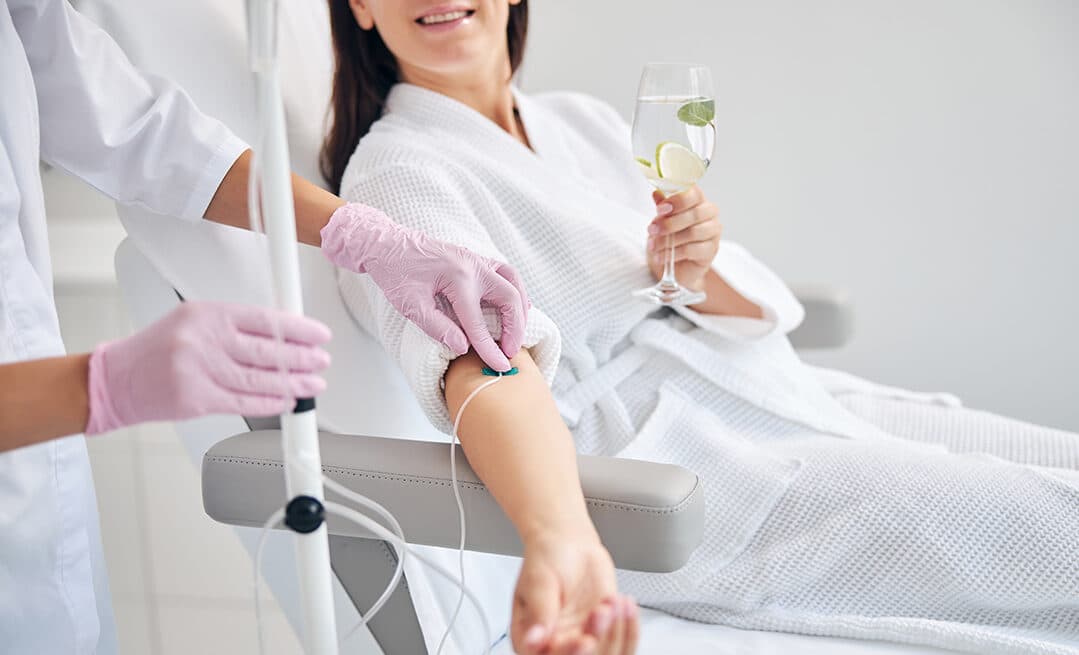
Neither treatment page describes a combined protocol, so there is no fixed order or spacing to quote — a doctor sets both at consultation. What the pages do fix is the shape of the decision: glutathione is a course of around ten infusions over one to three months, an IV drip is scheduled around what it addresses, and an infusion is a real load on the body.
That is an unsatisfying opening if you came looking for a protocol, and it is the accurate one. Combination pieces are usually written as though a sequence exists and only needs explaining. Here it does not, and the useful thing we can do instead is set out precisely what the two treatments commit to, what those commitments constrain, and which questions your doctor is answering when they put the two on a calendar.
What is each infusion actually for?
IV drip therapy delivers fluids, electrolytes, vitamins and minerals straight into the bloodstream, bypassing the digestive system so the dose given is the dose absorbed. Every infusion is made up after an assessment rather than picked from a menu, and it is used for rehydration and electrolyte replacement, nutrient supplementation, immune support, recovery from physical exertion, and supporting skin health from within.
Glutathione is a single antioxidant your liver already produces, and levels fall with age. Given as a supervised infusion, it is used to support the body's handling of oxidative stress and to improve how bright and clear the skin looks over a course of sessions.
One is a formulation; the other is a fixed compound in a course. That distinction drives almost every practical answer below.
Does adding a drip make a glutathione course work better?
We cannot tell you that it does, because nothing on either page says so.
This is the claim a combination article is expected to make, and it is worth naming the absence rather than filling it. Our IV therapy page describes the skin role as supporting skin health from within — the formulations include nutrients involved in skin repair and hydration, which is why patients treating dullness and dehydration are often sent for infusions alongside their topical plan. That is a support role. It is not a statement that a drip improves what a glutathione course achieves, and we are not going to imply one.
What a doctor may reasonably be doing when they run both is treating two things at once — a depletion or hydration problem on one hand, an antioxidant course on the other — rather than stacking two treatments at the same target. If someone offers you a package on the basis that the pair multiplies the effect, ask them where that comes from.
Which treatment sets the calendar?
The glutathione course does, because it is the one with a published structure. Most patients need four to six sessions before change is visible and around ten for a full course, with the change arriving gradually over one to three months — longer on deeper skin tones. Attending the full course as scheduled is part of the aftercare instruction, not an upsell.
IV drip frequency has no fixed schedule at all. Our page is explicit that the interval depends on your requirements, any medical conditions and what you are trying to achieve, and that your doctor sets it at consultation rather than applying a standard timetable.
So in practice the glutathione course provides the spine, and the drips are fitted to it according to what they are for. That is a structural observation, not a protocol — the actual dates are a clinical decision.
Can both be given on the same day?
Neither page addresses same-day administration, so this is a question for your doctor rather than one to plan around in advance. What is worth knowing is what they will be weighing.
Time in the chair. A glutathione infusion runs slowly for the first ten minutes so you can be observed for any reaction, then over a further 45 to 60 minutes if it is well tolerated. An IV drip is around 20 to 30 minutes. Doing both in one visit is not a quick appointment.
Fluid and mineral load. Our own page states it plainly: an infusion is a real fluid and mineral load on the body, and kidney and heart conditions materially change what is safe. Two infusions is a bigger version of that question, not a neutral one.
The observation period. The deliberately slow start to a glutathione infusion exists so that a reaction is caught early. Anything given around it has to leave that observation intact.
How would I prepare for a combined visit?
Assume the stricter set of rules applies, because glutathione's preparation is considerably more specific than the drip's. Arrive well hydrated and having eaten a proper meal, and bring someone with you if you can. Avoid antihistamines for 24 hours beforehand and alcohol for 48. Tell your doctor about any allergy, asthma or medication, and if you are pregnant or breastfeeding.
For the drip side, the assessment covers your general health, skin condition and objectives, and checks for the conditions and medications that change what can safely be infused.
Who should not be having this combination?
Screening is the union of both lists, and the stricter answer governs.
| IV drip therapy | Glutathione infusion | |
|---|---|---|
| Asthma | Not listed as a bar | Not recommended |
| Significant kidney or heart disease | May be unsuitable or need modifying | Assessed as part of history |
| Pregnancy or breastfeeding | May be unsuitable or need modifying | Not offered |
| Known allergy to a component | A reason it may be unsuitable | A reason it is not offered |
| Session length | Around 20 to 30 minutes | 45 to 60 minutes after a slow 10-minute start |
Asthma is the clearest example of why this matters. It rules out the glutathione half outright, and no amount of interest in the combination changes that. Tell your doctor about any respiratory condition or history of allergic reaction before treatment rather than on the day.
Is more infusion simply better?
No, and one line on the glutathione page is the reason to take that seriously: excessive or prolonged use has been associated with reduced zinc levels, which is one reason courses are dosed and scheduled by a doctor rather than taken open-endedly.
That is the whole argument against treating infusions as something you top up whenever you feel flat. It is also why the IV page says outright that an infusion does not replace a proper diet — it is a supplement to a reasonable diet and a working skincare plan, useful where absorption or depletion is a genuine issue, not a substitute for either.
What about skin lightening — the honest position
Glutathione is offered here as an antioxidant treatment aimed at clarity and radiance, not as a way of changing your natural skin colour, and a consultation will say that plainly before money changes hands.
The wider market is built on the opposite promise, so the position is worth stating in full. Using glutathione to alter skin tone is an off-label use: it is not an approved medicine for that purpose. The published studies behind the claim are small, mixed and short, long-term data is largely missing, and the intravenous route carries the greater share of that uncertainty. Results vary between individuals, and no one can promise you a particular outcome.
The related point on aftercare is not a footnote either. An antioxidant infusion is not a substitute for sun protection. Avoid direct sun and heat after a session, and use a broad-spectrum sunscreen daily — that is what preserves any improvement a course achieves.
Aftercare, and when to contact the clinic
After either infusion the site is cleaned and bandaged. Apply ice if there is swelling, keep the site clean and dry, stay well hydrated and include vitamin C-rich foods. There is no downtime with either and most patients resume normal activity straight away, though the site may be tender or bruised for a day or two.
Brief stinging on insertion is expected, as is a mild metallic taste, warmth or a flushed face while an infusion runs — those typically pass quickly. Spreading redness, increasing pain or heat at the site should be reported to the clinic rather than watched at home.
What does it cost, and where do I start?
A glutathione infusion starts from ₹4,999 per session. We deliberately do not publish a course total, because the number of sessions is a clinical decision made after assessment rather than a package sold in advance. IV drip therapy has no published starting price at all, since the infusion is formulated per patient — that figure comes at consultation too.
The consultation is ₹500, waived against treatment, and for a combination it is doing more work than usual: it is where the screening, the sequence and the question of whether you need both at all get settled. If that is the conversation you want, you can book an appointment at either of our Bangalore clinics.