
Combining Exosome Hair Treatment and GFC Hair Loss Treatment: Order, Spacing and Why
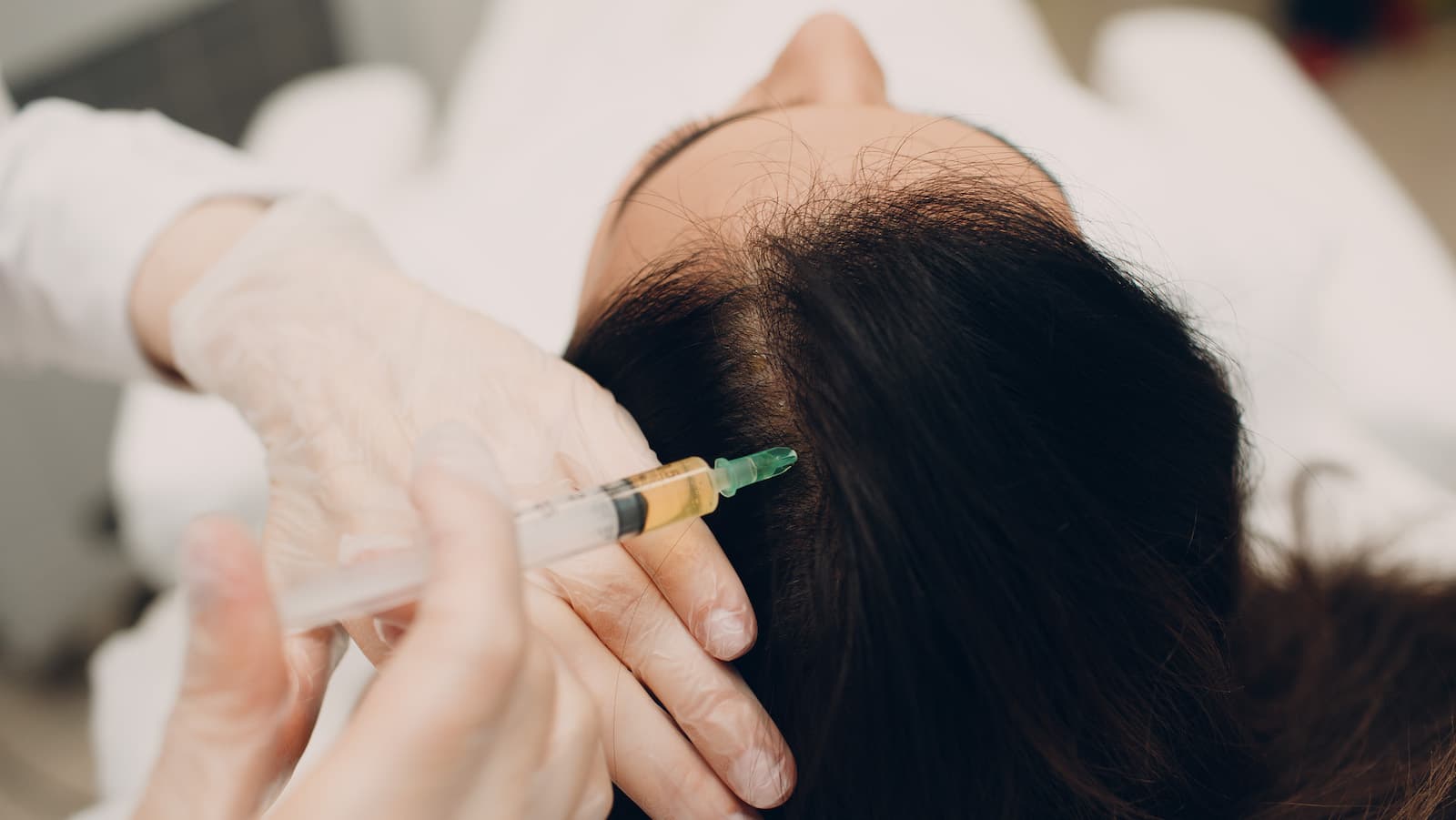
Both are regenerative scalp injections aimed at follicles that are thinning but still active, and the clinic's own answer is that they can often sit together — sequenced by your doctor so the scalp is never overloaded. What that means in practice is that a combination is a scheduling decision. The order and the spacing are set at consultation, not chosen from an article.
Why would anyone have both?
Because they arrive at the same follicle from different directions.
GFC is prepared from your own blood: around 10ml is drawn, processed in-clinic to isolate the growth factors your platelets release, and roughly 4 to 5ml of that concentrate is injected across the thinning areas. Nothing synthetic is introduced.
Exosome hair treatment uses lab-prepared exosomes — tiny vesicles carrying growth factors and signalling molecules, typically derived from stem-cell culture — delivered by fine micro-injections. There is no blood draw and no centrifuge step, and the concentration of signalling factors is higher than a blood-derived preparation typically reaches.
The clinic is also candid about the trade-off between them: blood-derived treatments have been in use for longer, while the research base for exosomes is newer and still growing. That is stated on the exosome page itself rather than buried, and it is a fair thing to ask about.
Does combining them make me a candidate when one alone would not?
No, and this is the most important thing to be clear about before any planning.
Both act on follicles that are weakened but still active. Exosomes signal follicles that still exist and cannot rebuild ones that are gone; GFC is described the same way, suited to early and moderate pattern loss. Areas that have been fully bald or scarred for years are not candidates for either, and two treatments do not change that arithmetic.
So the scalp assessment comes first, and it can end with a doctor telling you that neither is worth your money in the area that bothers you most. That is the outcome a combination plan cannot buy its way past.
What does each course look like on its own?
This is the raw material any sequence has to be built from.
| Exosome hair treatment | GFC | |
|---|---|---|
| Typical course | Three to four sessions, about four weeks apart | Four to six sessions, spaced by your doctor |
| Session time | About 45–60 minutes including numbing | About 30 minutes |
| Blood draw | None — lab-prepared vial | Yes, around 10ml, processed in-clinic |
| Maintenance | Set at review | Roughly every two to three months |
| Review point | Baseline photographs at around three months | Baseline photographs at around three months |
| Downtime | None — normal activity the same day | None — normal activity the same day |
| Performed by | A doctor, always | A doctor, always |
Neither course length is fixed at the outset. Both are reviewed at the three-month mark against your baseline photographs and adjusted from there, which matters here: a combination plan is not a longer fixed programme, it is two adjustable ones sharing a review date.
What actually constrains the order?
Three practical things, all of them documented on the treatment pages rather than invented for this article.
The medication pause. GFC asks you to pause aspirin, anti-inflammatories and blood thinners for 48 to 72 hours beforehand, on your doctor's instruction. That is a preparation window a session needs booking around. The exosome page carries no equivalent pause requirement, though it does note that bruising is more likely if blood-thinning medication was not paused as instructed.
The recovery instructions overlap. After GFC you are asked to avoid aspirin and anti-inflammatory medication for three days, strenuous exercise, swimming and direct sun for two days, and hair products for six hours, and to use a pH-balanced shampoo for the first three days. Bruising, redness, itching or mild pain can last two to five days. After exosome sessions, strenuous exercise, swimming and direct sun are avoided for two days and hair products for six hours, with redness and tenderness settling within a day or two. Stack two sessions closely and you are stacking those instructions, not halving them.
The appointment shape. One of these needs a draw and a spin; the other needs a vial readied while numbing cream sits for 30 to 45 minutes. Those are different lengths of visit and different things to fit into a working day.
What none of the above tells you is which should come first. The pages do not say, and neither will this one.
Why does spacing matter more than order?
Because the instruction the clinic actually gives about combining is about load, not sequence: sessions can sit alongside prescribed medication or other in-clinic regrowth treatments, sequenced by your doctor so the scalp is never overloaded.
Read that carefully and it is a spacing rule. A scalp that has just had a grid of fine injections has aftercare running for two to five days, and both treatments ask you to leave it alone during that window. Whatever order your doctor chooses, the interval is doing the work of keeping the scalp inside its own recovery instructions.
If you want a specific number of days between them, ask for it at consultation and have it written into your plan. Do not take one from a video.
Is a single visit for both ever an option?
The cores do not say, so neither will we. Put the question to the doctor directly at consultation, and if the answer is yes, ask what the combined aftercare then looks like — because that is the part that changes for you.
If the plan works, would I know which part did it?
Honestly, in a combined plan, you may not be able to separate them, and that is worth accepting up front rather than being disappointed by later.
What both treatments do give you is a measured answer to whether the plan is working. Scalp photographs are taken before the first session on both pages, so change at review is measured rather than recalled, and both reassess density at around three months. That review is the decision point: what continues, what stops, what the maintenance rhythm becomes.
On what to expect before then — reduced shedding is usually the first change patients notice, and visible density takes months, because hair grows roughly a centimetre a month regardless of what the follicle is signalled with. The exosome page says plainly that no clinic can honestly promise a visible difference in 30 days, and that regrowth cannot be promised at all where too little active follicle remains. Both statements apply to a combined plan as much as to either treatment alone.
What does combining them cost?
GFC is priced from ₹6,499 per session at this clinic. Exosome hair treatment has no published starting figure, so that number comes from the doctor at consultation.
No total is offered here, and that is deliberate rather than coy: neither course has a fixed session count at the start, so any figure calculated in advance would be a guess dressed up as a price. Ask for the plan and its cost together, once your scalp has been examined.
What should I bring to the consultation?
Bring whatever you currently use, including over-the-counter products — the exosome page asks for exactly that, and a plan built without it is built on incomplete information. Bring your full medication list too, since the pause requirement above depends on it.
Say plainly if there is something you want ruled out: no blood draw, no medication, no long programme. Those are legitimate constraints and they change what a sensible sequence looks like.
Neither treatment is carried out during pregnancy or breastfeeding, or where there is an active scalp infection, and exosome therapy is also not carried out alongside certain medications. If anything after a session concerns you, contact the clinic rather than waiting to see whether it passes.
Where to start
Start with the assessment, because it decides all three questions this article has deliberately left open — whether both are worth having, in what order, and how far apart.
A consultation is ₹500, waived against treatment, and includes the scalp examination and the baseline photographs that every later decision is measured against. Book a consultation and have the sequence written for your scalp rather than assembled from one.