
Combining Braces & Aligners and Teeth Whitening: Order, Spacing and Why
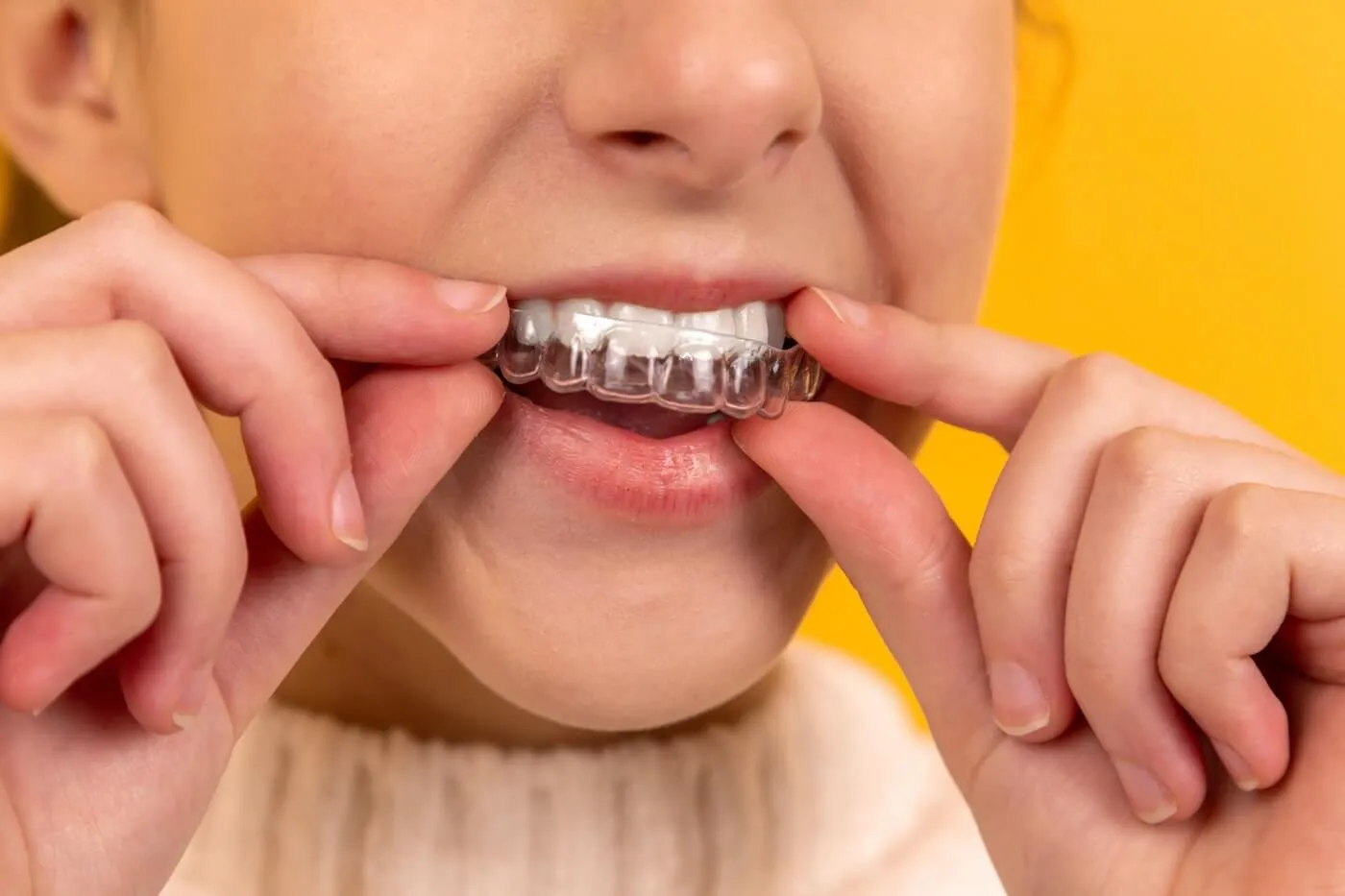
Alignment comes first and whitening comes last. Teeth are straightened over months, the appliance is removed, a retainer is fitted, and only then is the shade addressed — after a scaling and polishing, on enamel that is finally fully exposed and clean. Any crowns or tooth-coloured fillings in the smile line are matched to the new shade afterwards, not before.
That is the short version. The reasoning behind it is worth understanding, because most people arrive wanting both and assume the two can simply be booked in the same month.
Why can't I whiten my teeth while I'm wearing braces?
Fixed braces work by bonding brackets to the tooth surface and running a wire between them. Professional whitening works by applying a peroxide gel directly to the enamel, with the gums isolated and protected first. The two do not overlap comfortably: the enamel underneath a bonded bracket is covered for the whole of treatment, and a gel applied to the visible surface is not reaching it.
There is a second reason, and it is the one dentists actually worry about. Fixed braces trap food and plaque around the brackets. The braces and aligners core is blunt about it — without careful brushing and flossing there is a real risk of decay and white marks on the enamel. Adding a bleaching agent to a mouth that is already struggling to stay clean is not solving that problem, and whitening over untreated decay or exposed root surfaces causes genuine pain rather than a brighter smile. The pre-treatment examination exists to catch exactly that, which is why it is not a formality.
Do clear aligners change the answer?
Partly. Aligners are removable trays, taken out to eat and to brush, so the enamel is never permanently covered the way it is under a bracket. That removes the physical obstruction. It does not remove the sequencing logic.
Aligners only move teeth while they are actually in the mouth — they are designed to be worn for the large majority of the day and night, and inconsistent wear extends treatment. Anything that gives you a reason to leave them out, including a period of the tooth sensitivity that commonly follows whitening, is working against the treatment you are already paying for and waiting through.
If you are in aligners and want to discuss whitening at some point during the course rather than after it, that is a reasonable conversation to have with your dentist. It is a case-by-case judgement about your teeth and your wear consistency, not a rule that applies to everybody, and this page is not the place it gets decided.
How long do I actually have to wait?
Long enough that it is worth planning around. Braces are typically worn for around 18 to 36 months. Aligner treatment, in suitable cases, takes roughly 6 to 18 months. Your dentist gives a case-specific estimate at the planning appointment, once the X-rays and the scan or impressions have shown how much movement is needed.
Whitening, by contrast, is usually a single in-clinic session and sometimes two, with no downtime beyond avoiding strongly staining foods and drinks for a couple of days while the enamel rehydrates. So the two halves of the plan are not remotely comparable in scale. One is a project measured in years; the other is an appointment.
This matters most for the patients who come in with a date in mind. If there is a wedding, a shoot or a new job in three months, whitening can realistically be part of that timeline and orthodontic treatment usually cannot. Being told that plainly at the first appointment is more useful than being told it eighteen months in.
Why is a clean done before whitening, and does that change after braces?
A scaling and polishing appointment is normally done before whitening so that the gel makes contact with clean enamel rather than with a layer of deposit. That is standard for anyone. It is more pointed after fixed braces, because the areas around where the brackets sat are precisely the places plaque has been hardest to reach for the past two or three years.
Bangalore adds its own layer here. Years of filter coffee and chai are the single most common reason patients ask about whitening at all, and neither habit pauses for orthodontic treatment. What accumulates over an 18 to 36-month course of braces is not only alignment — it is also staining, laid down around fixed brackets that were awkward to brush.
If inadequate cleaning during braces has left white marks on the enamel, tell your dentist before whitening rather than after. Whitening does not respond uniformly to every kind of discolouration: staining from tetracycline, fluorosis, trauma or a dead nerve responds poorly or unevenly to external bleaching, and part of the assessment is identifying what is actually causing the colour you are unhappy with. A dentist who has examined your teeth will tell you what to expect before any gel is applied, which is the point of agreeing a realistic target shade in advance.
What about crowns, veneers and tooth-coloured fillings?
This is the part of the sequence people most often get the wrong way round. Whitening only affects natural enamel. Crowns, veneers and tooth-coloured fillings do not bleach. If you have visible restorations in the smile line and you whiten the teeth around them, the restorations can end up looking darker than everything else.
The order that solves this is: straighten, then whiten, then match. Restorations are often replaced afterwards to match the new shade, once there is a settled shade to match to. Replacing them first, against the colour your teeth are today, means matching to a target you are about to move.
If a fuller cosmetic plan is on the table, say so at the orthodontic assessment rather than at the end. It changes what the finished result is being planned towards.
Will my teeth be sensitive if I do both?
Some soreness is expected from the orthodontic side. Teeth feel tender for a few days after braces are placed or tightened, and after each new aligner tray, and it settles on its own. Brackets and wires can also rub the inside of the cheek or lip early on, which orthodontic wax helps with until the mouth adapts.
Whitening has its own, separate effect: tooth sensitivity is the most common one, usually a reaction to cold for a day or two, typically resolving on its own, with a desensitising toothpaste helping. Brief gum soreness or whitening of the gum margin can happen if any gel contacts soft tissue, and settles quickly.
Neither list is alarming on its own. Both are worth keeping separated in time rather than stacked, and if you already know your teeth run sensitive, say so before whitening is planned — sensitivity can be managed with a desensitising regimen before and after, or with a gentler protocol over more sessions.
Contact the clinic if soreness after an adjustment does not settle in the usual few days, if a bracket or wire is causing persistent injury inside the mouth, or if sensitivity after whitening carries on beyond a couple of days. These are things a dentist should look at rather than things to wait out.
What holds the result once both are finished?
Two different maintenance jobs, and they are easy to confuse.
The alignment is held by a retainer. Teeth naturally drift back toward their original positions after treatment, so the retainer is part of the treatment rather than an optional extra — relapse without one is the single most common reason orthodontic results are lost.
The shade is held by habit. Whitening results usually last several months to a few years, and it depends heavily on diet, smoking and oral hygiene. Heavy tea, coffee or tobacco use shortens it considerably. Nobody can promise a permanent shade, and any page that suggests otherwise is not describing how enamel staining works.
Where does the plan actually get decided?
At an examination. The orthodontic assessment involves X-rays and impressions or a digital scan to map current tooth positions and the bite, and it produces a plan setting out which appliance suits the case, the expected duration, and what the finished result should look like. The whitening assessment is separate: teeth and gums are checked, the cause of the discolouration is identified, and a realistic target shade is agreed.
Both are carried out by a dentist. Both consultations are ₹500, waived off against treatment.
If you want straighter teeth and a brighter shade, bring both goals to the same appointment rather than treating them as two unrelated errands. The order is not a matter of preference, and it is much easier to plan forwards than to unpick afterwards.
Book a consultation and have the sequence set out for your case before anything is bonded or bleached.