
Clear Aligners as an Adult: What Actually Changes vs Getting Braces as a Teenager
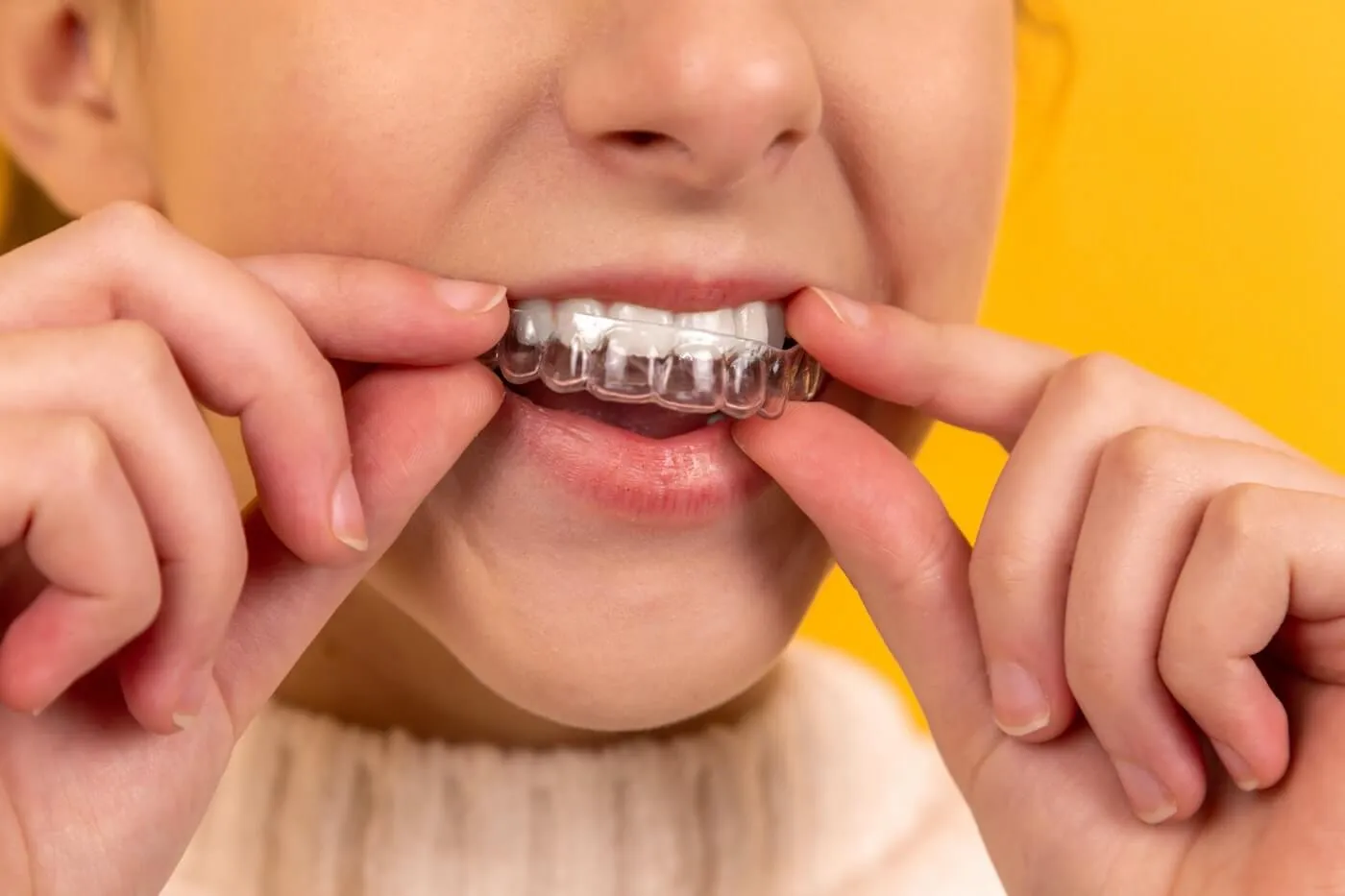
Two things decide whether clear aligners work for you as an adult, and neither is your age. The first is whether your particular misalignment can be corrected with removable trays at all — some cases can only be treated properly with fixed braces. The second is whether your daily routine lets you actually wear them, because aligners only work while they are in your mouth.
Most adults arrive with a different question, usually some version of whether they have left it too late. The more useful conversation is the one above, and it is worth having properly before you commit to anything.
What is the actual difference between braces and aligners?
Both move teeth using steady, gentle pressure over months. The difference is how that pressure is delivered.
Braces are brackets bonded to the teeth and connected by a wire, applying continuous pressure that you cannot interrupt. Clear aligners are removable custom trays, swapped every few weeks, that you take out to eat and brush.
Braces & Aligners covers both, and the honest framing on that page is the one to carry into a consultation: which suits you depends on what needs correcting, not on preference alone. Braces handle a wider range of complex movements. Aligners are discreet, but only work while they are actually being worn.
Timelines differ too. Braces are typically worn for around 18 to 36 months depending on the case. Aligner treatment, for suitable cases, takes roughly 6 to 18 months. Your dentist gives a case-specific estimate at the planning appointment, and that estimate is worth more than any range on a website.
Will aligners even work for my case?
That is the first question to ask, and you should ask it plainly.
It depends on the type and severity of the misalignment, on your bite, and on your routine. Some cases can only be treated properly with fixed braces, and a dentist should tell you honestly when aligners are not suitable for yours.
If you get an unhesitating yes to aligners before anyone has properly assessed your bite, treat that as a reason to slow down. The discreet option is not automatically the right one, and a plan built around what you would prefer rather than what your teeth need is a plan that disappoints slowly, over a year and a half.
Can a working adult realistically keep up with them?
This is the part worth being honest with yourself about. Aligners must be worn for most of the day to work. They come out to eat and to brush, and every time they come out, the clock stops.
For a working adult in Bangalore, that plays out in specific ways. Lunch with the team, the coffee you did not plan on, an evening out that turns into dinner, a long commute where snacking is the only entertainment — each of those is trays out and then back in. None of it is a problem in itself. It becomes one when the trays stay in a case on your desk until the next morning.
Set against that, there are real advantages in the same routine. The trays are near-invisible, which is genuinely why many adults choose them over fixed brackets. Nobody on a video call will notice. You can take them out for a presentation if you want to.
So the question is not whether you could wear them. It is whether you will, consistently, for six to eighteen months. If the honest answer is that your days are chaotic and you would rather not have to think about it, fixed braces remove the decision entirely, and that is a legitimate reason to choose them.
What are you actually fixing?
Worth knowing, because adults sometimes arrive thinking of this as purely cosmetic, and it usually is not.
Steady pressure moves teeth through the bone into planned positions, closing gaps and unwinding crowding so the arch lines up evenly. Beyond appearance, overbite, underbite, crossbite and open bite are bite problems rather than cosmetic ones, and correcting them spreads chewing force more evenly across the teeth.
That matters more with time. Teeth that meet badly wear unevenly and can chip or become sensitive. Aligning the bite takes concentrated load off individual teeth. Overlapping teeth also trap plaque where a brush and floss cannot reach, which raises the risk of decay and gum inflammation — so straighter teeth are simply easier to keep clean.
And if the reason you are reading this is that you do not like how your teeth look in photographs, that is a legitimate reason on its own. The functional gains come with it.
What happens during and after?
Expect regular adjustment or progress appointments throughout, whichever route you take. Plan for those — they are routine, short, and the thing most likely to slip in a busy calendar.
There is usually some soreness when braces are first fitted or adjusted, and for a day or two after each new aligner tray. It generally settles within a few days.
Afterwards, a retainer is needed to hold the result. This is not optional and not a sales line. Finishing eighteen months of treatment and then not wearing a retainer is the most common way people lose what they paid for.
Everything is carried out by a dentist. If gum health or cleaning comes up during the assessment, Scaling & Polishing may be discussed as groundwork. If your concern is the overall look of your smile rather than alignment specifically, Smile Makeover is a different conversation with its own page.
The two questions to take with you
Ask whether your case can genuinely be treated with aligners, and ask what daily wear time your plan assumes. Then be honest with yourself about the second one before you answer the first.
To get both answered properly, book an appointment at our Indiranagar or Bellandur branch. Describe your actual day at that appointment, not an idealised version of it — it changes which option a dentist will recommend.