
Chemical Peel: The Myths Worth Clearing Up Before You Book
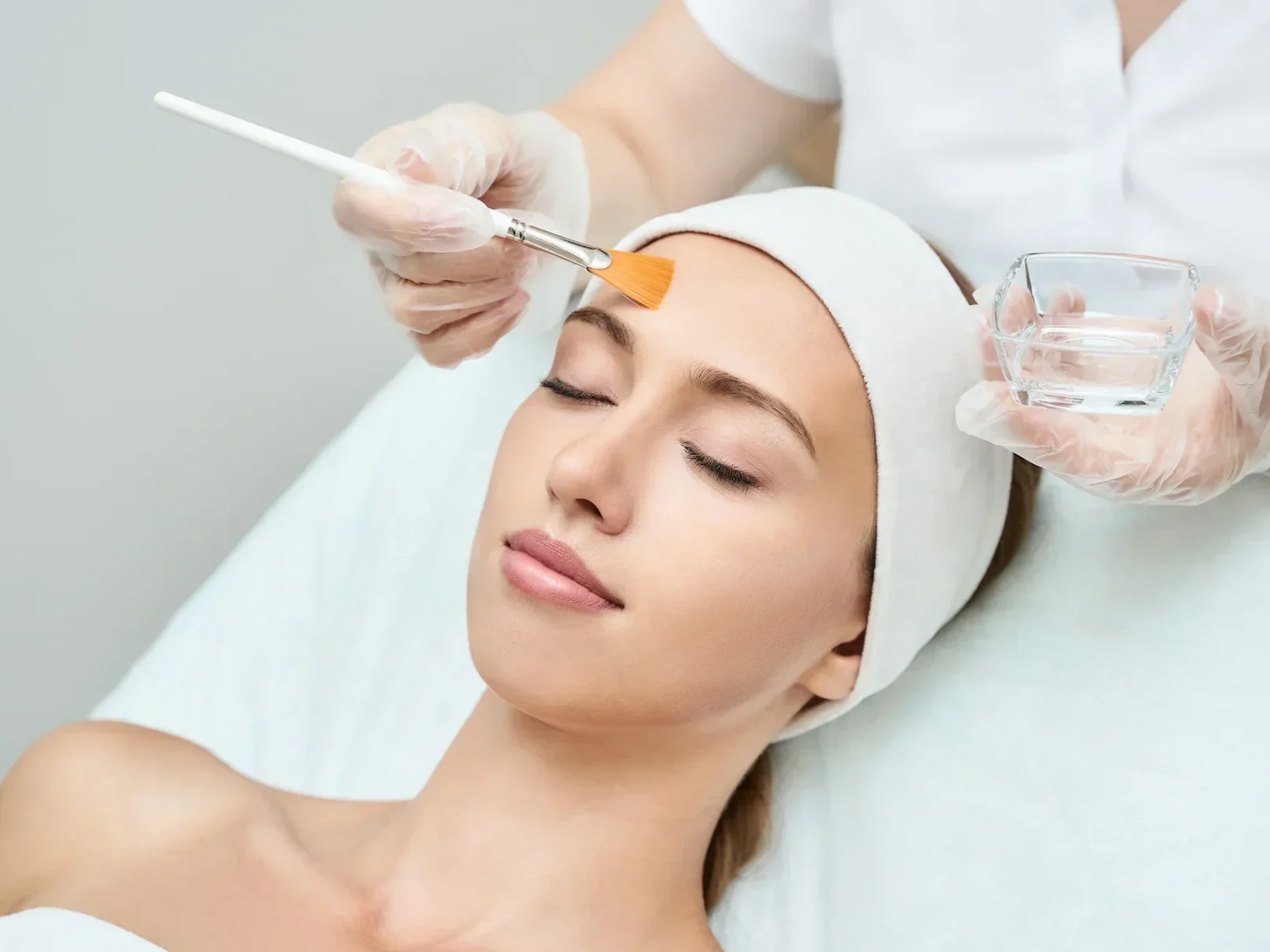
Almost every chemical peel myth traces back to one error: imagining the deepest peel that exists and assuming it describes all of them. A superficial peel is a few minutes of solution followed by a few days of light flaking — nothing sheets off. The corrections that genuinely change expectations are about depth, about who gets to choose it, and about what a peel will not do however many sessions you book.
Here are the eight that come up in consultation most weeks.
Does a chemical peel make your whole face come off?
No. After a superficial peel most people have slight redness or some flaking for a few days, and that is the whole of it. The dramatic images that circulate online are deep peels, which are a different treatment in everything except name.
The appointment itself is undramatic too — the solution stays on for roughly three to five minutes, varying by peel, before it is neutralised. What varies between depths is the recovery, not the theatre of the procedure. Deeper peels flake more and for longer, which is exactly why depth is discussed with you rather than sprung on you.
Is the yellow peel called that because of a dye?
It is not. The yellow colour comes from the retinol or retinoic acid in the formulation itself, not from anything added for appearance. It is a retinoid-based peel, used mainly for pigmentation, melasma, dullness and fine lines.
Its other distinguishing feature is more practical than cosmetic. Instead of being neutralised in the clinic after a few minutes, it stays on the skin for several hours and you wash it off at home at a time your doctor specifies. The flaking that follows is more visible than after a superficial peel, usually showing up around the second to fourth day, and the renewal it prompts reaches deeper. Whether it suits your skin, and at what strength, is settled at consultation.
Is a deeper peel a faster route to the same result?
It is a different trade, not a shortcut. Greater depth means a longer recovery and a wider margin for error — TCA, for instance, works deeper and asks for more downtime in exchange.
Depth is a medical decision for that reason. A peel pitched too strong for your skin type produces pigmentation rather than clearing it, and the rare complications that do exist — scarring, infection, prolonged swelling — sit at the deeper end of the range. "Give me the strong one" is not a request a good clinic should simply grant.
Are chemical peels unsafe for Indian skin?
They are safe when the depth and the solution are chosen for your skin type by a doctor and a patch test is done first — which is a genuine answer rather than a reassuring one, because the conditions in it are load-bearing.
Deeper pigmented skin is more prone to post-inflammatory pigmentation. That is precisely why a chemical peel here is selected after an assessment rather than picked off a menu, and why the patch test happens before the first full treatment without exception. The myth to discard is that Indian skin cannot have peels. The half-truth worth keeping is that the choice matters more.
Can I ask for the same peel my friend had?
You can ask; you may well not get it, and that is the system working. The agent is chosen at consultation, not selected from a list — salicylic for oily, congested, breakout-prone skin, glycolic and lactic for dullness and uneven tone, mandelic where a gentler option suits a deeper skin tone, TCA for work at greater depth.
Strength and area are decided the same way, including whether the peel goes across the whole face or is used as a spot treatment. Two people describing the same complaint can reasonably walk out with different peels, because the complaint is only one of the inputs. Your friend's skin type, history and sun exposure are the others, and none of them transfer.
Will one session clear my acne marks?
No, and expecting it to is the commonest source of disappointment with peels. Superficial peels are repeated several times across a few months, because each one lifts pigmented surface cells and encourages turnover underneath — the effect is cumulative rather than delivered in a single appointment. Medium and deep peels need fewer sessions to get there.
What often does change quickly is texture, frequently after one peel. So the honest expectation for a first session is that your skin will feel different before it looks different, and that the marks are a months-long project. Your doctor sets the schedule after seeing how your skin responds.
Do chemical peels get rid of acne scars?
Marks and scars are two different problems, and peels address one of them. Flat brown or red discolouration left behind after a breakout is pigment, and peels are commonly used for it across a course. True acne scars are a change in the texture of the skin, and a peel on its own is not the usual answer.
This is not a distinction you should have to make yourself — your doctor will tell you which of the two you have, and it is often not obvious in a mirror. Where the problem is textural, microneedling works by a different mechanism, building new collagen and elastin through the scar rather than resurfacing above it. And if what you actually want is a more even-looking tone rather than resurfacing at all, BB Glow is a separate conversation again.
Are the results permanent, and can I stop the sunscreen afterwards?
They are long-lasting rather than permanent, ranging from months to years depending on the depth used — and sun protection is the main factor deciding where in that range you land. So the second half of the question answers itself.
There is a shorter-term version of the same rule. The treated area can look lighter or darker than the surrounding skin while it settles, and daily broad-spectrum sunscreen is the biggest influence on whether that resolves cleanly. Direct sunlight is avoided for about a week afterwards, and swimming and strenuous exercise for the first 24 hours.
One more correction while we are here: it does not hurt the way people brace for. Most patients describe tingling or warmth for the few minutes the solution is on, and relief once it is neutralised. Deeper peels are more intense, and that is discussed with you before you agree to one.
What is actually worth checking before you book?
That someone will examine your skin, take a history and patch test before committing to anything — and that they will tell you if a peel should wait. Pregnancy and breastfeeding, diabetes for certain peels, recent isotretinoin or other acne treatment, and recent cosmetic surgery all change what can safely be used.
Sessions start from ₹2,999 per session, with course length settled after an assessment rather than quoted in advance. The consultation is ₹500, waived against treatment. If you have been putting a peel off because of something you read, book a consultation and put the specific worry to a doctor — some of them turn out to be true for your skin, which is worth knowing too.