
Botox vs Thread Lift: How to Choose
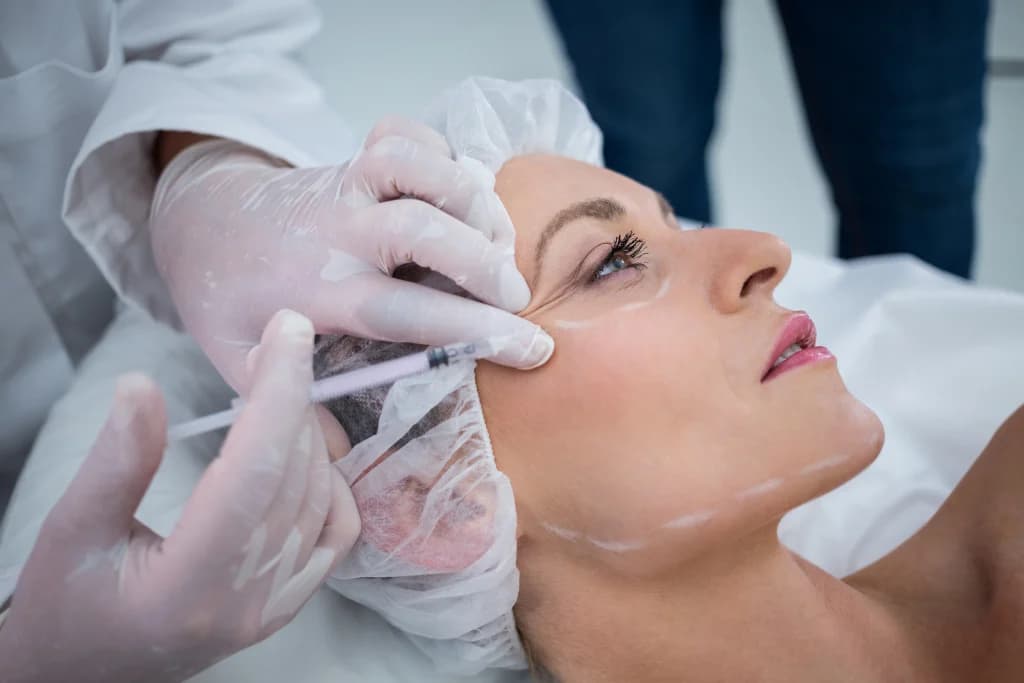
Choose Botox when the problem is a line your own muscle keeps folding into your skin — forehead lines, frown lines, crow's feet. Choose a thread lift when the problem is tissue that has slid downward and needs repositioning: a softened jawline, cheeks that have dropped. One quietens a muscle; the other physically moves tissue and holds it. Neither substitutes for the other.
People usually arrive having decided already, and usually on the wrong basis — which sounds less invasive, or which a friend had. The useful question is much narrower than that: is your complaint a fold, or a slide?
What is each one actually doing under the skin?
They work at different depths on different structures.
Botox is a purified botulinum toxin placed with a fine needle into specific muscles. It temporarily reduces how hard those muscles contract, and because the muscle is what folds the skin above it, the skin creases less. It adds nothing and lifts nothing; it lowers the amount of pulling.
A thread lift uses fine dissolvable threads placed under the skin and drawn along planned directions to reposition tissue that has descended. The threads are anchored, so the lift is mechanical — and as they absorb over time they provoke a collagen response along their path, so firmness can keep improving for some weeks after the lift itself.
Which areas does each one reach?
Botox is scoped to lines made by movement: horizontal forehead lines, the vertical frown lines between the brows, and crow's feet at the outer corners of the eyes. Crucially, only dynamic lines respond well. At assessment the doctor sorts your lines into dynamic and static, and a line that is fully present on a completely still face is not one relaxing a muscle will lift.
Threads are scoped to descent and laxity. The mid-face and cheeks are among the areas they suit most, because as the cheek pad drops it flattens the cheekbone and deepens the fold beside the mouth. The jawline is the other commonly requested area, where threads lift softened tissue back toward the angle of the jaw. Threads are also used to lift the brow tail for a fox eye, and along the nasal bridge in a nose thread lift.
When does each one show, and how long does it hold?
The timetables are close to opposite, and this alone decides some cases.
With Botox nothing happens immediately. Changes usually begin at around four to seven days and settle by about two weeks, which is when the doctor reviews the result and adjusts any point that has taken unevenly. It then typically lasts three to six months before the muscle gradually returns to its usual movement.
With a thread lift the lift is visible during the procedure itself and at the end of the appointment, then continues improving as collagen builds. It generally holds for several months to around a year, depending on the thread type, the area and your own skin — and the collagen laid down along the way can outlast the threads, which dissolve and need nothing removed.
What is the appointment like on each side?
Botox is the shorter one: roughly fifteen to thirty minutes, a brief sting at each marked point rather than pain, and numbing cream beforehand if you would prefer it. Downtime is minimal and most patients go straight back to the rest of their day.
A thread lift is an in-clinic appointment typically under an hour, performed under local anaesthetic — no general anaesthetic and no overnight stay. Most patients describe pressure and pulling rather than pain, and go home the same day.
What does the week afterwards ask of you?
This is where the two genuinely part company, and it is worth planning around.
After Botox the week is mostly waiting. Small red bumps at the points usually settle within an hour or two, and the effect arrives on its own schedule while you carry on.
After a thread lift, expect mild swelling, bruising or a feeling of tightness for a few days, generally resolving within about a week. You are asked to avoid vigorous facial movement, facial massage and sleeping face-down for the first week, and to skip strenuous exercise for a few days. Tightness and a pulling sensation in the early days are normal as tissue settles into its new position.
When is Botox the right answer?
When the complaint is a line you can watch appear as you move, and when you want something reversible. It is temporary by design, so a first treatment is a comparatively low-commitment way to see whether you like the result — and if you stop, the effect simply wears off and the lines return to how they were rather than worse. It is also the shorter appointment with less asked of you afterwards.
When is a thread lift the right answer?
When gravity rather than expression is the problem, and when you want to see the change the same day. It gives a modest, visible repositioning that creams and facials cannot produce, without the incisions and recovery of surgery.
It is honest to say the degree of lift is modest by design. For mild to moderate laxity in skin of reasonable quality that is exactly the point — the result reads as rested rather than altered. Beyond that range a thread lift disappoints, and the assessment exists to tell you so before you book rather than after. A surgical facelift is a far larger and longer-lasting change; if that is what you need, you should be told.
What can go wrong on each side?
Botox: tiny raised bumps and mild redness at the points, usually settling within an hour or two; occasional bruising, more likely on blood thinners or fish oil, generally clearing within days; and uncommonly, temporary heaviness or asymmetry as the effect settles in the first fortnight, which the two-week review exists to correct.
Threads carry a longer list because something is physically placed. Swelling and bruising are common in the first days. Small puckering or dimpling can appear along a thread's path early on; it usually settles, but tell your doctor if it persists rather than waiting. Infection or thread extrusion is uncommon but possible. And circulation problems, particularly in the nose, are rare but are the reason a nose thread lift is a doctor's procedure — threads on the nasal bridge sit close to the vessels supplying the overlying skin.
When to contact the clinic rather than manage it at home. After threads: increasing pain, redness or discharge at an entry point; puckering that is not settling; and — after any nose treatment — severe pain, blanching or a dusky colour change, which should be reported straight away rather than left to see if it settles. After Botox: a bruise deepening rather than fading, redness increasing rather than settling, or any weakness that seems to spread beyond the treated area, or difficulty with swallowing, breathing, speaking or vision. Do not spend the evening working out whether it counts; that assessment is ours.
Who is ruled out of each?
Both are unsuitable during pregnancy and breastfeeding, and both are postponed where there is an active infection at the site.
Beyond that they differ. Botox is not advised with certain neuromuscular conditions, and all medication including blood thinners has to be disclosed. Threads are additionally not advised where there is skin cancer, or where laxity is significant enough that a different approach would serve you better.
What do they cost, and why is neither a flat price?
Because both are billed by the piece rather than by the procedure.
Botox is dosed and billed in units, from ₹299 per unit, and the unit count follows the area and how strong the muscle is. A thread lift is priced per thread, from ₹399 per thread, because the number of threads depends on the area treated and how much lift is planned — a single-area lift uses far fewer threads than a full-face plan. You are given the exact thread count and total at the consultation, before anything is done.
A consultation is ₹500 either way, waived off against treatment.
Can you have both?
Often, yes, and a combined plan is common because the two address different problems. Sequencing is a decision for your doctor rather than something to arrange yourself, and there is no fixed interval published here for the pair.
How to decide
Bring the complaint, not the treatment name. Say whether the thing that bothers you appears when you move or sits there when you are still, and whether what you see in the mirror is a crease or a shape that has dropped. That description does most of the sorting, and the examination does the rest.
Book a consultation at Indiranagar or Bellandur.