
Botox: The Myths Worth Clearing Up Before You Book
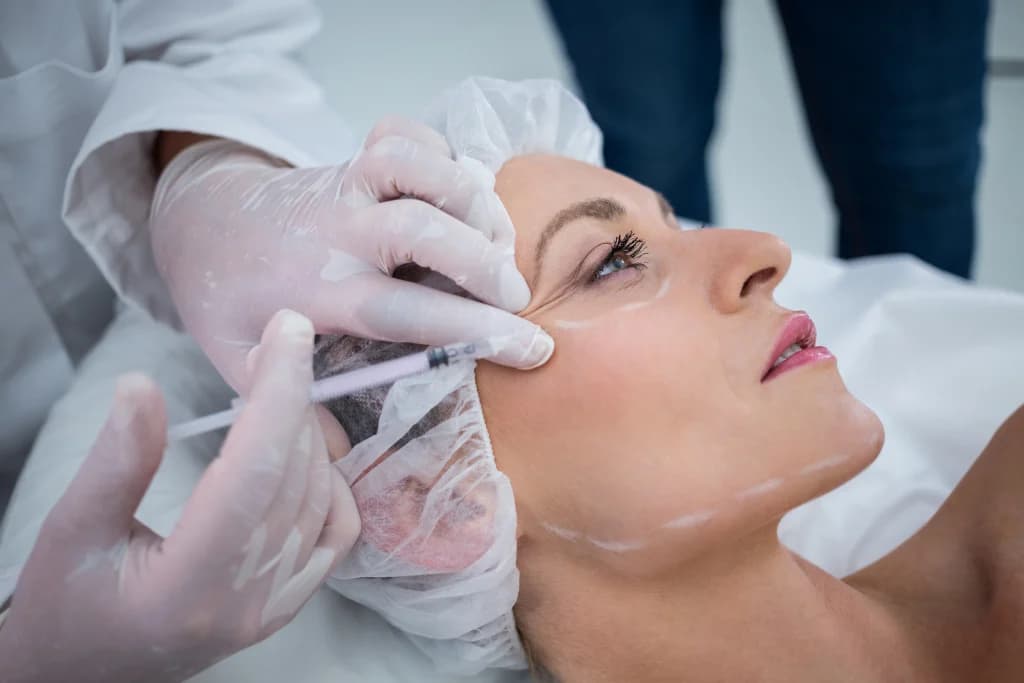
The three beliefs that stop people booking a wrinkle-relaxing injection are that it will freeze the face, that stopping later makes things worse, and that it smooths every line. None survives contact with how the treatment actually works: a frozen look is a dosing outcome rather than an inevitability, the effect simply wears off over months and leaves lines as they were, and only lines produced by movement respond at all.
Here are those and the rest, in the order patients raise them.
"Everyone can tell. It freezes your face."
This is a question about dose, not about the drug.
How much movement you keep depends on how much is injected and where. The default here is conservative dosing, with the explicit aim of softening lines while you keep enough movement to smile, frown and look like yourself. The dose is planned after the doctor has watched how your face actually moves, rather than taken from a fixed template — which is the part that stops a plan being someone else's plan.
The faces you can spot across a room are the ones dosed heavily, often to a template. If a frozen result is your worry, say so out loud at the consultation. It is a legitimate instruction and it changes what gets planned.
"Once you start, you have to keep going forever."
Nothing sudden happens if you stop. The effect wears off over months, the muscle returns to its previous movement, and the lines come back to how they were — not worse than they were.
That is worth restating because the myth has a specific, sticky version: that stopping causes an accelerated collapse. It does not. The treatment is reversible by design in the sense that it is temporary; the effect typically lasts three to six months and then fades. That temporariness is precisely why a first treatment is a comparatively low-commitment way to find out whether you like the result.
"It fills the line in."
It does the opposite of filling. Botox is a purified botulinum toxin injected in very small amounts to temporarily reduce the contraction of specific facial muscles. Less contraction means the skin over those muscles creases less. Nothing is added to the crease.
The practical consequence is the one people miss: if a line is fully present when your face is completely still, relaxing the muscle will not lift it. At assessment the doctor sorts your lines into dynamic and static, and only the dynamic group responds well. Somebody promising to erase every line on your forehead with this one treatment has not made that distinction.
"You will see it the next morning."
You will not. Changes usually begin at around four to seven days and settle by two weeks.
This one causes more distress than it should, because people judge the result on day two, conclude it has not worked, and go looking for someone to blame. The two-week point is the honest moment to assess, which is why the review is booked for then.
"The review appointment is just an upsell."
The review is where an uneven result gets fixed rather than lived with.
Temporary heaviness or asymmetry is uncommon, and it is usually a matter of the effect settling unevenly across the first fortnight. Reviewing at two weeks is what allows a small adjustment to be made at the right moment, instead of the dose being over-guessed on the day of treatment to avoid a second visit. A clinic that dose-guesses to save you a trip is optimising for the wrong thing.
"It is a poison, so it cannot be safe."
Botulinum toxin has a long record of clinical use and the products used here are FDA-approved. It is injected in very small amounts and into specific muscles.
The part of the safety question that genuinely matters is who is holding the syringe: safety depends heavily on who is injecting, which is why every treatment here is performed by a doctor and why your medical history is reviewed before anything is planned. It is a prescription medicine, and there are people who should not have it — it is not advised during pregnancy or breastfeeding, or where there is an active infection at the injection site, and certain neuromuscular conditions rule it out. Tell your doctor about all your medication, including blood thinners.
If something feels wrong afterwards — swelling or redness increasing at a point after the first day, a bruise that keeps spreading, heaviness or asymmetry appearing or persisting past the first fortnight, or any change in swallowing or breathing — contact the clinic rather than deciding for yourself what it means. If you cannot reach us, go to the nearest emergency department.
"If the product is genuine, anyone can inject it."
Two different things are being conflated: what is in the vial and what is done with it. A genuine product injected into the wrong point at the wrong dose produces exactly the results people are afraid of.
The clinical work is in the assessment and the map — which lines are dynamic, which points, how much at each, planned for your muscle pattern and marked before injecting. That is the reason this is doctor-only here rather than a service added to a salon menu.
"There will be nothing to see for weeks and it hurts a lot."
Neither, in most cases. The appointment itself runs about 15 to 30 minutes and most patients describe a brief sting at each injection point rather than pain; the needles are very fine, and a numbing cream can be applied beforehand if you would prefer one.
Afterwards, downtime is minimal and most people return to work the same day. Tiny raised bumps and mild redness at the injection points are common and usually settle within an hour or two. Bruising is occasional, more likely if you take blood-thinning medication or fish oil, generally clears within a few days, and can be covered with makeup after the first 24 hours.
"It is only for women, and only after forty."
The assessment is about which lines you have, not about a birthday or a gender. The three complaints this treatment is built around are forehead lines visible even at complete rest, looking tired or stern in photographs because of the line between the brows, and wanting lines softened without looking overdone. Whether those describe you is a question about your face.
"Anything injected in the face is basically the same treatment."
Not remotely. Skin Botox — also called micro-Botox or mesobotox — places heavily diluted toxin into the most superficial layer of the skin rather than into the muscle, aiming at texture, pore size and oiliness while leaving expression alone. A wrinkle relaxer plan uses the same injection for recognised medical purposes such as jaw clenching, tension headaches and excessive underarm sweating.
Three different problems, three different plans, all reached through a needle. Which one you need is what the consultation is for.
What is genuinely true
That it is temporary, that it works only on lines produced by movement, that nothing shows for the first few days, and that the result depends more on the person injecting than on the brand in the vial.
Botox here is priced from ₹299 per unit, which is a per-unit rate rather than a treatment cost, so the figure is only meaningful once your points are mapped. A consultation is ₹500, waived against treatment.
Book a consultation and bring the questions you have not seen answered here.