
Botox for Men: What men ask that the marketing never addresses
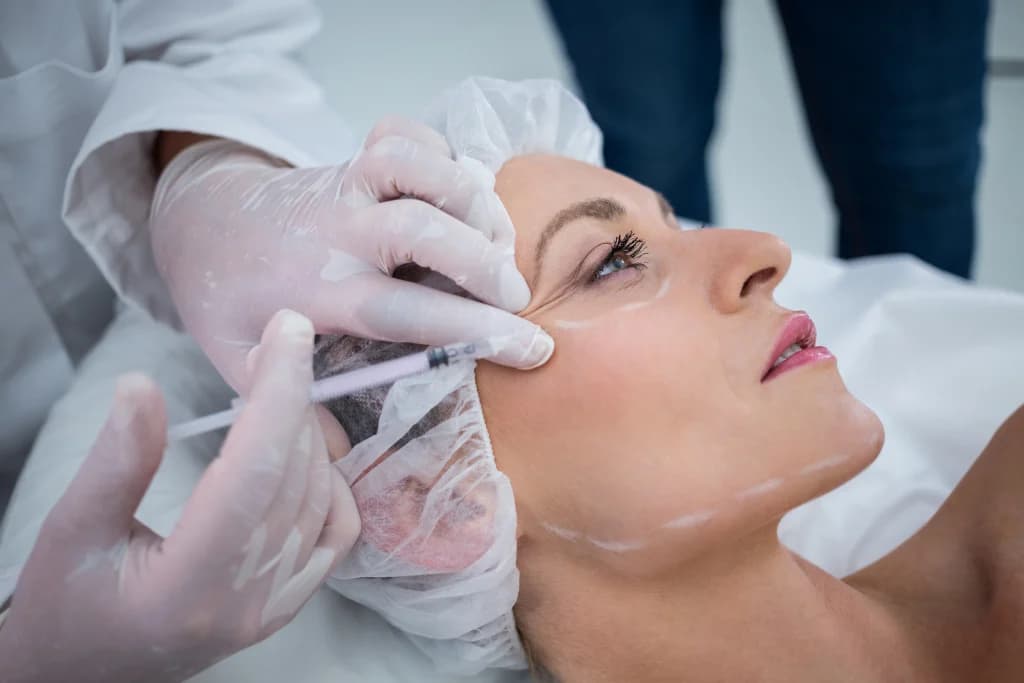
Botox for men is the same treatment, delivered the same way: one sitting of fifteen to thirty minutes, an effect that begins at four to seven days and settles by two weeks, a review at that point, and three to six months before the muscle returns to its usual movement. What differs is not the protocol but the questions — and most of them are practical rather than clinical.
Those questions get asked in the room and almost never in the marketing, so here they are, answered from what this clinic's own treatment information actually says.
Is Botox a different treatment for men?
No. There is one protocol, and it is the one described on the Botox page: the doctor examines your face at rest and in movement, separates the lines that come from muscle activity from the ones that are there regardless, maps the injection points, injects, and reviews at two weeks.
What varies between any two patients — male or female — is the map. The dose and the points are planned for your own muscle pattern rather than taken from a fixed template, which is the part of the process that quietly does most of the work.
Do men need a higher dose?
The honest answer is that the dose follows your muscles, not your gender, and the doctor decides it after watching your face move.
You will find confident statements elsewhere that men need substantially more. We are not going to repeat a number our own treatment information does not state. What it does state is the principle that makes the question mostly irrelevant: dosing here is worked out from your muscle pattern and from how much softening you have asked for. If your frown muscle is strong, the plan reflects that; if it is not, it does not.
Practically, that means two things. Your quote comes out of the assessment, not off a page — the rate here starts from ₹299 per unit and it is the number of units, not the rate, that decides what you pay. And a friend's dose tells you nothing useful about yours.
Will colleagues notice — and what actually gives it away?
Nobody notices an appointment. What people occasionally notice is a result that has gone too far, and that is a dosing outcome rather than something inherent to the treatment.
Dosing here is deliberately conservative, and the stated aim is softened lines with your expression intact — you should still be able to smile, frown and look like yourself. The giveaway everyone is picturing is a forehead that does not move at all, and that is a specific over-treatment, not the default.
Say what you want out loud at the consultation. "I want to look less tired, and I do not want anyone to be able to tell" is a perfectly ordinary brief and it changes the plan.
I need to be able to frown. Will I lose that?
Not if that is what you ask for. The whole point of a conservative dose is that movement is retained while the crease it produces is softened.
Worth being straight about the trade, though: a treatment that entirely removes a line will also remove more of the movement that makes it. If your work involves your face — presenting, teaching, negotiating, being on camera all day — say so at the assessment, and expect the first round to be deliberately light. That is what the two-week review exists for. You can always add a small amount at that appointment; you cannot subtract on the day.
When can I train again, and what about lying on a bench?
Give it twenty-four hours before exercise, and stay upright for roughly the first four — no lying flat, no leaning forward, no bending down.
That combination is genuinely restrictive for a lifting session rather than a walk, which is why it is worth planning around rather than discovering afterwards. A bench press is lying flat; a deadlift is bending and bearing down. Book the appointment for an evening you were not training anyway, or take the rest day.
After the first twenty-four hours there is no ongoing restriction. Downtime is minimal and most patients go straight back to the rest of their day from the appointment itself.
Does it change shaving or the beard line?
The injections go into the forehead, between the brows and at the outer corners of the eyes — not the beard area — so your usual routine is unaffected below that line.
On the day, the treated area is better left alone: the aftercare here is not to rub or massage it for twenty-four hours, so dragging a razor across an injection point the same evening works against that. You will have tiny raised bumps and some redness where the needle went in, which usually settle within an hour or two. If you shave the forehead or brow area for any reason, ask at the consultation how to sequence it.
How long until it wears off if I hate it?
Three to six months, and then the muscle gradually returns to its usual movement. Nothing sudden happens, nothing has to be undone, and lines come back to how they were rather than worse.
That is the honest reassurance for a first-timer, and it is why a first treatment is a genuinely low-commitment way to find out whether you like the result on your own face. The effect is temporary by design rather than permanent.
Between the appointment and the two-week review, resist the urge to judge it early. At day five you are looking at something half-finished.
What would rule me out?
Botulinum toxin is a prescription medicine, so the assessment starts with your medical history rather than with your forehead. It is not advised during pregnancy or breastfeeding, with an active infection at the injection site, or with certain neuromuscular conditions.
Tell the doctor about every medication you take, including blood thinners — and mention supplements, because fish oil makes bruising more likely. Men frequently forget the second half of that sentence.
What is worth reporting afterwards, rather than sitting on
Most people have nothing beyond a couple of small bumps. If something does not look right, ring the clinic and describe it rather than working out what it means yourself — that is the doctor's job, and there is a two-week review already in the diary.
Worth a call rather than a wait: redness, swelling or tenderness at an injection point that increases after the first day; a bruise still spreading or getting more painful after several days; a heavy eyelid or brow, or any change in your vision; a headache that is not settling. And because this is a prescription medicine rather than because it is likely — difficulty swallowing, speaking or breathing, or weakness in muscles away from the treated area, needs urgent medical attention, not a phone call at opening time.
What to ask at the consultation
Three things, and they are the ones that shape the outcome:
- Which of my lines are actually dynamic? Only the lines produced by movement respond well to a wrinkle-relaxing injectable, and separating them is the first step of the assessment.
- How many units, across which areas? This is what your quote is built from.
- What will I look like at day seven, and what at day fourteen? Knowing the difference stops the middle of week one feeling like a mistake.
If your concern is jaw clenching or grinding rather than lines, or excessive underarm sweating, the same injection is used for those and is described under wrinkle relaxer. If it is oily skin and visible pores, that is a different, far more diluted technique — Skin Botox.
Ready to have your own map drawn? Book a consultation. It is ₹500, waived off against treatment.