
Are You a Good Candidate for MNRF Treatment? An Honest Checklist
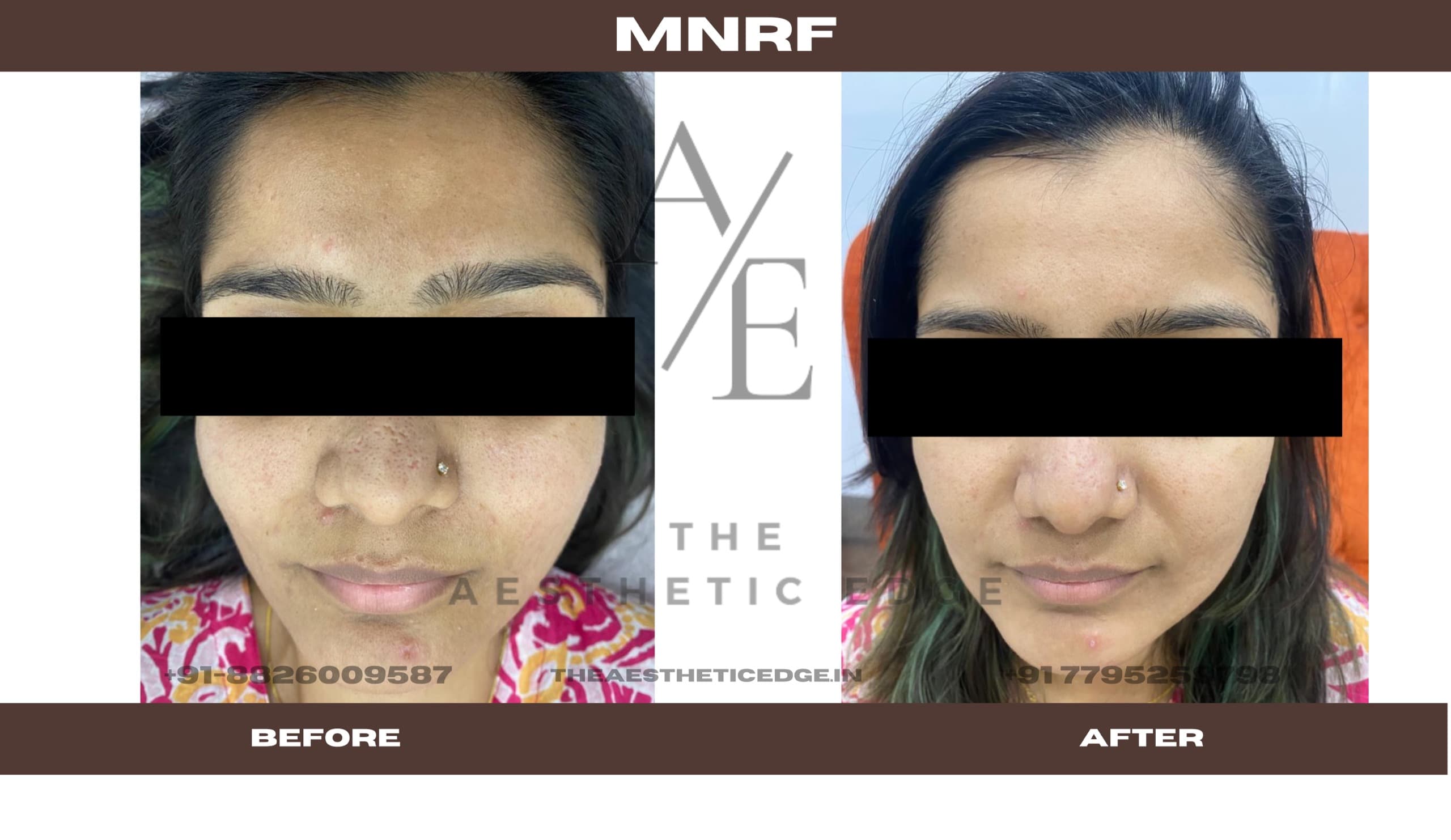
MNRF tends to suit people whose acne has cleared but whose scarring and enlarged-looking pores have not, whose skin has begun to loosen in a way creams do not reach, or who are bothered by rough texture and stretch marks. It is not suitable if you are pregnant or breastfeeding, if you form keloid scars, or if psoriasis or eczema is active where the treatment would be carried out.
Those exclusions are short, specific and non-negotiable — and they are the half of this page worth reading first.
Who should not have MNRF?
Three documented situations, each screened at the consultation.
Pregnancy and breastfeeding. Declare it when you book. Nothing about this is a judgement call to be made in the treatment room.
A tendency towards keloid scarring. If your body has previously healed injuries, piercings or surgical sites into raised, thickened scars, that history rules this treatment out. The logic is straightforward: MNRF works by provoking a controlled healing response, and a healing response that over-produces is not one you want to provoke deliberately.
Active psoriasis or eczema in the treatment area. Skin managing an inflammatory condition is not skin to needle through, and treating around it is a clinical judgement rather than a compromise you should negotiate.
If any of the three applies, the honest answer is that this is not your treatment — at least not now. It is not a case of finding a clinic willing to proceed anyway.
Who is a reasonable candidate?
Somebody with a structural complaint rather than a colour one. The concerns this treatment is built around are:
- Acne that has resolved and left scarring or open pores behind. This is the most common reason people arrive, and the collagen remodelling happens under the scar rather than on the surface above it.
- Skin that has started to loosen or sag in ways topical products do not affect. Early laxity and fine lines respond to the same collagen stimulation, giving a firming effect that accrues across the sessions.
- Stretch marks and rough texture that have become a source of self-consciousness — softened over a course rather than in a visit.
Notice what is missing from that list: pigment. Nothing above is about brown patches or dark marks, and if that is your primary concern you may be looking at the wrong page.
Does my skin tone affect whether I am a candidate?
It affects the settings far more than the eligibility.
MNRF delivers its energy below the surface, so it carries a lower pigmentation risk than many surface lasers — which is why it is a frequent choice for acne scarring on medium and deeper skin tones rather than a treatment people are steered away from. The depth and energy are still chosen for your skin type by the doctor, and that choice is the safety mechanism.
So skin tone is rarely the thing that rules someone out. The three histories above are.
What if my acne is still flaring?
Then say so, because it changes the sequencing conversation.
This treatment addresses what acne leaves behind rather than acne itself, and what is happening on your skin right now is part of what the consultation screens. Whether to settle the breakouts first and treat the scarring afterwards is a clinical decision that depends on your skin, not a rule that can be stated in advance on a website.
The general principle holds regardless: treating the aftermath while the cause is still running is rarely the efficient order.
Am I too young, or too old, for this?
Neither, usually — it is a concern question rather than an age one.
Someone in their twenties treating scarring from teenage acne and someone in their forties treating early laxity are both using the same collagen response for different reasons. What decides candidacy is what is on your skin and what is in your history, which is why an examination settles it and a birth date does not.
What if I have had other treatments before?
Disclose all of them, including things you paid for elsewhere and would rather not mention.
Peels, lasers, needling and home devices all change how skin behaves and how it responds to what comes next. The assessment maps what is being treated and sets depth and energy accordingly, and it does that better with a complete history than with a flattering one.
How is candidacy actually decided?
In person, by a doctor, at an assessment that comes before any device is touched. Your scars, pores or laxity are mapped, your history is taken, the exclusions above are screened, and the treatment depth and energy are set for your skin.
MNRF here is performed by a doctor, always — not delegated — and that is directly connected to the fact that the settings are the treatment.
What does it involve if I am a candidate?
A course rather than an appointment. Most plans run to three or four sessions, spaced by the doctor, each around sixty minutes and worked through zone by zone after numbing cream. Afterwards, redness and mild swelling that generally settle within hours, a few days of light crusting at the needle points, and a fortnight of diligent sun protection.
MNRF starts from ₹6,999 per session. How many sessions your skin needs is a clinical judgement made at the assessment, which is why no page here quotes a course total.
And if the answer turns out to be no?
There are other routes, and knowing that in advance makes a refusal easier to hear.
Microneedling with a Dermapen uses controlled micro-channels to prompt collagen and elastin without the radiofrequency component. If your concern turns out to be pigment rather than structure — sun spots, freckles, marks from old acne — a Q-Switch laser addresses that directly.
Full detail on the procedure sits on the MNRF treatment page. To find out which category you fall into, book a consultation at Indiranagar or Bellandur. It costs ₹500, waived off against treatment — including if the outcome is that you should not have this one.