
A Thinning Hairline & Visible Scalp: What Actually Works, and What Only Sounds Like It Does
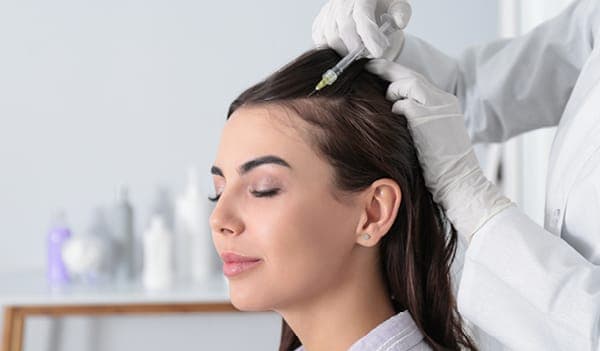
A visible scalp is a density problem, and density is not the same thing as shedding — you can be losing very little hair and still see more scalp than you did. What helps depends entirely on whether the follicles in that area are still active. Where they are, treatment aims at supporting them. Where they are not, the honest options change shape completely.
Why can I see scalp when my hair does not seem to be falling out?
Because you are noticing a different thing.
Shedding is about how much hair leaves. Visibility is about how much hair is covering a given patch of skin, and how the light hits it. Hair that is still present but finer, or growing in less densely than it used to, covers less. So a parting can widen and a hairline can look thinner while the amount you find in the drain stays roughly what it always was.
This matters practically, because it changes what you should be describing to a doctor. "I am losing hair" and "I can see my scalp under the bathroom light" lead to different examinations.
Is a receding hairline the same problem as a wide parting?
Not necessarily, and it is worth being precise about which one you have.
They can share a cause and often do, but they are different areas of scalp with different amounts of hair left, and a treatment that suits one may not suit the other. Nothing you read online can sort this out for you — it is what the examination is for. A doctor looks at your scalp, your hair density, your history and any blood work, and the plan follows from that rather than from the name of the pattern.
Be wary of anything sold to you before that step has happened.
What actually helps while the follicles are still active?
This is the window where the treatments people ask about genuinely apply.
Scalp mesotherapy delivers a blend of vitamins, minerals and amino acids into the layer of skin where the hair follicles sit, using very fine microinjections. The point of injecting rather than applying is reach: a serum on the surface cannot reliably get to the layer of skin around the hair root. The blend itself is mixed for your scalp, according to what your examination and blood work show, rather than being the same cocktail everybody gets. A session runs 20 to 30 minutes, downtime is little to none, and it is performed by a doctor.
It is also, deliberately, not sold here as a standalone answer. Mesotherapy is frequently used to support a broader hair fall plan that also includes topical or oral medical therapy. If your scalp is dry and irritable as well as thin, patients frequently report that side of it improving too, which matters because scalp condition limits how far any hair treatment can go.
GFC is the other in-clinic option for active follicles, and it works from a different starting point: about 10ml of your own blood is drawn, processed in-clinic to isolate the growth factors your platelets release, and roughly 4 to 5ml of that concentrate is injected across the thinning areas. Four to six sessions is typical, with maintenance roughly every two to three months afterwards. It is suited to early and moderate pattern loss — that is, to follicles that are weakened but still active — in both men and women.
Which of the two is appropriate, or whether both belong in a plan, is a consultation decision. They are not interchangeable and neither is a default.
What if the area has been bare for a long time?
Then you should be told so plainly, and this is the part most likely to be fudged elsewhere.
Mesotherapy is used to support follicles that are still active. It cannot be relied on to bring back areas that have been bare for a long period. GFC has the same boundary from the other direction — it acts on follicles that are weakened but still active, which is why the earlier stages of pattern loss are the strongest candidates.
If your complaint is a long-standing bare patch or a hairline you have already made peace with losing, there is a separate answer, and it is honest about what it is. Scalp micropigmentation places tiny deposits of pigment in the scalp to replicate the look of hair follicles, giving the appearance of a closely shaved, fuller head of hair. It does not grow hair, and the clinic's own page says so outright. What it does is change how visible the scalp is, from the first session — which is the actual complaint a lot of people walked in with.
It suits pattern baldness, diffuse thinning and scars on the scalp, and the pigment shade is mixed against your natural hair colour and skin tone so the result reads as stubble rather than as a block of colour. One thing to take seriously before agreeing to it: it is designed to be long-lasting. It can be adjusted or modified, but complete reversal may not be possible.
What only sounds like it works?
Anything offered without an examination first. Anything that promises a fixed number of sessions before your scalp has been looked at — the number is not fixed at the start here, precisely because it depends on what is driving your hair loss and how you respond. And any surface product sold on the claim that it reaches the follicle, when the reason microinjection exists is that surface application does not do so reliably.
Also treat before-and-after photographs with suspicion unless you know how they were taken. At this clinic scalp photographs are taken before the first session so that change at review is measured against a baseline rather than recalled. Protocols are reviewed at the three-month mark against those photographs.
How soon would I see anything?
Depends which of the three you have had, and the difference is stark.
Micropigmentation is visible immediately after the first session. The regrowth treatments are not — the review point for both mesotherapy and GFC is around three months, and that is when the plan is reassessed and adjusted. If you want a change you can see next week, only one of these does that, and it is the one that does not involve growing hair.
What happens afterwards, and what rules me out?
After mesotherapy, mild redness, tightness or irritation of the scalp is common and typically subsides within a few days; most patients go straight back to their day. After GFC, bruising, redness, itching or mild pain can last two to five days, and you are asked to avoid strenuous exercise, swimming and direct sun for two days and hair products for six hours. After micropigmentation, temporary redness and mild swelling usually resolve within a few days, and keeping the scalp out of direct sunlight matters because sun affects how the pigment settles.
Scalp mesotherapy is not suitable during pregnancy or breastfeeding, where there is an active scalp infection or open wound, or where you are allergic to any component of the blend. For GFC, blood thinners and anti-inflammatories are usually paused for 48 to 72 hours beforehand on your doctor's instruction — so tell the clinic everything you take, prescription or otherwise.
If anything after a session worries you, contact the clinic rather than waiting it out.
Where to start
Not with a treatment name. Start by describing the thing you actually notice: where you can see scalp, when you first noticed it, whether hair is also coming out, and what your hair used to look like.
A consultation is ₹500, waived against treatment, and includes the scalp examination and baseline photographs that everything after it is measured against. Book a consultation and let the examination decide which of these three conversations you are actually having.