
Stretch Marks: What Actually Works, and What Only Sounds Like It Does
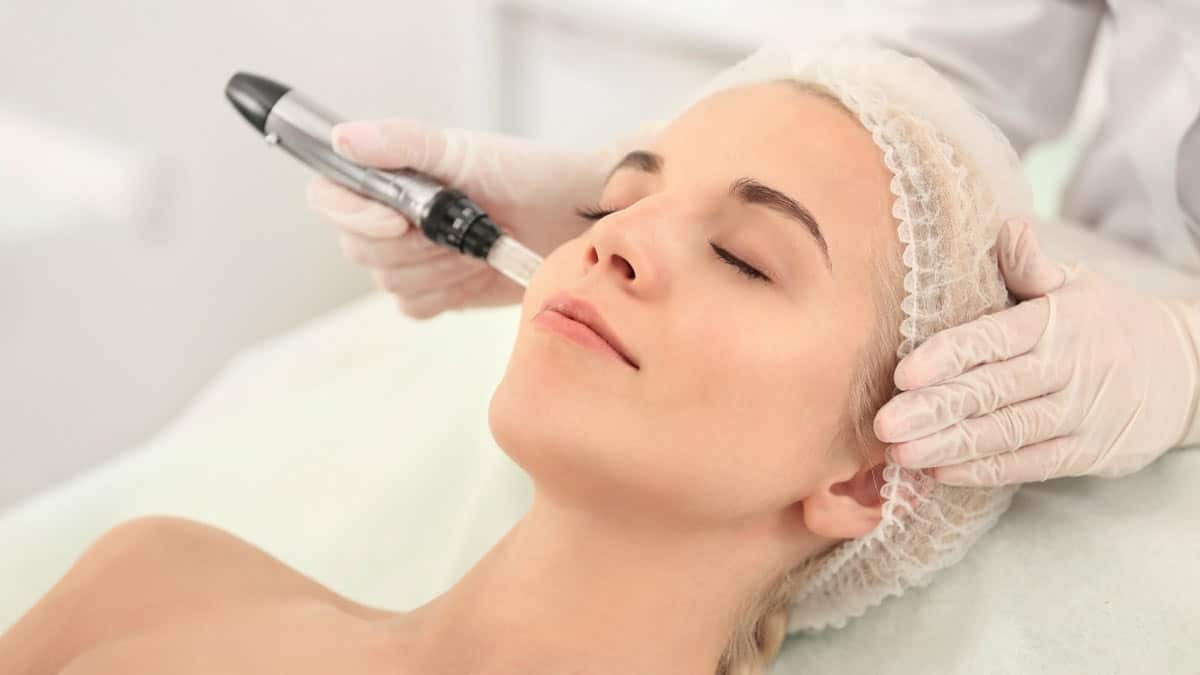
Stretch marks are scars sitting in the dermis, beneath the skin's surface. That is why creams do so little, and why no treatment returns the skin to how it looked before. What in-clinic treatment can do is improve how visible they are, softening the texture and helping them blend with the skin around them. Microneedling and MNRF are the two routes we use.
Everything else in this article follows from that first paragraph, including the parts you may not want to read.
Why do stretch marks form?
Because the skin was stretched faster than the dermis could keep up with, and the supporting collagen and elastin in that layer gave way. What is left behind is a scar, in a line, running along the direction of the stretch.
The usual settings are the ones you would expect — pregnancy, a growth spurt, a rapid change in weight or in muscle. Our own microneedling page names pregnancy and growth spurts directly, because those are what patients most often arrive describing.
This article cannot tell you why yours formed, and neither can a search. If your marks appeared suddenly, or arrived alongside other changes you were not expecting, say so at the consultation before any treatment plan is drawn up. That belongs in front of a doctor rather than in a comparison of clinics.
Why don't creams and oils do much?
Because of where the problem is.
A cream works on the surface. A stretch mark is a scar in the layer underneath. Moisturising the skin over a scar can improve how the surface looks and feels, and there is nothing wrong with doing it. What it cannot do is rebuild the collagen that failed in the layer below, because almost nothing applied to the surface gets there in a form that would.
This is the same reason topical products do not resolve acne scarring. The treatments that help stretch marks are the ones that work at depth, and they work by asking the skin to rebuild rather than by covering anything over.
Does the age of the mark matter?
It is one of the first things a doctor will look at.
Newer marks tend to be red, pink or purple. Older ones lose that colour over time and become pale or silvery, and often feel slightly sunken or ridged against the skin around them. They are the same scar at different stages, and they do not behave identically.
As a general rule there is more to work with while a mark is newer — the skin in and around it is still actively remodelling. That does not mean older marks are untreatable, and it does not mean a newer one will resolve. What it means is that two people with the same treatment plan can reasonably expect different amounts of change, and neither of them could have predicted their own result from a photograph. Your doctor will look at colour, texture, width, site and how long the marks have been there before saying anything about what a course might achieve.
What does microneedling do for stretch marks?
It treats them as what they are: dermal scars.
Microneedling with Dermapen creates controlled micro-channels so the skin repairs itself with new collagen and elastin. The same remodelling response that helps acne scarring reduces how visible stretch marks are, on the body as well as the face. Nothing synthetic is placed in the skin — the improvement is your own repair response, which is why it builds gradually and why it holds.
Practically: the depth is set for the concern, a topical anaesthetic goes on fifteen to twenty minutes beforehand, and a course is typically six to eight sessions depending on what is being treated. Body skin heals more slowly than facial skin, so sessions on the abdomen, thighs or arms are spaced a little further apart than they would be on a face. That makes a stretch mark course a commitment measured in months.
What does MNRF do for stretch marks?
The same job with a second lever.
MNRF sends fine needles into the skin carrying radiofrequency energy with them, and the doctor sets both the depth and the energy. Controlled micro-injury plus RF softens rough texture and reduces the visibility of stretch marks over multiple sessions. Plans typically run three to four sessions at around an hour each, so it is fewer visits than a microneedling course at a higher price per session — ₹6,999 against ₹3,999.
Which of the two suits your marks is a clinical judgement, and it is genuinely made case by case. Neither is the automatic answer.
What should I realistically expect?
Improvement in how visible the marks are. Not their disappearance.
It is worth spelling out what that looks like, because vague promises are how people end up disappointed by a treatment that actually worked. A course can soften the ridged or indented feel of a mark, narrow the difference in texture between the mark and the skin beside it, and make the whole area read as less obvious in ordinary light. It builds over months, because collagen remodelling continues for weeks after each session and accumulates across the course.
What it does not do is return the skin to how it was. Nobody can promise that, and a scar in the dermis does not become unscarred skin. If a clinic tells you otherwise, that is a fact about the clinic.
Two other honest limits. Results vary between people in a way that cannot be predicted in advance, and older, white marks generally respond differently from newer, red ones. Both of those should be said to you before you pay for a course, not after.
What does recovery look like, and when should I call?
After microneedling, expect redness, mild swelling and some flaking, usually settling within a day, with occasional light bruising at deeper settings. Plan around two days without strenuous exercise — which matters more than usual here, since stretch marks are often on the abdomen, thighs or arms.
Two aftercare points do the heavy lifting. The micro-channels stay open for a few hours, so the treated skin is not washed for the first four hours and the antiseptic cream you are given is used as instructed. And freshly needled skin burns easily and pigments easily, so SPF 50 or higher goes on daily — including on body skin that is going to see sun.
Because the skin has been deliberately opened, a few things are worth a phone call rather than a wait-and-see. This is a list of reasons to ring us, not a list to interpret yourself:
- Redness, swelling or tenderness that worsens after the second day instead of settling
- Pain that increases rather than fades
- Any discharge, or yellow crusting over the treated area
- Any clustered blistering, or tingling that comes before it
- A fever in the days after a session
- Treated skin that darkens beyond the expected flaking
You should not try to work out which of those matters — that takes a look at the skin, and it is the doctor's job. Call the branch that treated you, at Indiranagar or Bellandur, describe what you are seeing, and put nothing new on the area in the meantime.
Who should not have either treatment?
Microneedling is avoided in pregnancy and breastfeeding, and where there is active acne, active herpes, or a moderate-to-severe chronic skin condition such as eczema or psoriasis. MNRF is avoided in pregnancy and breastfeeding, in anyone with a keloid tendency, and where there is an active skin condition in the treatment area.
The pregnancy line is worth repeating, because a great many people start searching for stretch mark treatment during or immediately after a pregnancy. Neither treatment is done while you are pregnant or breastfeeding. That is not a delay anyone can negotiate around, and it is one of the first things the consultation checks.
The keloid point matters too. If you scar thickly, say so before anything is planned.
What is the first step?
A look at the actual marks. Colour, texture, how long they have been there and where they are all change the answer, and none of them can be assessed from a description.
The consultation is ₹500, waived off against treatment, at Indiranagar or Bellandur, and both treatments are performed by a doctor. Come with a question you actually want answered — including, entirely reasonably, whether a course is worth it for marks like yours. A straight answer to that is worth more than a course booked on hope.
Book an appointment when you are ready to hear it.