
Microneedling with Dermapen vs MNRF Treatment: How to Choose
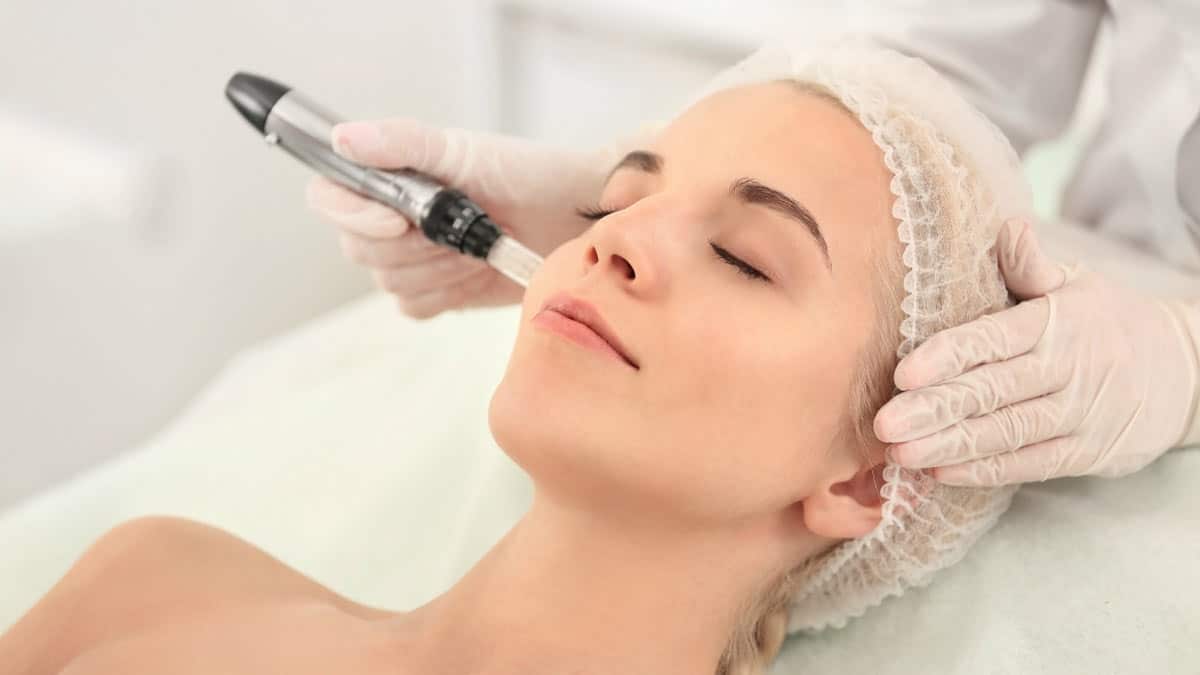
Choose microneedling with Dermapen when the concern is texture, open pores, stretch marks or fine lines and you want the improvement to come purely from your own healing. Choose MNRF when the concern is deeper acne scarring or early loosening of the skin, because radiofrequency delivered through the needles works at a depth that needling alone does not reach.
That resolves most cases. The rest of this article is for the ones it does not, and for the trade-offs that come with either answer.
What is the actual difference between them?
One variable: whether energy is added.
Microneedling with Dermapen creates controlled micro-channels in the skin so it repairs itself with new collagen and elastin. The needle depth is set to reach the layer where collagen and elastin are made — shallower for texture and tone, deeper for scarring. Nothing synthetic goes in and nothing comes off. The result is your own repair response, which is why it builds gradually and holds.
MNRF uses fine needles too, but they carry bipolar radiofrequency into the deeper skin layers as they go. The doctor sets both the depth and the energy — deeper for scars, shallower for texture. So it is the same idea plus a second lever, working where surface treatments cannot reach.
They are relatives, not rivals. That is why the choice is usually decided by your concern rather than by one being stronger across the board.
Which one for acne scars?
Both treat them, and this is the row where the honest answer depends on the scar.
Microneedling's mechanism here is direct: controlled micro-injury prompts the skin to rebuild through a scar rather than over it, which is why post-acne marks and depressed scars respond to it where topical products do not. It is one of the strongest indications the treatment has.
MNRF's claim is about depth. RF energy delivered through microneedles remodels collagen under the scar, working where surface treatments cannot reach. For scarring that sits deep, that reach is the point of the treatment.
Which means: shallower, more superficial post-acne change is well served by needling on its own. Deeper, established scarring is where MNRF earns its extra cost. Nobody can tell which category yours is from a photograph on a phone, and a doctor mapping the scars is the step that decides it.
Which one for open pores and rough texture?
Either, genuinely.
Microneedling refines pores and texture because repeated collagen remodelling tightens the skin around pores and evens out rough, blackhead-prone texture over a course of sessions. MNRF's collagen stimulation tightens the skin around enlarged pores in the same way, softening their appearance over its session course.
When two treatments both fit, the tiebreakers are the practical ones lower down this page — how many visits you can commit to, how much downtime you can absorb, and what the session costs.
What if my main concern is skin that has started to loosen?
This is MNRF's clearest win, and it is worth being precise about why.
The MNRF core describes the same collagen response addressing early sagging and fine lines — a non-surgical tightening effect that builds over weeks. Our microneedling page makes no such claim. It describes improving the skin's strength and elasticity as it heals, which is a different and more modest thing than lifting skin that has begun to loosen.
If loosening is the reason you are looking, MNRF is the treatment to ask about. Neither treatment lifts sagging tissue in the way a surgical or thread-based approach would, and any consultation that suggests otherwise is overselling.
Which one for stretch marks and body skin?
Both cores cover stretch marks. Microneedling describes stretch marks as dermal scars and the same remodelling response that helps acne scarring reducing how visible they are, on the body as well as the face. MNRF describes controlled micro-injury plus RF softening rough texture and reducing the visibility of stretch marks over multiple sessions.
Two honest notes. Neither erases a stretch mark — both improve how visible it is, and the difference between those two words is the whole of realistic expectation. And body skin heals more slowly than facial skin, so microneedling sessions on the body are spaced a little further apart than facial ones.
How do the session counts compare?
This is the difference most people underestimate.
Microneedling typically runs six to eight sessions, depending on the concern — deep acne scarring needs more than general texture and tone. MNRF plans typically run three to four, spaced by the doctor, at around sixty minutes a session.
So MNRF is fewer visits over a shorter stretch of your calendar. Microneedling is more visits at a lower price each. Which of those is the easier commitment is a real question about your life, not a clinical one, and it is a reasonable thing to say out loud at the consultation.
Both build the same way afterwards: collagen keeps remodelling for weeks after each session, which is exactly why the sessions are spaced.
How do downtime and recovery compare?
Microneedling: redness, mild swelling and flaking, usually settling within a day, with occasional light bruising at deeper settings. Plan around two days without strenuous exercise.
MNRF: redness and mild swelling that typically settles within hours, sometimes light crusting at the needle points for a few days. Those crusts should not be picked; they resolve on their own.
MNRF wins on the first day. Microneedling wins on not leaving crusts to manage. Neither is a lunchtime treatment you should schedule before an event.
The aftercare instructions differ too, and the difference is not cosmetic. Microneedling asks for SPF 50 or higher every day, and for the face not to be washed for the first four hours while the micro-channels are still open, with the antiseptic cream you are given used as instructed. MNRF asks for strict sunscreen and no sun exposure for two weeks, with SPF 30 or higher, and you are sent home with a written aftercare sheet.
What about pigmentation risk on Indian skin?
Read this row carefully, because it is the one most easily misquoted.
Our MNRF page notes that because the needles deliver energy below the surface, MNRF carries a lower pigmentation risk than many surface lasers, with settings chosen for your skin type by the doctor. That comparison is against lasers. It is not evidence that MNRF is gentler on pigment than microneedling, and it should not be read that way.
What is true of both: the skin has been deliberately broken, and skin with more melanin responds to inflammation by producing pigment. Both treatments therefore put strict sun protection at the centre of aftercare, and both are set by a doctor for your skin rather than run at a standard setting. Which treatment carries less pigmentation risk for you is an assessment, not a fact you can look up.
What do they cost?
Microneedling with Dermapen starts at ₹3,999 per session. MNRF starts at ₹6,999 per session. Both are the same at Indiranagar and Bellandur, and the consultation is ₹500, waived off against treatment.
We publish per-session prices rather than course totals, because the number of sessions is a clinical decision made after someone has looked at your skin. When you compare quotes elsewhere, check whether the number you are given is per session or for a bundle — those two figures are not comparable.
Who is not suitable for either?
The lists overlap but are not identical, which is occasionally the thing that decides it.
Microneedling is avoided in pregnancy and breastfeeding, and where there is active acne, active herpes, or a moderate-to-severe chronic condition such as eczema or psoriasis. MNRF is avoided in pregnancy and breastfeeding, in anyone with a keloid tendency, and where there is an active skin condition such as psoriasis or eczema in the treatment area.
A keloid tendency is the one worth flagging early. If you scar thickly, say so before anything is planned.
So which should I choose?
If your concern is texture, pores, fine lines or stretch marks and you would rather spread the cost across more, cheaper sessions, start the conversation at microneedling. If it is deeper acne scarring or early loosening, and fewer appointments suits you better, start it at MNRF.
Both are performed by a doctor at both our clinics, and the consultation exists precisely so that this decision is made by someone looking at your skin rather than by an article. Book an appointment and bring your question in the shape you have it — including, quite reasonably, "which of these two, and why that one".