
PRP Hair Regrowth Treatment vs GFC Hair Loss Treatment: How to Choose
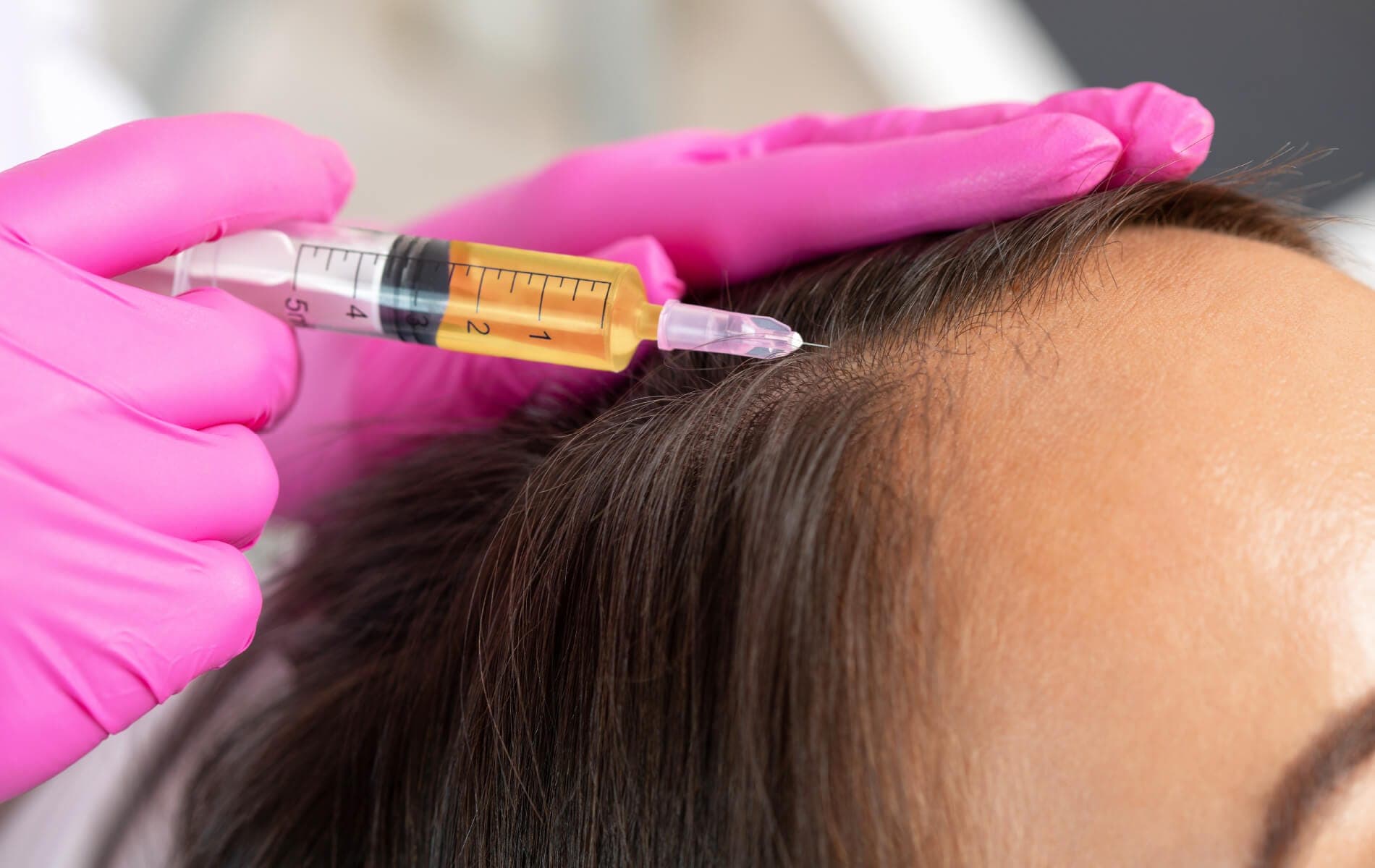
Both are made from your own blood and both are injected into the scalp by a doctor. The difference is preparation: PRP injects the concentrated platelet fraction whole, while GFC processes it further to isolate the growth factors those platelets release. That changes the course you are quoted and the recovery you feel — not what either one can act on.
What is actually different between the two?
One step in the lab, and everything that follows from it.
With PRP, a small blood sample is spun in a centrifuge to concentrate the platelets, and that platelet-rich fraction is what goes into the scalp.
With GFC, around 10ml is drawn and processed further — the platelets are activated and the growth factor fraction they release is separated out. Roughly 4 to 5ml of that concentrate is then injected across the thinning areas.
So GFC is a more concentrated preparation than standard PRP. That is a description of the product, and it is worth being precise about what it does and does not follow from.
What does "more concentrated" actually buy you?
It buys a difference in what is delivered per injection. It does not buy a difference in what is there to work on.
Both treatments act on follicles that are weakened but still present and active. Neither will do anything for an area that has been fully bare for years — both cores say so plainly, and a doctor should tell you at consultation rather than selling you a course that cannot work. Concentration changes the preparation; it does not change the biology of what is left on your scalp.
Both are also positioned for the same stage of loss: early and moderate pattern thinning, in men and women. If you are past that stage, the answer is not the more concentrated of the two — it is a different conversation entirely.
And neither can be promised. Both cores say the same thing in different words: reduced shedding is usually noticed first, visible density takes months because hair grows slowly, and what happens depends on how much active follicle remains. That is why both take baseline scalp photographs before the first session and review against them at around three months.
How long is a session, and how many will there be?
Here the two genuinely differ, and it is worth reading the numbers carefully rather than taking "shorter" at face value.
| PRP | GFC | |
|---|---|---|
| What is injected | The concentrated platelet fraction | Growth factors isolated from those platelets |
| Stated session time | About 20 minutes, plus 30-45 minutes of numbing | About 30 minutes, including preparation |
| Typical course | One session a month, three to five months | Four to six sessions, spaced by your doctor |
| Maintenance | Spaced sessions after the initial course | Roughly every two to three months |
| Documented after-effects | Tenderness or heaviness for a day or two | Bruising, redness, itching or mild pain for two to five days |
| Performed by | A doctor, always | A doctor, always |
Two things stand out.
First, the appointment lengths are closer than the headline numbers suggest. Both apply anaesthetic cream for 30 to 45 minutes before anything starts. PRP counts that separately from its 20 minutes of injecting; GFC's 30 minutes covers the draw, the processing and the injecting. Either way you are in the clinic for around an hour, and neither needs time off afterwards.
Second, the session counts do not line up with the way GFC is usually described. GFC's own page says a course is generally shorter than a comparable PRP course, while the stated numbers are four to six sessions for GFC against three to five monthly sessions for PRP. That is a real inconsistency and we would rather point at it than paper over it. Ask your doctor what "shorter" means for your scalp — fewer visits, or the same number over a shorter calendar — because with neither is the number fixed at the start. Both are reviewed at three months against photographs and adjusted from there.
Which one is easier to live with afterwards?
On the cores' own descriptions, PRP is the gentler of the two in the days following a session. Its documented after-effect is tenderness or a heavy feeling in the scalp for a day or two. GFC's is bruising, redness, itching or mild pain lasting two to five days.
The aftercare lists differ accordingly. After PRP: skip hair washing for about 48 hours, and avoid exercise, swimming, steam and direct sun for two days. After GFC: ice if there is swelling, avoid aspirin and anti-inflammatory medication for three days, no strenuous exercise, swimming or direct sun for two days, no hair products for six hours, and a pH-balanced shampoo for the first three days.
GFC also documents a preparation step PRP does not: aspirin, anti-inflammatories and blood thinners are usually paused for 48 to 72 hours beforehand, on your doctor's instruction. If you take any of those regularly, raise it early — both cores also list blood-thinning medication among the reasons not to treat, so this is a conversation to have with a doctor rather than a rule to apply yourself.
Neither has downtime in the sense that matters to a working week. Most patients go back to their day immediately after either one.
I have already had PRP. Is GFC the obvious next step?
It is the question GFC is most often asked, and the honest answer is: sometimes, and not automatically.
GFC's own page names this reader explicitly — someone who has tried PRP elsewhere and wants to know what else exists. That is a fair description of who it suits. But "PRP did not work" can mean several different things, and only one of them is solved by a more concentrated preparation:
- The area treated was already too far gone. Then neither will help, and changing product changes nothing.
- The course was never completed, or never reviewed against a baseline photograph. Then what you have is an unfinished trial, not a failed treatment.
- PRP was performed without a doctor assessing the pattern of loss first, or without the topical and oral therapy that is meant to sit alongside it. Then the missing part was the plan, not the injection.
- The course was completed properly, reviewed at three months, and the response was poor. This is the case where trying a different preparation is a reasonable next conversation.
PRP remains a sensible choice for plenty of people, including people who have never tried either. It is the shorter stated course, the shorter recovery, and it is designed to sit alongside the rest of your medical plan rather than replace it. Choosing it is not settling for less.
Who should not have either?
The exclusion lists are near-identical: not during pregnancy or breastfeeding, not while you are taking antibiotics or blood-thinning medication, and not where there is an active scalp infection. PRP's core additionally names a platelet disorder. Disclose every medication and condition at consultation — this is the part where being thorough is genuinely in your interest.
Some soreness, redness or itching afterwards is on the expected list for both. If the scalp instead becomes increasingly painful, swollen or inflamed, or symptoms are still worsening past the few days each treatment describes, contact the clinic and have it looked at rather than waiting for the next session.
So how do you choose?
Not from a page, and not from the concentration figure. The things that decide it are your pattern of loss, how much active follicle you still have, what you have already tried and how properly it was done, what medication you take, and how much visible bruising you can tolerate in a given week.
A consultation is ₹500, waived off against treatment. A doctor examines the scalp, reviews your history and tells you which of the two is appropriate — or whether something else in the plan should come first.
Book an appointment at Indiranagar or Bellandur, and if you have had PRP before, bring the details: how many sessions, over what period, and whether anyone photographed your scalp at the start. That last answer often settles the question on its own.