
Mesotherapy for Hair vs PRP Hair Regrowth Treatment: How to Choose
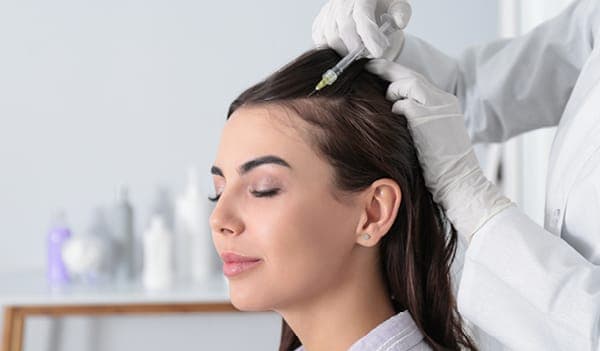
One of these is compounded for you; the other is harvested from you. Scalp mesotherapy injects a blend of vitamins, minerals and amino acids your doctor mixes for your scalp. PRP injects platelets concentrated from a sample of your own blood. The blood draw, whether the contents can be tailored, and who is ruled out all follow from that.
Compounded for you, or harvested from you?
Scalp mesotherapy delivers a customised blend of vitamins, minerals and amino acids into the layer of skin where the hair follicles sit. The blend is chosen by your doctor for your scalp, not taken off a shelf, and you can ask to be told exactly what is being used before the session starts.
PRP contains nothing that was not already in you. A small blood sample is drawn and spun in a centrifuge to separate the platelet-rich fraction, and that concentrate is what goes back into your scalp. Nothing foreign is introduced.
Read that as a difference in how the material is obtained, and the rest of this article follows from it.
Does one of them need a blood draw?
Yes, and it is the most practical difference on the day.
PRP starts with a draw. That shapes the appointment — you are asked to eat before you come, the sample is spun while numbing cream sits on your scalp for 30 to 45 minutes, and the injecting itself then takes around 20 minutes.
Mesotherapy has no draw at all. The solution is prepared rather than harvested, the scalp is cleansed, numbing cream is applied where needed, and the session runs 20 to 30 minutes. If the prospect of having blood taken is what has kept you out of a clinic, that is a legitimate reason to ask about mesotherapy first, and one of the reasons the clinic lists for considering it is wanting to start with the least invasive option available.
Can what goes in be adjusted for me?
This is where the difference in origin bites hardest.
Mesotherapy's composition is a decision. Your scalp, hair density, history and any blood work are reviewed, and the composition of the blend is decided from that — combined according to what your examination and blood work show, rather than every patient receiving the same cocktail. At review, the course and the blend are adjusted. If your assessment picked up a specific deficiency, that is something a formulation can be pointed at.
PRP's composition is not a dial in the same way. What is injected is the platelet fraction of your own blood, so the raw material is you. Your doctor decides how much is placed and where, and PRP sits alongside topical and oral medical therapy rather than replacing it — but nobody is choosing the ingredient list, because there is not one.
Neither of those is superior. They are different kinds of control, and which matters more depends on what your assessment turned up.
Does it change who gets ruled out?
Directly, and this is the clearest illustration of the point.
Mesotherapy's exclusions include being allergic to any component of the blend — an exclusion that only exists because there is a formulation to react to. It is also not suitable during pregnancy or breastfeeding, or where there is an active scalp infection or open wound.
PRP's exclusions read like a blood list, because it is one. It is not carried out during pregnancy or breastfeeding, while you are on antibiotics or blood-thinning medication, or where there is an active scalp infection or a platelet disorder. Blood thinners and aspirin usually need to be paused beforehand.
So a course of antibiotics rules out one of these and not the other. So does a platelet disorder. Disclose everything you take at consultation either way — prescription, supplement or otherwise.
What is each one aiming at?
Related goals, described differently by the clinic, and worth reading closely.
PRP is aimed at the follicle's environment: injecting into the scalp is intended to improve circulation around the follicle and support the hair shaft, which is why reduced shedding is usually noticed before any added density. It suits follicles that are weakened but still alive — the earlier stages of pattern loss in both men and women. The clinic's own examples of who considers it: gradual thinning someone wants to slow down before it worsens, and a widening parting where hair is still present but finer than it was.
Mesotherapy is aimed at nourishment and at the scalp itself. Alongside the hair, patients frequently report a less dry and less irritable scalp — which matters, because scalp condition limits how far any hair treatment can go. The clinic's examples of who considers it: thinning hair with a scalp that feels dry and undernourished, and wanting something to support hair alongside medication already being taken.
Side by side
| Scalp mesotherapy | PRP hair regrowth | |
|---|---|---|
| What is injected | Vitamins, minerals and amino acids, blended for you | Platelets concentrated from your own blood |
| Blood draw | No | Yes, a small sample, spun in-clinic |
| Contents adjustable | Yes — blend reviewed and adjusted | Not as a composition; your own blood is the material |
| Session time | 20 to 30 minutes | About 20 minutes, plus 30 to 45 minutes numbing |
| Course | A short course, spaced by your doctor | Monthly across three to five months |
| Maintenance | Set at review | Spaced sessions after the initial course |
| Ruled out by | Allergy to a component of the blend | Antibiotics, blood thinners, a platelet disorder |
| Also ruled out | Pregnancy, breastfeeding, active scalp infection or open wound | Pregnancy, breastfeeding, active scalp infection |
| Downtime | Little to none | None — most return to work the same day |
| Performed by | A doctor, always | A doctor, always |
What is the same in both?
More than the comparison suggests, and it is worth saying so.
Both are performed by a doctor at this clinic, every time. Both take scalp photographs before the first session so that change at review is measured rather than recalled, and both are reassessed at around the three-month mark against those photographs. Neither has a session count fixed at the outset — it depends on what is driving your hair fall and how you respond.
Both also share the same honest ceiling. Mesotherapy supports follicles that are still active and cannot be relied on to bring back areas bare for a long period. PRP acts on follicles that are still present and active, and areas fully bare for a long period are unlikely to respond. On the timeline, PRP's own page says plainly that no one can promise a result and that outcomes vary with the cause and stage of your hair loss. That applies to both.
What happens afterwards?
After mesotherapy, mild redness, tightness or irritation of the scalp is common and typically subsides within a few days; most patients go straight back to their day.
After PRP, leave the hair unwashed for about 48 hours and avoid sun, heat, saunas, steam, swimming and vigorous exercise for two days. Mild redness or a heavy feeling in the scalp is common and usually settles within 24 hours, and some tenderness or bruising can last two to three days.
If anything after either session concerns you, contact the clinic rather than waiting to see whether it passes.
So which should I book?
Book the consultation, not the treatment — and that is not a dodge, because the choice turns on things you cannot check yourself.
Lean mesotherapy if your scalp itself is part of the complaint, if blood work has found something specific to aim at, if you want to know exactly what is going in, or if a blood draw is the barrier. Lean PRP if you would rather use something from your own body than begin a long-term medication, if the pattern is gradual thinning you want to slow, or if the exclusion list above rules out a blend rather than a draw.
It is also entirely possible that the answer is neither on its own — both are described here as sitting alongside topical and oral medical therapy rather than replacing it.
A consultation is ₹500, waived against treatment, and includes the scalp examination, the history review and the baseline photographs that make the choice a decision rather than a preference. Book a consultation to have your scalp looked at first.