
Hair on the Pillow: Falling Out, or Snapping Off?
A handful of strands on the pillow is alarming, and the conclusion most people jump to is hair loss. But a strand that snapped along its length and a strand that came away from the root look nearly identical lying on a bedsheet, and they are not the same problem. Sorting out which one you are looking at is the first thing worth doing, because it decides whether anything on a clinic's treatment list is relevant to you at all.
This matters more than it sounds. People arrive having already decided they need a regrowth treatment, having already read about something called "hair botox", and having already spent months on products chosen for a diagnosis nobody made.
Am I actually losing hair?
That is a question for an examination rather than a bathroom-floor count. What is worth paying attention to is not the volume of strands but whether the hair on your head has changed: whether your parting reads wider than it did, whether your ponytail feels thinner in your hand, whether it has been unusually heavy for more than a few weeks.
If none of those is true and what you are noticing is strands accumulating, the honest position is that you do not yet know what you are dealing with — and neither does anyone answering you online. A doctor examines the scalp, and hair fall is treated as a symptom to be explained rather than a diagnosis to be accepted.
Two practical notes before you book anything. Bring the timeline: when it started, whether it tracks with a season, a treatment, a change of water or a stressful stretch. And bring what you have done to your hair — colour, chemical straightening, heat, tight styles — because that is information the person examining you cannot get any other way.
So what is the hair botox you offer?
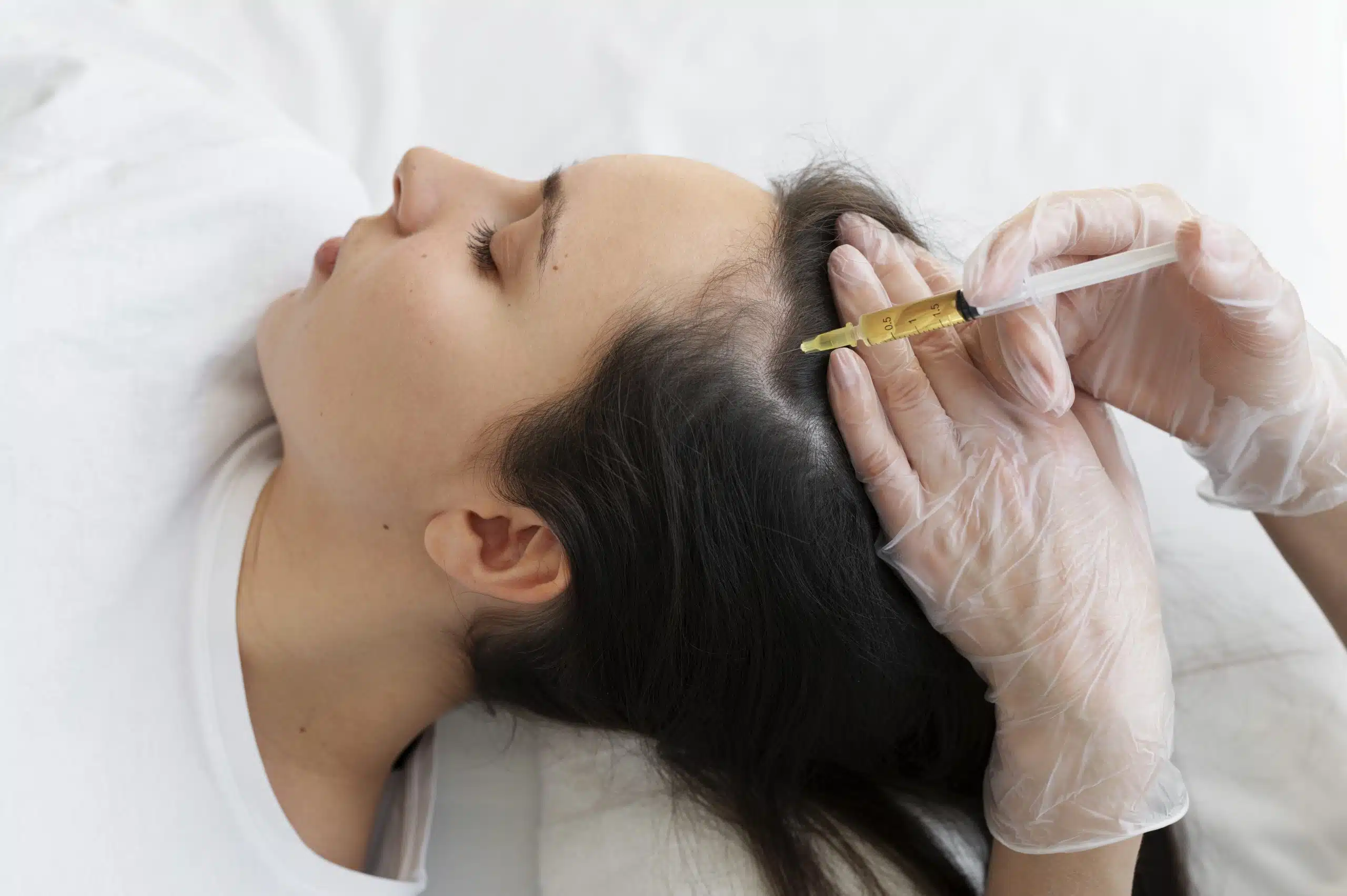
Not what most of the internet means by the phrase, and this is the single most useful thing to clear up. At The Aesthetic Edge, hair botox is an injectable scalp treatment: a doctor places micro-injections of botulinum toxin into the scalp to calm excessive sweating and oiliness.
Salons use the same words for something entirely different — a topical deep-conditioning mask that contains no botulinum toxin at all. Two treatments, one name, and almost everything published under it is about the mask. If you arrived here because you read that hair botox fixes damaged hair, you were reading about the salon version.
What ours actually does, and does not do, is worth stating flatly:
- It calms scalp sweating and oiliness. With sweating reduced, a blow-dry survives a Bangalore commute or a workout instead of collapsing by evening, and reduced sebum means the roots stay fresher longer, so you wash less and strip the hair less often.
- It is not a regrowth treatment on its own. The doctor may pair it with a regrowth protocol after a scalp review, but the injections themselves are not what would regrow hair.
- It is not a conditioning treatment, and nothing in it is placed on the length of your hair.
Practically: injection points and dosing are mapped by a doctor for your scalp rather than applied as a one-size template, numbing cream goes on first, the session runs around thirty minutes, most patients describe brief pinpricks rather than pain, and there is no downtime to speak of. The effect typically lasts four to six months, after which scalp sweating gradually returns to its earlier pattern and the treatment can be repeated.
What if my strands are breaking rather than shedding?
Then you should know plainly that this is not something our treatment list addresses. We document no treatment for repairing the length of a strand, and inventing one for the sake of having an answer would not serve you.
What we can do is tell you which problem you have, which is not a small thing when the alternative is another six months of guessing. An examination separates a scalp problem from a length problem, and if the answer is the length, you will be told so rather than sold a course.
That honesty cuts the other way too. If you have been treating your hair as damaged and the real story is happening at the root, that is worth finding out before more time passes.
Could it be the scalp instead?
Often it is, and the scalp is where our documented treatments actually work. Flaking, itching and an oily scalp are symptoms with several possible causes — seborrhoeic dermatitis, fungal overgrowth, psoriasis and simple dryness all look similar and are treated differently, which is why anti-dandruff treatment begins with a doctor examining the scalp rather than a product recommendation.
There is a sequencing point here that is easy to miss. An inflamed, flaking scalp limits what any hair treatment can achieve, so settling the scalp is frequently the first step rather than an afterthought. And a drier, calmer scalp is a better environment for whatever plan follows — which is the honest way to describe where hair botox fits: it improves the conditions, it is not the plan.
What to ask when you come in
Three questions, and they will tell you a great deal about the place you are sitting in.
Ask which of the two problems you have, and what they are basing that on. Ask whether the treatment being suggested targets the scalp or the strand, because those are different jobs and the answer should be immediate. And ask what happens if it does not work — a plan with a review point is a different proposition from one that simply continues.
If strands have been collecting and you would rather know what is actually happening than keep reading about it, book a consultation at our Bellandur or Indiranagar clinic. Come with the timeline and an honest account of what your hair has been through; those two things shorten the conversation more than any product list.