
Non-Surgical Vaginal Tightening: A Straightforward, Judgement-Free Explainer
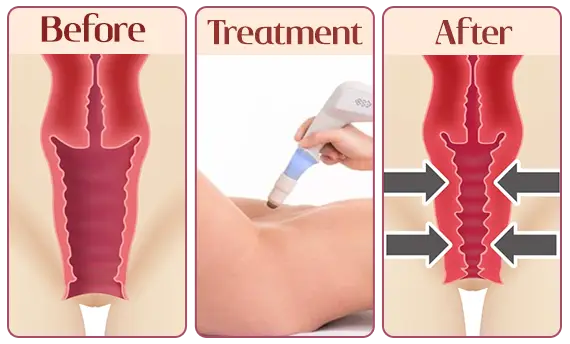
Non-surgical vaginal tightening uses laser or radiofrequency energy to warm the vaginal tissue and prompt a collagen response, with the aim of improving tone, elasticity and dryness. A session takes around 20 to 30 minutes, involves no incisions and no general anaesthetic, and most patients return to normal activity almost immediately.
That is the factual answer. The more useful thing to say is that this is a medical consultation topic rather than a cosmetic decision you should make from a website, and that includes this one. What follows is written to help you arrive at an appointment with good questions, not to persuade you of anything.
What does the treatment actually involve?
A slim probe delivers laser or radiofrequency energy along the vaginal wall, warming the tissue to prompt a collagen response. That collagen response is what addresses the looseness that commonly follows childbirth or the hormonal changes of menopause.
Vaginal Tightening is carried out in a private consulting room by a doctor, and takes around 20 to 30 minutes. A topical anaesthetic is used where needed; there is no general anaesthetic. Most patients describe warmth and pressure rather than pain, and if anything is uncomfortable you should say so, because the settings can be adjusted during the session.
A short course is usual, with maintenance discussed afterwards.
Who is it actually for?
Two groups arrive most often, and their reasons differ more than people expect.
The first is patients dealing with laxity, commonly after childbirth or through the hormonal changes of menopause. That is the concern the treatment is usually marketed around.
The second, and it is a large group, come in for dryness rather than laxity. Improving the moisture and quality of the tissue is frequently the change that matters most to them day to day — and day to day is the right measure here, since this is about comfort during ordinary life rather than any single occasion.
Neither of those is a vanity complaint, and neither needs justifying at the appointment. They are physical symptoms with physical causes, and they are discussed the same way any other symptom is.
Why does the assessment matter more than the treatment?
Because this is an area where patients are often sold a course before anyone has established what is actually causing their symptoms. That sentence comes from our own treatment page, and it is there deliberately.
Dryness, discomfort and a sense of laxity can arise from several different underlying causes, and they are not all addressed by warming tissue. If the assessment points to something that belongs with a gynaecologist, then a referral to a gynaecologist is the right answer and that is what you will be told. A clinic that reaches the same conclusion for every patient who walks in is not assessing anything.
So the sequence is: assessment first, then a recommendation, which may or may not be this treatment. It is worth arriving prepared to be told that something else suits you better.
What should I expect afterwards?
Little to no downtime. Most patients resume ordinary daily activity almost immediately.
There is a short list of things to avoid for a defined period — intercourse, tampons, swimming and hot baths — and your doctor will specify how long. Ask for that in plain terms before you leave, and ask for it in writing if that is easier than remembering. It is a brief, specific list, and following it properly matters more than anything else you will do afterwards.
Improvement typically develops over the weeks after treatment rather than appearing immediately. That gradual arrival is normal and is a consequence of how the collagen response works.
How long does the result last?
Commonly several months to about a year, after which a maintenance session may be suggested.
Your own result depends on the cause of your symptoms, which is another reason the assessment sits at the centre of this rather than at the edge of it. Two patients with similar descriptions of the same symptom can reasonably be given different expectations, and a clinic that quotes one number to everybody is not accounting for that.
On privacy, practically speaking
The appointment is in a private consulting room with a doctor, and it is treated with the same discretion as any other medical consultation. If it helps to know what to expect: you are not required to explain or justify why you have come, and "I read about this and want to understand whether it applies to me" is a complete answer to why you booked.
Practically, both branches — Indiranagar and Bellandur — offer the same private setting, so choose whichever is easier to reach at a time you are not rushing back across the city afterwards. Booking a slot that does not have you watching the clock makes for a better conversation.
One thing this is not
It is not the same treatment as body skin tightening, even though both use energy to prompt a collagen response. Evolve Skin Tightening addresses skin laxity on the body and has its own page, its own indications and its own protocol. If your question is about one, do not assume the answers transfer to the other.
If you want to ask properly
Good questions to bring: what is causing my particular symptom, is this treatment the right one for that cause, what would you expect it to change and what would it not change, and what happens if it does not help.
To have that conversation, book an appointment at our Indiranagar or Bellandur branch. If the honest answer turns out to be a referral elsewhere, that is a useful outcome from the appointment rather than a wasted one.