
Combining GFC Hair Loss Treatment and Mesotherapy for Hair: Order, Spacing and Why
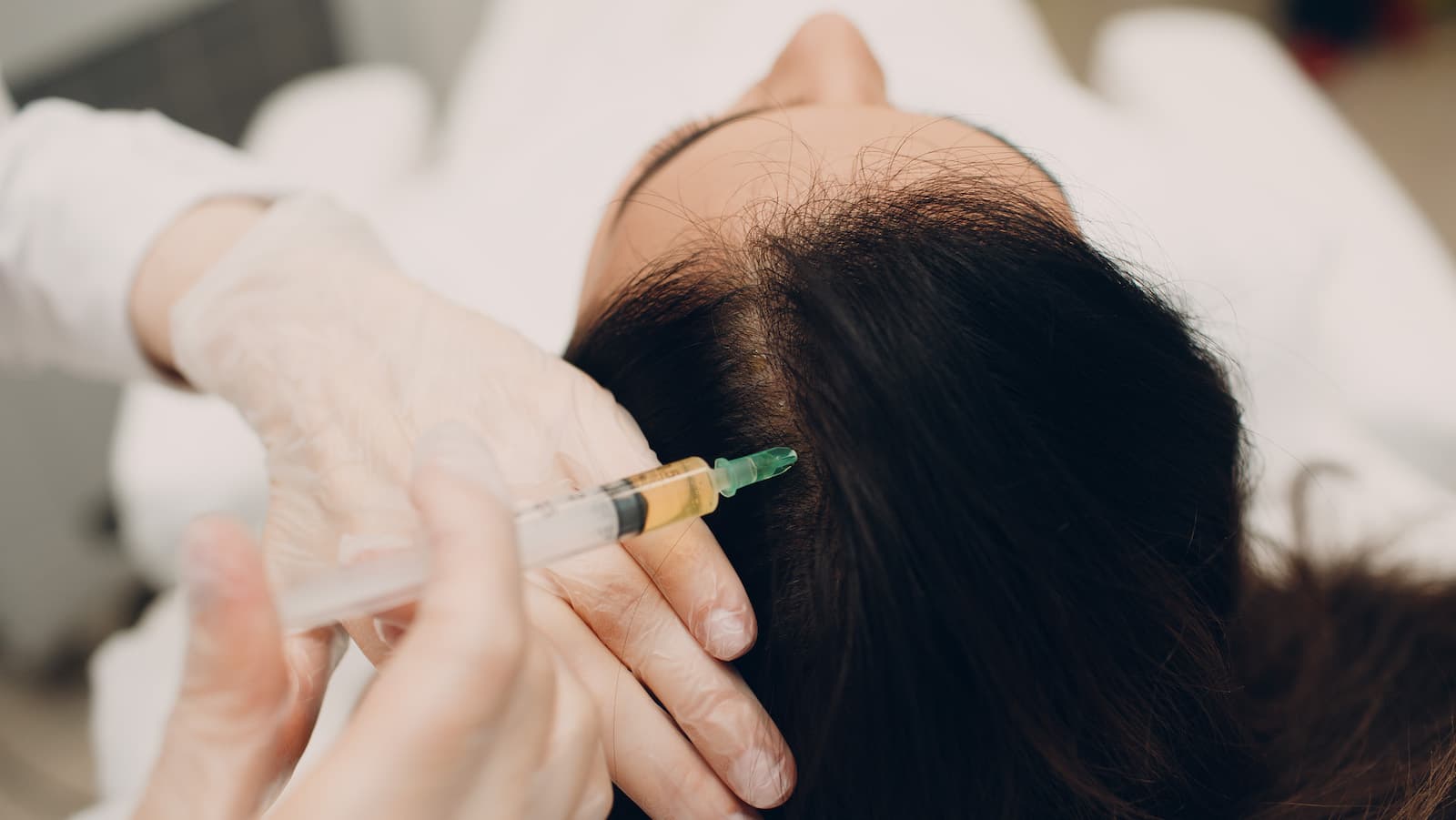
GFC and scalp mesotherapy do different jobs, which is why they are combined rather than compared: GFC returns growth factors drawn from your own blood to weakened follicles, while mesotherapy delivers a doctor-mixed blend of vitamins, minerals and amino acids into the layer of skin where those follicles sit. There is no fixed order — sequence and spacing are set at consultation, against one shared set of baseline photographs.
Why would a plan include both?
Because they act on different problems that often show up in the same person.
GFC is about the follicle. Around 10ml of blood is drawn, processed in the clinic, and roughly 4 to 5ml of growth factor concentrate is injected across the thinning areas. It acts on follicles that are weakened but still active, in both men and women, which makes the earlier and moderate stages of pattern loss the strongest candidates.
Mesotherapy is about the environment the follicle sits in. The blend is chosen for your scalp on the basis of your examination and blood work rather than taken off a shelf, and it is placed into the layer of skin around the hair root — somewhere a serum applied to the surface cannot reliably reach. Patients frequently report a less dry, less irritable scalp afterwards, and that matters for a practical reason: scalp condition limits how far any hair treatment can go.
Mesotherapy's own positioning is the honest version of the case for combining. It is used to support a broader hair fall plan that also includes topical or oral medical therapy, rather than as a standalone answer. A combination is the normal shape of a hair plan, not an upsell on top of one.
Which one comes first?
Neither treatment carries a published rule that puts it before the other, and you should be sceptical of anyone who quotes you one over the phone. What a doctor is weighing at that first appointment is roughly this:
- What the scalp itself looks like. A scalp that is dry, tight or irritable is a limiting factor on everything else, which is an argument for addressing condition early rather than late.
- What your blood work says. The mesotherapy blend is composed against what your assessment and blood work show. If deficiencies turn up there, that finding shapes the plan rather than sitting beside it.
- How much active follicle is left. GFC supports follicles that are still present and active. Areas that have been bare for years are unlikely to respond, and mesotherapy cannot be relied on to bring those areas back either. Where the honest answer is that neither will do much, you should be told at consultation and not after four sessions.
- What you are already taking. Both treatments are planned around your medication.
Can both be done in the same appointment?
That is a decision for the doctor who is treating you, and it is worth asking directly rather than assuming.
The time arithmetic is at least straightforward. A GFC session runs about 30 minutes including preparation, and anaesthetic cream is applied for 30 to 45 minutes before it. A mesotherapy session runs around 20 to 30 minutes, with the scalp cleansed first and numbing cream applied where needed. Both are short enough to sit inside a working day, which in a city where the journey to the clinic can outlast the appointment is not a trivial point.
What neither treatment publishes is a combined protocol — how much of each, in what order, on what day. That gap is real and we would rather name it than fill it with something invented. Ask at consultation and you will get an answer built on your scalp rather than on a template.
How far apart should the sessions be?
Both run as courses spaced by your doctor rather than on a fixed public calendar.
For GFC, four to six sessions is typical, with maintenance roughly one session every two to three months afterwards. For mesotherapy, an initial short course is set by your doctor, and the number is deliberately not promised at the start because it depends on what is driving your hair fall and how you respond.
The two share a review point, and that is the part worth holding on to. Both take scalp photographs before the first session, and both reassess against those photographs at around the three-month mark. In a combined plan that should mean one baseline and one review, not two sets of pictures and two separate verdicts. If a clinic is running the two treatments as separate projects with separate reviews, nobody is assessing the plan as a whole.
Do the two aftercare lists contradict each other?
They do not conflict, but they run to different lengths, and the sensible way to read them together is to follow whichever window is longer.
After GFC there is no downtime — you return to normal activity the same day — but exercise, swimming, steam and direct sun are avoided for two days, and hair products for six hours. After mesotherapy, temporary tightness, redness or mild irritation of the scalp is common and usually settles within a few days, with most patients going straight back to their day.
Mild soreness, redness or itching for a couple of days after GFC is likewise normal. Confirm the combined instructions with your doctor before you leave, particularly if both treatments have happened close together.
How will I know whether the combination is working?
Reduced shedding is usually the first change patients notice after GFC. Visible density takes months, because hair grows slowly — which is exactly why the photographs exist. Improvement from mesotherapy is likewise gradual, and its course and blend are adjusted at review rather than fixed at the outset.
No one can promise regrowth from either treatment, and how much you see depends on how much active follicle remains. What you should expect is that the answer at three months is measured against a picture rather than recalled from memory, and that the plan changes if the picture does not.
Who should not have this combination?
GFC is not carried out during pregnancy or breastfeeding, while you are on antibiotics or blood-thinning medication, or where there is an active scalp infection. Mesotherapy comes with its own pre-treatment instructions, typically around medication and blood thinners, given at the consultation visit.
Disclose everything you take, including supplements and anything started between sessions. It is the single most useful thing you can bring to the appointment.
What should I watch for afterwards?
Some soreness, redness, tightness or itching in the days after either treatment is expected. If it runs on well past a few days, worsens rather than settles, or the scalp looks or feels infected, contact the clinic rather than waiting for your next scheduled session.
Getting a plan rather than a package
A combination is a sequence, and a sequence needs somebody who has looked at your scalp to set it. Book an appointment at Indiranagar or Bellandur — ₹500, waived off against treatment — and ask specifically for the order, the spacing and the review date in writing.